Public art is everywhere in Carmel Indiana

Carmel, Indiana is a suburban city immediately north of Indianapolis. Known as the roundabout capital of the U.S. with 140 of those wild traffic routes, the city is also known for its many pieces of public art.  Fifteen of these works of art are by Seward Johnson,  an American artist known for trompe-l’œil painted bronze statues. Other artists also have public art displayed.

“Ambassador of the Street” by Seward Johnson, placed 2012, cost $78,000
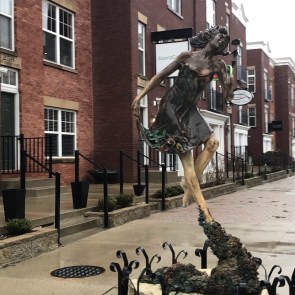
“Spring Eternal” by Jerry Joslin, placed 2010, cost $49,975

“Things To Do” by Seward Johnson, placed 2008, cost $80,000

“Who’s In Charge” by Seward Johnson, placed 2008, cost $88,000

Even bike racks have become “art” in Carmel

The day we were in Carmel the weather was not conducive to enjoying street art. We’ll return on a day without cold rain and see more of the many other public art displays. There is some controversy about the people street statues, as not all taxpayers feel that they are worth the price.
Remember the Alamo

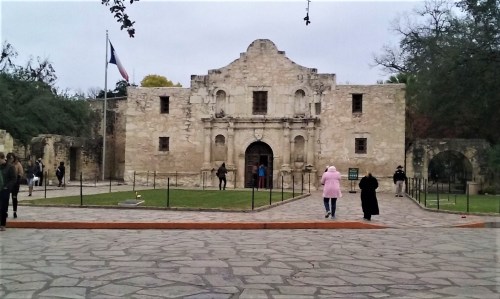
“Remember the Alamo” echoes across history

The battle of the Alamo Mission near San Antonio de Béxar took place for 13 days, February 23 to March 6, 1836. The siege of the mission by Mexican troops under President General Antonio López de Santa Anna ended with the defenders being wiped out. The Alamo remains one of the most revered historic sites in Texas. We’ve visited a couple of times, and you can feel the history there.

The Carroll Lee Cropper Memorial Bridge

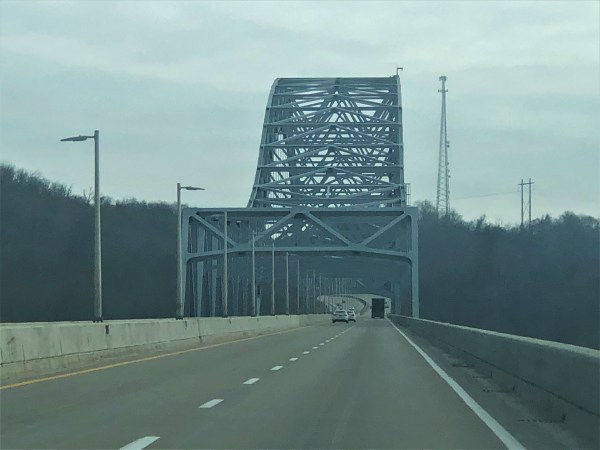
Interstate 275 is the beltway that runs around Cincinnati, Ohio. A portion of this beltway crosses the Ohio River 20 miles west of downtown as it runs between Indiana and Kentucky. In 1968 construction began on a four lane continuous steel arch-shaped truss bridge. It was completed in 1977.

Approaching the bridge, Kentucky ahead

The bridge is 1,759 feet long, with its largest span being 758 feet. The official name is the Carroll Lee Cropper Memorial Bridge. Carroll Lee Cropper was a judge in Boone County, Kentucky,  where the bridge lands on the Kentucky side of the river. Cropper was judge for 20 years starting in 1942.

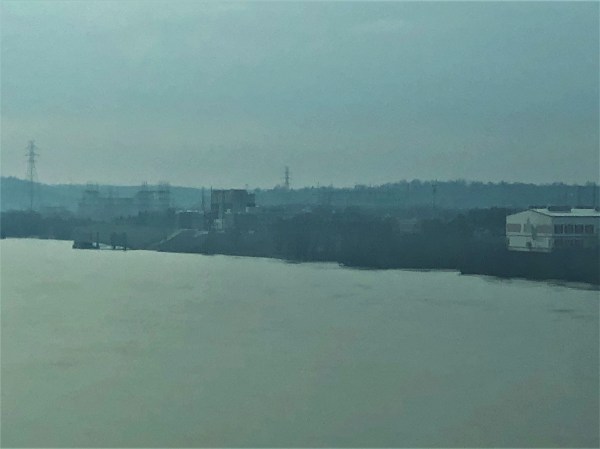
Looking downriver from the bridge, you can see the pier at the Lawrenceburg landing in the water. The pier is the header picture at the top of this post.

We crossed this bridge twice on our day trip last weekend. It is quite impressive, and stands out when you are on the riverfront in Lawrenceburg looking up river toward the bridge. This is also the bridge that ultimately was responsible for the end of service of a small local ferry.

Lawrenceburg Indiana Bicentennial Monument

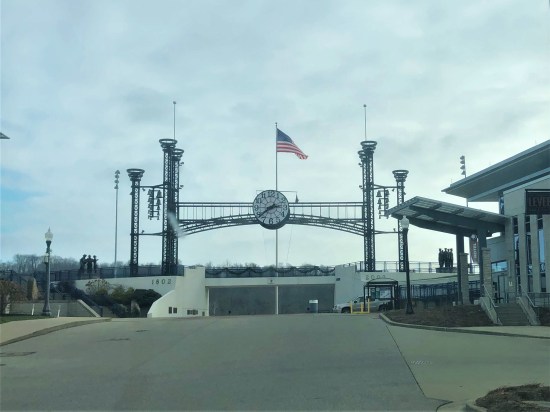
Lawrenceburg Indiana is on the Ohio River across from Kentucky. The pictured riverside monument was erected for the city’s 2002 bicentennial celebration. Two 12 foot diameter clocks face both the river and the land. A 30 bell carillon plays every hour with the peal of bells honoring the struggles of the “everyday man.” Stylized smokestack-styled columns frame the monument symbolizing Lawrenceburg’s long river heritage.


Honoring all branches of the service

Honoring first responders

The monument features bronze statues of soldiers and sailors of all branches of the service. On the opposite flank is a bronze statue honoring the police and firefighter first  responders in the act of rescuing a child and passing him to an EMT. The center of the monument is open to the riverfront, however there are flood gates that may be closed, as the monument is also part of the flood control levee protecting the city.

Old Kentucky tobacco barn

We spotted this old tobacco barn from the I-275 interstate in Kentucky. These barns are used to hang tobacco plants after they are cut at their base. Burley tobacco plants can grow to a height of six feet. The barn’s missing siding boards and roof vents enable the large leaves to dry before they are baled and sold. Beyond the barn is the Ohio River.

A busy day by the river

Downtown Lawrenceburg

Even though it was a very cold and breezy day on Saturday, we still enjoyed a very nice day trip along a stretch of the Ohio River. It was one of those no itinerary trips. We just drove around and took in the sights.

Standing in front of a large wood chair in Aurora

We took the I-275 interstate bridge over the Ohio River into Kentucky and drove through the Creation Museum grounds. Returning to Indiana we stopped at Lawrenceburg, followed the River Road and went as far as Aurora.  All in all we had a wonderful and exciting day as we took in the sights of southeast Indiana.

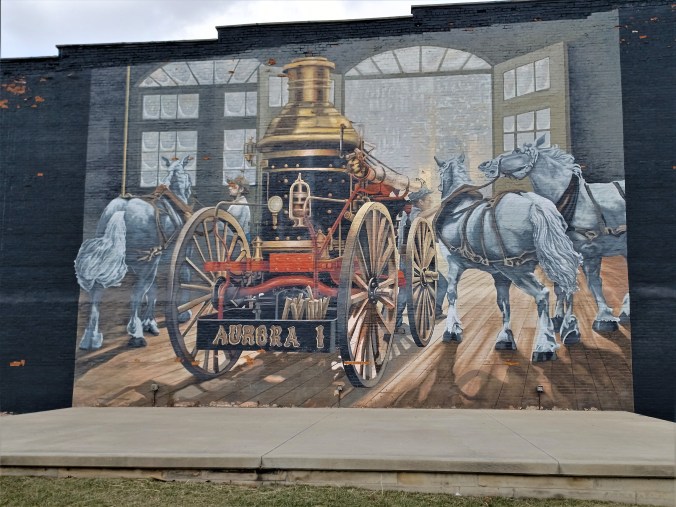
Mural remembers an 1885 fire wagon

Aurora, Indiana is a quaint and historic Ohio River town about 34 miles downriver from Cincinnati, Ohio. Go back to February, 1885 and see the city spend $3000 for a horse drawn steam pumper suitably christened Aurora. This beautiful horse drawn firewagon served the city well. In 1962 it was loaned to the Cincinnati Fire Museum in trade for professional restoration and the right to display. There Aurora remains.

In 2017 Mr. Don Andrew, a local resident and businessman, commissioned the Christian Dallas Art company to paint a mural on the side of his building depicting the Aurora in her stable with the team of horses being hitched up. Andrew paid $11,000 towards the total cost of $16,000. The rest was paid from the City of Aurora’s 2017 Facade Improvement Grant funded through riverboat gaming. This mural will really catch your attention when you first come into town on the Ohio River Scenic Highway.

This ferry ran from 1802 to 1978

Aurora, Indiana and Petersburg, Kentucky were connected for nearly two centuries by ferry that transported people, vehicles and goods back and forth across the Ohio River. From the first two horse powered days until the 15 car ferry in service at the end, the Aurora Ferry Company provided uninterrupted service seven days a week.

The history of the ferry

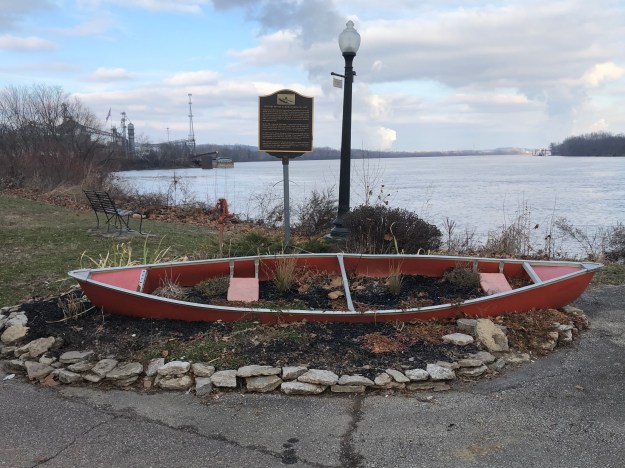
This canoe with the accompanied bronze plaque makes up a memorial marker for a long time icon of the Ohio River. From 1802 to 1978 a ferry ran back and forth across the Ohio. You can see this on the Ohio River Scenic Highway that runs along the river through Aurora, Indiana. The bridge that killed the ferry is out of sight in the background.