St. Peter’s UCC is a beautiful country church

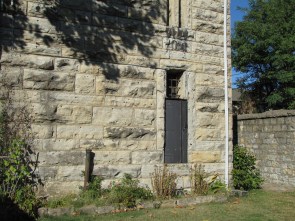
St. Peter’s United Church of Christ is a lovely church in Ripley County, Indiana. While it has an Osgood address, it is actually closer to Napoleon.

Front of the church

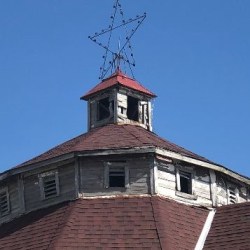
The steeple

Unique double entrance doors

There is a decent sized graveyard behind the church building. Of note is the interesting iron graveyard gate signage over the entrance drive to the graveyard. Also seen is an additional smaller gate entrance piece that has been mounted over a sidewalk entrance to the back of the fellowship hall of the church. It could be guessed that both of these structures have been relocated for original placements.

View of the graveyard

Fancy iron entrance signage

Smaller iron gate arbor


This church is located on the south east corner of the intersection of W County Rd 700 N and N Fink Road in Ripley County, Indiana.


A Vice President’s family log cabin

Shelbyville, Indiana is a small town in central Indiana and was home to Thomas A. Hendricks, Vice President to Grover Cleveland. A replica of the Hendricks family log cabin is on display at the Shelby County Fairgrounds.

Reconstructed log cabin made from original logs from the Hendricks family cabin

Thomas A. Hendricks was a politician and lawyer who served as the 16th governor of Indiana from 1873 to 1877 and the 21st vice president of the United States from March until his death in November 1885. Hendricks also served Indiana in the U.S. House of Representatives and the U.S. Senate. He was born in Ohio and his family moved to Shelbyville in 1822.

Information plaque mounted on the cabin

Vintage postcard of the original cabin, courtesy Indiana Historical Society

Thomas A. Hendricks


Hendricks was married to Eliza Morgan, and they had one child, a son who sadly died at age three. Hendricks was very popular with the people, and unfortunately he died on Thanksgiving night during his first year in office as Vice President. Hendricks is buried in Crown Hill Cemetery in Indianapolis.


Mud Pike Baptist Church and Cemetery

We were off on another daytrip in south east Indiana. We did have a couple of specific destinations, but as usual we did enjoy just coming upon interesting sights. One of these surprises was the Mud Pike Baptist Church and Cemetery which we came upon on, you guessed it, East Mud Pike Road. The church is roughly equidistant from Napoleon and Osgood, Indiana, both on US Highway 421, aka Michigan Road.

Pretty white church edifice

Remounted bell and one side of the cemetery

Notice the “Weeping Willow” tree in Mary’s tombstone

The grave of thirty two year old Sarah, passed in 1878

Grave of John Blackmore, Charter Member and church land donor

The bell remounted

Originally Delaware Baptist started in 1842 with 12 members, and Charter Member John Blackmore donated the ground for the church in 1844. In 1911 the bell was mounted in the belfry of the structure. A  fire devastated the church in 1996, resulting in the bell crashing to the floor. It now is mounted in a place of honor next to the flagpole and bench. The church was renamed Mud Pike Baptist Church in 1938, and it celebrated its 175th anniversary in 2017.

Finks Road stone arch bridge

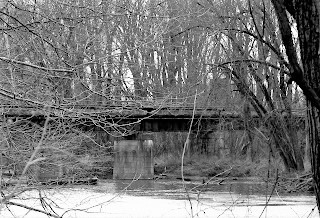
Ripley County, Indiana is allegedly home to 11 stone arch bridges. The Fink Road bridge spans a branch of Laughery Creek, one of the main waterways in the county. This is a smaller single arch bridge that is not really obvious from the road.

Hard to see the stone arch through the vegetation

All you see are guardrails

Courtesy bridgehunter.com by Anthony Dillon

Stonework in B&W

This bridge was probably built around 1900 and refurbished in 1993. This turn of the century time frame saw many stone arch bridges constructed. The Fink Road Bridge, while only 60 feet long, has an unusual full 19 feet wide two lane spacing. It shows the high degree of craftsmanship typical of the times.


Historic Miller Cemetery

Just a few miles west of Shelbyville in central Indiana, on a road aptly named Cemetery Road, you’ll come across a well-kept and decent sized rural cemetery. Miller Cemetery has roots back in the early 1800’s.

Proud flag and pure white lettering

Corn and soybean fields beyond the graves

Equipment shed, and yes, an outhouse

Civil War Veteran of CO.K, 42nd IND. INF


Sad record of the death of a very young wife

A member of the Odd Fellows, symbolized in the 3 chain links

According to the Cemetery Facebook page farm neighbors formed a loosely knit organization in 1926 for the purpose of upkeep and administration of the grounds. The volunteers still perform their loving tasks. This is one of the best manicured country graveyards you will find.

Bond Cemetery Road Bridge, abandoned

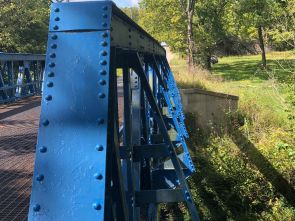
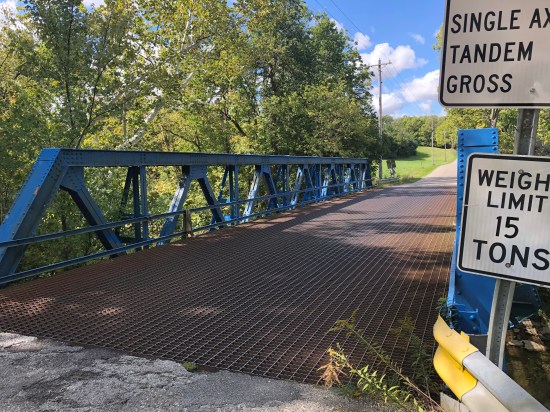
Bond Cemetery Road Bridge, aka Brown County Bridge #36, is a very interesting bridge that has been abandoned and is, frankly, degrading at a fairly rapid pace. The HistoricBridges.org website states: “The bridge is severely deteriorated and the bridge is at an increasing risk for collapse. One of the plates that is part of the floorbeam and hanger system is cracked so badly it is split nearly in half. (see photo below) Many diagonal and vertical members have extremely severe section loss at the heads. Restoration of this bridge would likely need to include disassembly and restoration of these parts in a shop setting.”

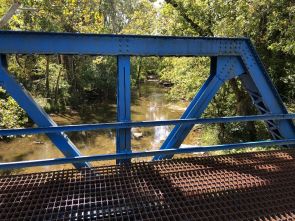
Abandonment is, ah, obvious

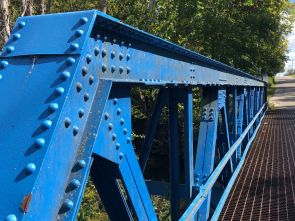
This historic bridge was constructed in 1908 by the Pan-American Bridge Company of New Castle, Indiana, who were very prolific iron bridge constructors in Indiana. The technical design name of this bridge is a single-span, pin-connected Pratt through truss with an “I” beam approach to the south. The bridge rests on metal abutments, wingwalls and round caisson piers.

The concrete filled metal caisson foundation

The cracked plate referenced above

Looking through the decorative lattice guardrail at North Fork of Salt Creek

Bridge behind camera looking down old Bond Cemetery Road


This bridge spans the North Fork of Salt Creek and is a couple of hundred yards south of Green Valley Road on what is left of Bond Cemetery Road. The old road bed continues towards Highway 46 past the cemetery of that name. There was discussion in the early 2000’s about building some type of trail along the road, including refurbishing the bridge as part of the trail. Too bad nothing ever came of that plan.

Note the “interlaced” I beam verticals, and the moss growing on the deck boards.

This is one of those stories that apparently will not have a happy ending. The private owner of the bridge does not seem to care if the bridge collapses. According to the experts at HistoricBridges.org it is not a matter of if, but when this classic 1908 bridge goes down. What a shame.


The reconstructed 1885 Cedar Ford Covered Bridge

This beautiful Kennedy Brothers bridge started its life in 1885 by spanning Little Blue River northeast of Shelbyville, Indiana. In 1975, instead of demolishing the bridge to make way for a modern bridge, Cedar Ford was relocated to the Shelby County Fairgrounds.

Beautiful white reconstructed bridge


The bridge remained at the fairgrounds for several years and was a great addition to the historic fairgrounds. However, someone raised a liability issue, and unfortunately the fair had the bridge dismantled, sold it to a private individual and then it was stored unprotected for years. So much for “historic” Shelby County Fairgrounds.

One of the abutments

Kennedy Bros trademark scroll work


A Monroe County, Indiana engineer named Jim Barker got ahold of the useable parts and incorporated them into the design of the fully authentic covered bridge. According to Bridge Hunter website the bridge was reconstructed at “the site of the Millikan/Milligan/McMillan/Williams Covered Bridge that was destroyed by an arson fire in 1976. Remnants of the original abutments of that bridge can be seen just West of the current bridge. Although that bridge wasn’t a Kennedy built span, there were at least two of them that once existed in Monroe County.”

Typical notched connection joint

The Burr-Arch truss


This reconstruction took place in 2019 with as many of the original members as were structurally sound. New materials were faithfully reproduced when required to finish the structure. This bridge is a Kennedy Brothers Burr-arch truss design typical of Kennedy bridges in Indiana. It spans Bean Blossom Creek on Old Maple Grove Road north of Bloomington.

Looks, sounds and smells like it did in 1885

The smell of freshly sawn lumber is perhaps the most remarkable feature of this marvelous rebuild. That’s right, when we walked across the deck of the 127 foot long span, you could clearly smell the clean scent of newly sawn lumber. You can’t help but realize that that fragrance is what the first users of the bridges encountered as they crossed the first time.


Indiana’s “Grave in the middle of the road”

A history and legend filled roadside oddity can be found on CR 400S outside of Amity, Indiana  which is south of Indianapolis in Johnson County. The story begins in 1808 when 14 year old Nancy Kerlin married William Barnett. The couple had 11 kids.

The only marker on the grave

Fast forward to 1831, the year of Nancy’s passing. She had a favorite spot on a rise overlooking nearby Sugar Creek. This became her final resting place. Stories say that others began to be buried there as well, creating a small country cemetery. A road was discussed through the cemetery, but Nancy’s son refused to move his mother, so the road went around her.

The road still splits around the graves

In the early 1900’s CR 400 was plotted out, again right through Nancy’s grave site. This is when her grandson Daniel Doty showed up with his shotgun refusing to allow any such activity. Don’t mess with Grandma’s grave! Thus the county said fine, they would run the road on either side of the grave.

The old raised grave mound, photo by Rick Hinton

Over the years vehicle traffic, including large farm machinery, took its toll on both the protection barriers and the grave mound itself. Then in 2016 it was decided that the grave should be lowered and covered with a low profile concrete structure. Archaeology students from the University of Indianapolis excavated the grave and were surprised by the discovery of not just Nancy’s body but remains of six others.

New (2016) historical plaque

The bodies of two women, a man and four children were reburied in individual coffins. The low profile concrete structure now protects Nancy and other early Indiana pioneers. Today flowers and hundreds of coins adorn the surface of the grave in the middle of the road.