Ah, you might want to duck

Here he comes, center of picture

Look closely, there is a starling who just left the suet feeder heading right towards the camera. The yellow beak is in the center of the black body, and the out stretched wings are very blurry. We see the starlings getting a beak full of suet and flying off to, we assume, their nests. According to one of our resources the young starlings should be leaving their nests anytime now.

A flash of red on final approach

A beautiful splash of red

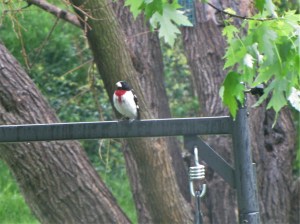
It’s always fun to see a new (to us) species coming to our backyard and our feeders. We are slowly putting together a pretty decent list of the birds we have seen. Yesterday a flash of red, white and black caught our eye. We first saw the Rose-breasted Grosbeak sitting on a swing frame.

Coming in for a landing

It wasn’t long before a second Grosbeak joined in on the feeding fun. They both found the glass shelf feeder and shared a meal together. These colorful birds are always fun to see and hear.

Family life on the river bank

Young goslings under watchful eyes

It was a pretty day so we went on a drive to a local park. This park has a river running through it and is home to lots of waterfowl. We were treated to an idyllic scene of an adult goose with 3 very young goslings poking around on the river bank. White ducks and Mallards were in the background enjoying the day.

Sher and I were serenaded today

Nothing like getting photobombed by a twig!

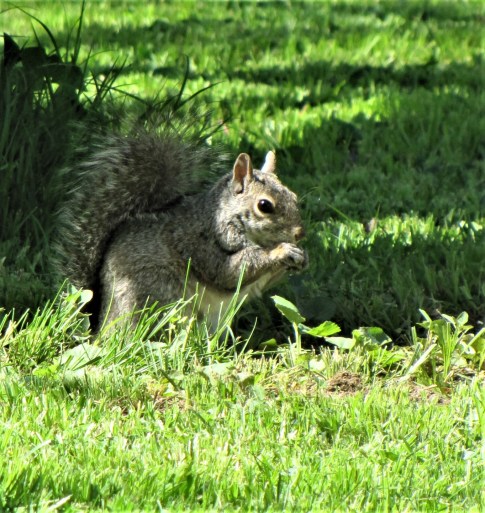
It was a beautiful Thursday afternoon with mostly sunny skies and a very light breeze with temps near 65. The birds and a couple of squirrels were taking advantage of the food we had set out for their use.

We have been thrilled with the variety of species that have come to our feeders. Today we spotted a new little bird, a Carolina Wren, one we haven’t seen before . He decided to flit up into the tree and serenade us with a beautiful song!

Listening to our backyard friends is as fun as watching them,.


Free trees

List of available saplings

The Indiana Dept. of Natural Resources once again provided free trees for anyone who wanted to come pick them up. Last year we picked up some free trees, and have had reasonable success with them.

This year the give a way was organized at the County Fairgrounds. The variety was larger than last year’s offering and I was pleased to see Red Buds on the list. They are so pretty each year!

There was a good sized crowd as soon as it opened
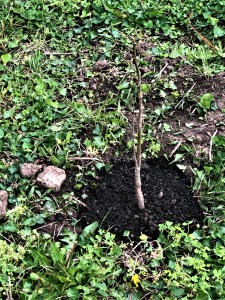
This is one of the two Pecan saplings now planted
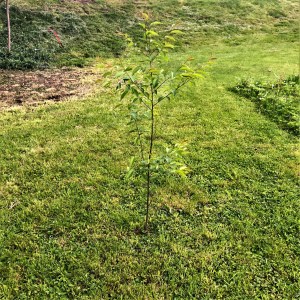
This is our Black Cherry from last year. It has grown a lot!


As was the case last year, you could get a maximum of ten trees per household. We decided that this year I’d pick up two Red Buds, two Pecans and one Shag Bark Hickory. All five are now planted, and hopefully they will all survive. We did have a couple of losses last year due to (I think) pesky rabbits. This tree give a way is a great program.

I see you!

Sometimes there are birds that just stand out when you see them. Here is one:

This interesting gaze belongs to a White-crowned Sparrow. Below are a couple more images of the same bird after he flitted about a bit.


This is a direct quote from the allaboutbirds.org website “Scientists interested in movement and energetics have discovered that White-crowned Sparrows can run on a treadmill at a pace of about one-third of a mile an hour without tiring out.” I can’t imagine any self respecting bird allowing itself to be run on a treadmill.

Nests? We don’t need no stinking nests

It’s really neat to see a breeding pair of birds together. Yesterday we saw a pair of Cowbirds. There is a very interesting way that Cowbirds “raise” their young.

Male on the left, female on the right

The Brown-headed Cowbird is known as a “Brood Parasite” The Brown-headed Cowbirds do not make nests. Females put all energy into egg production, up to 3 dozen a season. Yes, you guessed it, the females lay their eggs in other birds nests. The eggs hatch before the host nest eggs do, giving the Cowbird young a head start. Some birds recognize these imposters and pitch the trespassers out of their nests. Some people consider Cowbirds a nuisance bird, as they are responsible for the destruction many songbird eggs.

Having spotted this pair, we can now surmise that somewhere nearby another unsuspecting bird family is wondering why that one chick is so much larger than the rest of their brood.

First glance ID was wrong

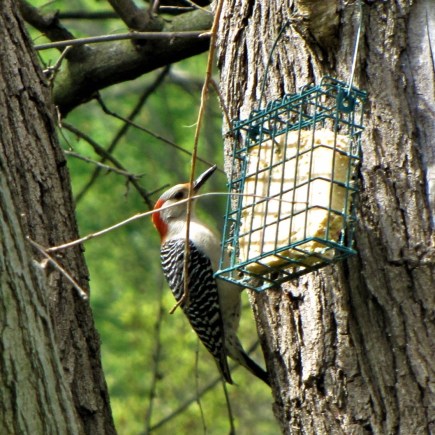
When I first spotted this woodpecker I thought it was a Male Northern Flicker. With our camera I captured this image of the pretty woodpecker next to the suet feeder.

Turns out this is a female Red-bellied Woodpecker. The female is distinguished from the male in the red nape vs. the male with a red cap. This bird can stick its sticky saliva covered barbed tongue a full 2 inches past the tip of the beak, letting it successfully catch food deep in crevices.

Suet yourself

Always looking for a new thing, we decided to try our hand at making our own suet. An internet search produced several different recipes. A quick trip to the store and we had what we needed to get started.


  • crunchy peanut butter
  • Crisco
  • corn meal
  • quick cook oats
  • white flour
  • bit of sugar


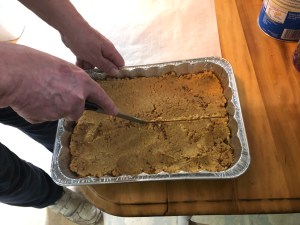
The simple ingredients were fairly easy to mix in the pan over medium heat. Once everything was mixed we pressed it into the aluminum pan, roughly an inch thick. After setting in the freezer for about we cut the the appropriate size cakes for the cages.

Couple of starlings going bonkers over the new suet

The results? The birds went nuts over the home made suet when we put it out. Sher and I had a ball watching all different species enjoying the new suet. It seems like the starlings especially had gotten a sugar high. They acted like like a bunch of kids who got into the candy a half hour before bedtime.