Zaharakos Ice Cream Parlor and dueling banjos

We stopped at Zaharakos Ice Cream Parlor in Columbus, Indiana for a treat during our day trip in Bartholomew County. And they had the Banjo Orchestra machine playing its whole play list! Enjoy the “Dueling Banjos”!

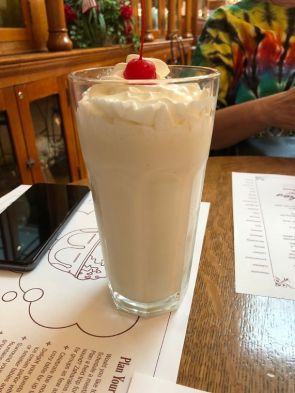
Vanilla Milkshake

Butter pecan and caramel sauce sundae


I caught all but the first few bars of the banjo pickin’ classic.

Here’s a post about our first trip to Zaharakos

Mill Race Park in Columbus Indiana

Mill Race Park is situated where the Flat Rock and the Driftwood rivers join together on the west side of Columbus. The 35 acre park is an extremely popular place to walk, picnic, attend concerts, climb the tall observation tower or just simply enjoy a bit of Nature.

The bottom of the bridge is in the background

Duck enjoying the reflecting pond


Among the attractions at the park are a large reflecting pond ringed by sidewalks and benches. One side of the pond features the historic covered bridge. Columbus is known for its public art displays, and several are located in the park. One recent addition to the park landscape is a set of tall, wooden poles topped with bat nesting boxes. The poles are set in rock cairns for shelter of amphibians and reptiles.

Each provides shelter for bats, birds, amphibians and reptiles

The lovely pond, suitable for leisurely walks or resting

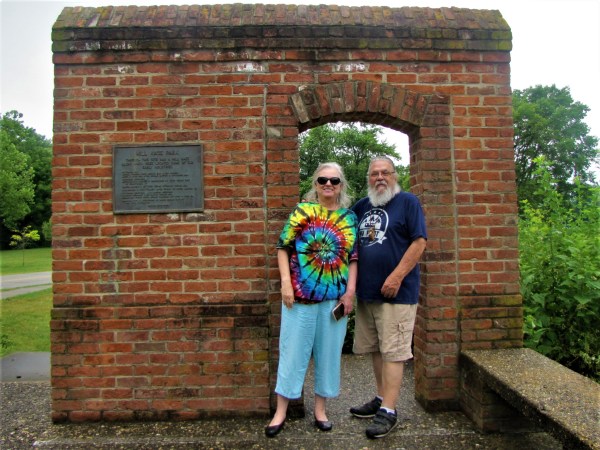
The brick “monument” with bronze info plaque (yes, that’s us)

The brick “monument” complete with an arch and flanked by a bronze information plaque is a highly visible structure. The plaque describes the mill race that ran through acreage. It also listed the many industries along the old mill race, including mills and brickyards. The Mill Race Park in Columbus is a delightful place. It is worth your visit.


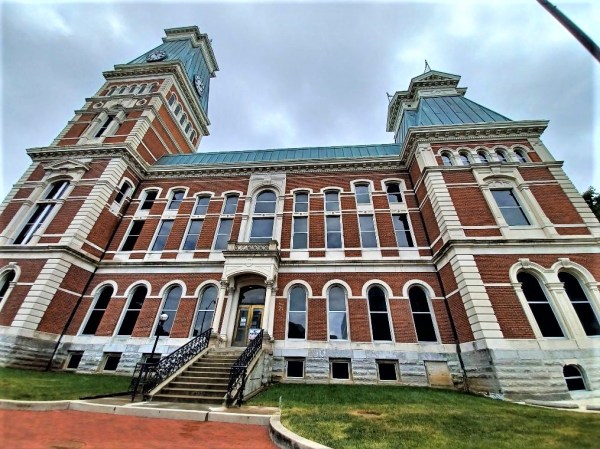
The historic Bartholomew County Courthouse in Columbus, Indiana

Bartholomew County, Indiana is south of Indianapolis and is known for its architecture, public art and well known and long running industry. Columbus is the county seat, and thus is home to the County Courthouse. This striking edifice was designed by noted Indiana architect Isaac Hodgson. The building was constructed from 1871–1874 at the cost of (then)$250,000. The courthouse was put on the National Register of Historic Places in 1979.

A panorama view

The following Court House description is from Wikipedia: It is a three-story, Second Empire style red-brick building trimmed in limestone. It features a mansard roof, corner pavilions, Corinthian-order portico, and a six-level clock tower. The clock tower is 154 feet tall. A six-inch thick, 10-ten clock bell was installed in 1875. The clock’s weighted mechanism were replaced with an electric motor in 1940 and a 900-pound weight fell.

We visited on a Saturday, so the building was closed. It would be interesting to see inside this county government building.

The Forsythe Covered Bridge, aka Forsythe Mill Bridge

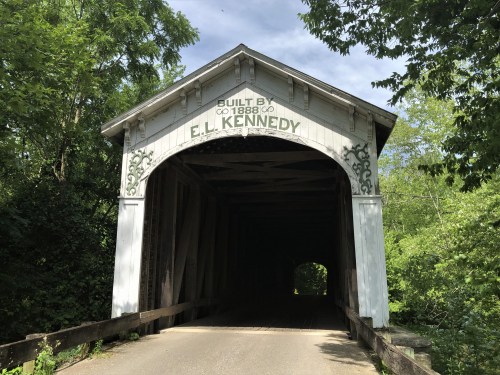
We found yet another one of those magnificent 1880’s covered bridges, this one again in Rush County, Indiana. The Forsythe Bridge, also known as the Forsythe Mill Bridge spans Big Flatrock River in the southeast corner of the county. This bridge was built by E. L. Kennedy bridge building company. Emmet Kennedy was one of the sons of Archibald M Kennedy, premier bridge builder from Rush County.

The Forsythe Bridge over Big Flatrock River

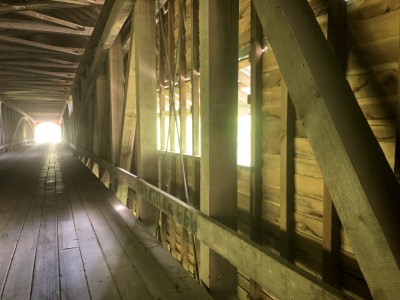
A long view of the Burr- Arch truss system

A look outside over the river below


We spotted Maj shooting the video of the river and the bridge

This bridge is 196 feet long, as noted designed with the typical Burr-Arch truss system. This bridge was one of six bridges that all were registered on the US National Registry of Historic Places. All six of the bridges were constructed by the Kennedy family, and were registered at the same time in 1983.


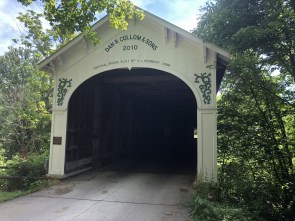
The 1886 Moscow Bridge rebuilt in 2010

In June of 2008 an F3 tornado ripped through the small town of Moscow in Rush County, Indiana. Tragically one life was lost, several homes were destroyed and the 1886 Kennedy covered bridge was ravaged and tossed into the river below. Through the heroic effort of the community, businesses and others, a reconstruction project was begun. Original pieces of the bridge were salvaged. With the balance of new materials, a faithful reproduction of the original E L Kennedy double-span Burr-Arch bridge was rebuilt by the Don Collom and Sons company from Bridgeton, Indiana. It was dedicated in September, 2010.


The Moscow Covered Bridge remains the heart and soul of not only the town, but a valuable part of the history of Rush County as well.

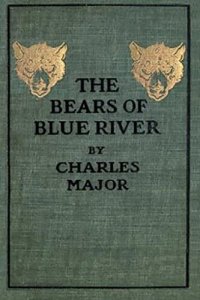
The Bears of Blue River by Charles Major

Vintage book cover

When I was in 4th grade I, like most every other 3rd to 5th grader in Indiana was introduced to and told to read The Bears of Blue River by author, lawyer and politician Charles Major. The website Yesterday’s Classics shares a concise summary of the book: “Balsar, a pioneer lad, enters manhood at the age of 13 when he encounters a great bear while fishing on the river and proves his mettle. This book, full of harrowing adventures, great danger, and many acts of valor, tells of Balsar’s subsequent encounters with bears, wolves, Indians and the legendary one-eared ‘demon’ bear, offering a dynamic portrait of the daily life in Indiana during the 1820s.”
Charles Major lived most of his life in Shelbyville, and his influence has been most appreciated in the community for years. Major’s first book was published in 1898, When Knighthood Was In Flower which was very successful, having been adopted into both theater and film. He published The Bears Of Blue River in 1901.

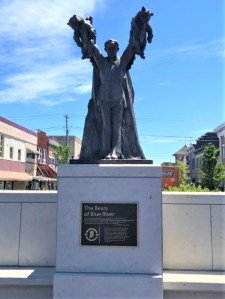
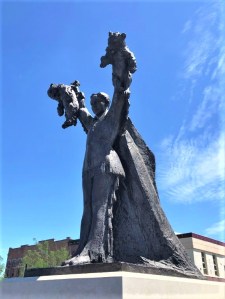
The statue of Balsar holding his pet bear cubs Tom and Jerry was placed in front of an elementary school named for the author. After the school was demolished in the sixties, the statue remained in storage until it was placed on the town square years ago. Once the new downtown project to redo the square was designed, the statue of Balsar and the cubs was restored and placed in the center of the structure housing the fountain and nice seating.
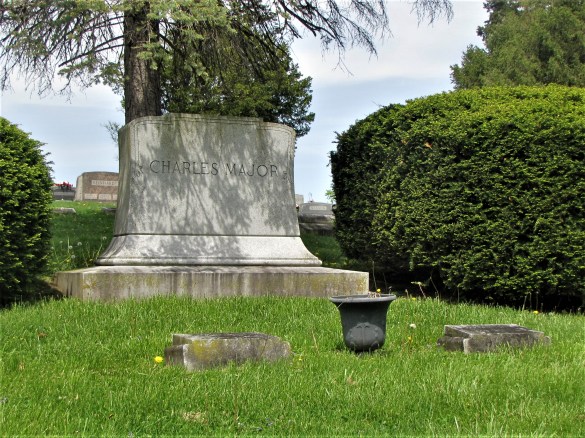
Graves of Charles Major and his wife, Alice, in Forest Hill Cemetery, Shelbyville

Back when Sher and I were in elementary school, reading The Bears of Blue River was a requirement. I so remember being totally absorbed while reading the book. What a series of adventures Balsar enjoyed. I’ll always remember the excitement and danger of the stories. (Wait ’til you read about the Fire Bear!) I’d suggest if you have family in the 7 to 10 year old range, get them a copy of The Bears of Blue River. Heck, get one for yourself. You might enjoy an exciting trip back to Indiana in the 1820’s.

A refurbished local landmark back in service

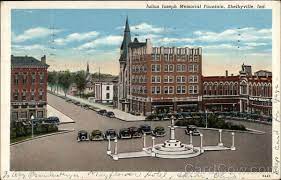
The Joseph Fountain was first dedicated in 1923 on the center of the town square in Shelbyville, Indiana. It has been the center of the “square” (as the center of town has been known for decades by the locals) and has supported the Christmas Trees and for one year in the 1950’s it was covered  with cornstalks in the fall.

Vintage photo showing the Fountain in the center of the square

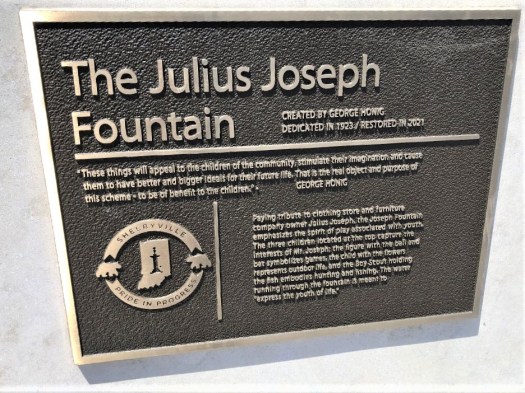
New information plaque placed at the rededication of the fountain

During the years 2020-2021 a massive project completely reconstructed the square, entrance streets, sidewalks and parking. There the fountain, after complete restoration, was replaced in its historic location. With water again flowing freely, the fountain is once again the center of the square delighting young and old alike.


Oliver P. Morton, Indiana’s “War Governor”

Unveiled in 1907, this statue of Morton stands in front of the Statehouse. It was sponsored by Union veterans

Vintage portrait of Morton, courtesy in.gov

Oliver P. Morton was Governor of Indiana during the Civil War. He was chief executive of the state from 1861 to 1867. He took office a mere 90 days before the war began with the Confederate attack on  Fort Sumpter. As soon as he heard of the attack, he rushed the following dispatch to President Lincoln: “On behalf of the state of Indiana, I tender you for the defense of the nation and uphold the authority of the government, 10,000 men.”

Indiana was the first of the western states to send soldiers to join the Union Army. Initially the legislature provided funds for the Indiana troops. Later on when controversy arose, Morton also helped to raise funds to insure that Indiana troops had the best and newest uniforms and weapons.  Morton was known by Indiana Civil War veterans as “the soldier’s friend”. A 12 foot statue of Morton in front of the Indiana Statehouse was placed in 1907.