
A cute little woodpecker
We heard and spotted this woodpecker in our backyard this morning. What species is this one?
House fire down the street
We had just started on our afternoon walk. About a half a block into the walk we looked up and noticed a huge column of smoke billowing up. The smoke looked like that of a structure fire. It was. We rounded the corner as the first fire truck arrived.
A big song from a tiny bird
Outside our window came a very pretty and loud song. If someone cares to offer their opinion as to what species this is, please feel free to chime in!
Signs of spring
There are certainly signs of spring everywhere you look, including our yard.
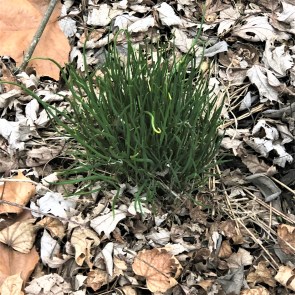
Regrowth of the chives
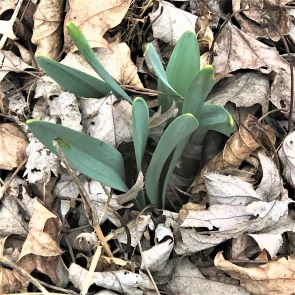
The blooms will be here soon!

Sage new growth

Buds on a maple tree
It is now the time to clear off the leaves from the flower bed and herb garden. Wow, the bulbs are really pushing up! Trees are beginning to bud out. And yes, the grass is starting to perk up as well. Here comes Spring 2022.
Wooden Bear Brewing
Sunday afternoon seemed like a good time to have an adventure. So it was off to Greenfield, Indiana for a stop at the Wooden Bear Brewing company. Wooden Bear is in an old auto repair garage, and it is quite spacious.
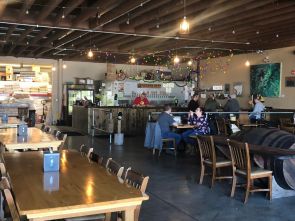
Seating with bar on back wall
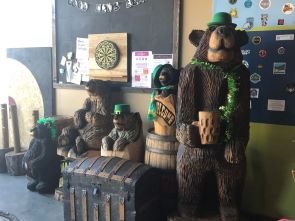
Company namesakes
The Wooden Bear has quite a nice selection of brews on tap. We decided to start with a four sample flight each. You can have as many as you like, with six being a full set, or as our waiter said, six is the most he can carry in one hand.
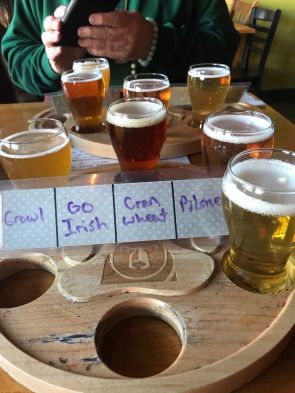
Sher’s flight

Maj’s flight
A local pizza restaurant happens to be in the back of the building. Very handy, and we certainly enjoyed the thin crust pizzas. They got to our table quickly after we ordered them.

Black olives!

Pepperoni!

We liked the NEIPA (hazy) so much we got a growler to go
Lazy Sunday afternoons are perfect for relaxing, enjoying a pizza and a flight of different brews. It is also a perfect time when you can spend it with the love of your life and the most important person in your life. Sundays don’t get any better than that.
Fire damaged Jefferson County Indiana courthouse
The Jefferson County courthouse in historic Madison, Indiana was built in 1855. In May of 2009 a fire broke out in the clock tower during a construction project. The fire destroyed the clock tower and most of the third floor.
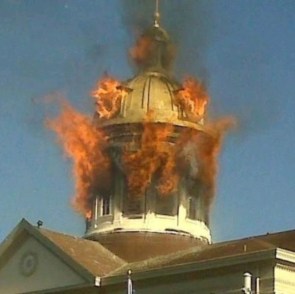
Photo by Jamey Cobb, May 20, 2009
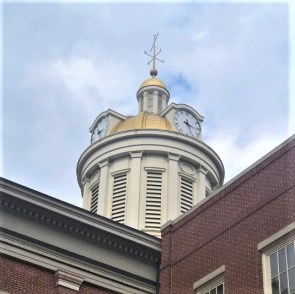
Restored after the fire
The massive 3100 pound bell in the tower fell into the third floor as the fire destroyed the bell supports. The bell was removed from the wreckage by crane after the fire was put out. The repairs on the courthouse were completed in 2011, including a modern chimes system in place of the bell.
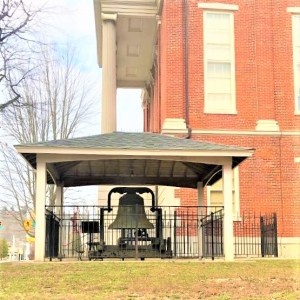
New home for the bell
The bell became a project for a couple of trade classes and a teacher from the Madison Consolidated Schools. This group designed and built an open-air structure on the courthouse grounds to house the bell. The bell has a distinctive strip of figures and the markings “Buckeye Foundry” and “1864 Cincinnati.” One story says that the bell is tuned to the musical note “E”. The project was dedicated in 2014.
Greek Revival Lanier Mansion finished in 1844
Madison, Indiana is known for it many historic buildings, including some of the best examples of Greek Revival architecture preserved in the country. The Lanier Mansion was the home of James Franklin Doughty Lanier, a banker, railroad developer and Clerk of the Indiana General Assembly. The south face of the home faces the Ohio River, and is considered the “front door” to the mansion.
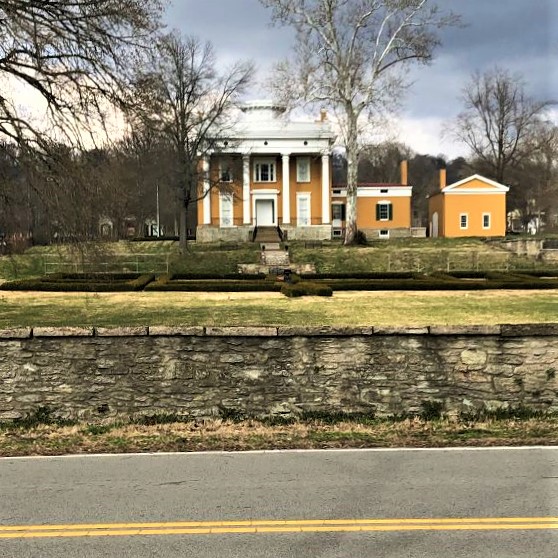
The Ohio River is behind the camera
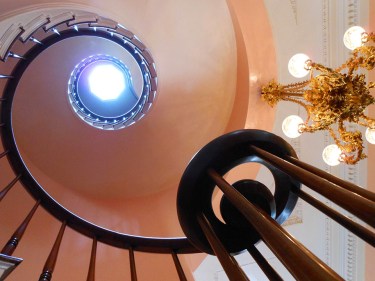
Spiral staircase in the mansion. Photo courtesy Ind. State Museum
From an Indiana State Museum website: Francis Costigan designed the mansion with many Greek Revival features. These include its square plan, the full façade porch on the south elevation, the Corinthian columns on the south portico, the Doric pilasters that appear on several locations on the exterior, the massive exterior entablature and dentilated cornice, the ornamental anthemia, the ornamental pediments over the windows and doors, and the Ionic columns that separate the double parlors on the first floor.

West side of the mansion, Ohio River to the right
The Lanier Mansion was designed by renowned architect Frank Costigan, with the project completed in 1844. It is now part of the Indiana State Museum system as an official Historic Site. It has been referred to as the Crown Jewel of the Madison Historic District, and provides insight into the life and times of the 1840’s Indiana along the Ohio River.
Colonial is good Bread
Old advertisements have always been popular, it seems. Keep your eyes open and you never know when you’ll spot a piece of pure Americana.

The back of the oval sign says “Thank You”
We found a nice example of a vintage (pre 1958) functional advertisement in the form of a working wooden/screen door on the Whistle Stop Cafe in Osgood, Indiana. The well worn metal cross piece proudly announces that “Colonial is good Bread”. Colonial Bread began in 1928 in Oklahoma City. The name was changed to Rainbo Bread in 1958 when the recipe was changed.
Complete Colonial Bread screen doors are bringing quite a lot on the online sites like ebay, Pinterest and Etsy. Just the signs without doors also command high prices.
Jefferson Proving Grounds use today
In 1940 the US War Department designated 56,000 acres in southern Indiana as a future munitions testing area. In May of 1941 the first round of ammunition was fired from the firing line. Thus began the long history of the Jefferson Proving Grounds (JPG).
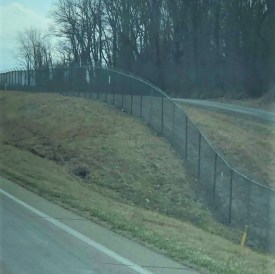
View from US Highway 421
Driving on US Highway 421 (the old Michigan Road) north of Madison, Indiana you’ll see on the west side of the road a long barbed wire topped tall chain link fence set back from the road. It runs for 17 miles. Inside the fence there will be another road, and US Govt. No trespassing signs evenly spaced on the fence. This is the old JPG site.
The JPG closed in 1995, but is still utilized by different entities. Part of the acreage is now the Big Oaks National Wildlife Refuge. Over 1000 acres is still used as a munitions training area for Indiana National Guard Aviation wings. A local railroad museum has a collection of rail stock on an old rail line within the site. Some areas are open for camping and seasonal permit hunting.
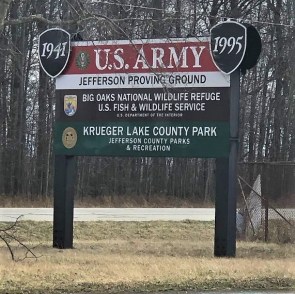
Signage on US 421

Boarded up original gate house
The following is from a Site Status Summary from this USNRC website: “JPG was established in 1940 for the purpose of production and specification testing of all types of ammunition, projectiles, propellants, cartridge cases, primers, fuses, boosters, bombs, and grenades. From 1941-1995, over 24 million rounds of conventional explosive ammunition were fired.” To this day there are areas within the old firing range that still contain millions of rounds of unexploded ordinance making those areas extremely dangerous.
 Roadtirement