


The weather was nearly perfect, not too hot, partly cloudy and a nice breeze. We decide that Sunday would be a great time to get out and have a day trip. Our son put together a tentative itinerary, and we hit the road late morning. It was sure nice having our son driving.
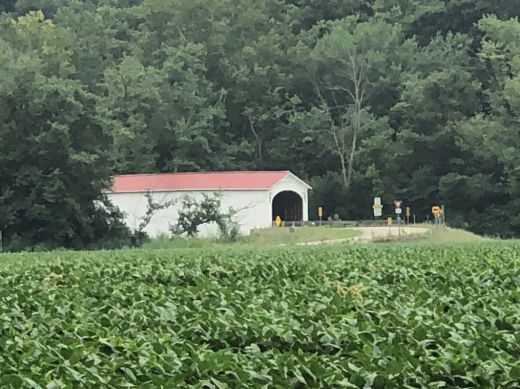
Soybean fields, forests and a covered bridge
We had quite a day, long in time but most enjoyable. We saw several historic bridges, which you know we enjoy visiting. A country church was a nice stop. We also visited some of the shops in Nashville, Indiana, a huge tourist mecca in south central Indiana. (Yep, two fudge shoppes!)
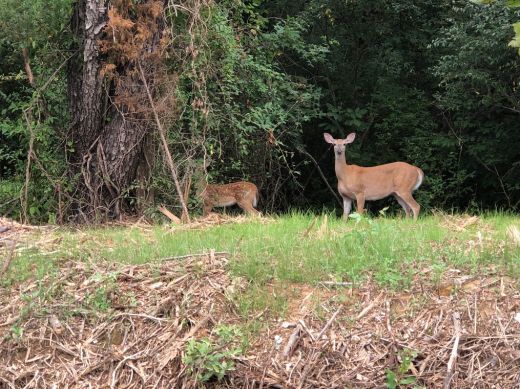
More deer images coming
We also had a couple of wineries planned. In addition, we found a distillery we were not aware of. Turns out is is well known, and had a marvelous tasting event and enjoyable grounds. In addition we were blessed with the sightings of quite a lot of wildlife and frankly a few surprises as well. Stay tuned, we have several posts on the way!
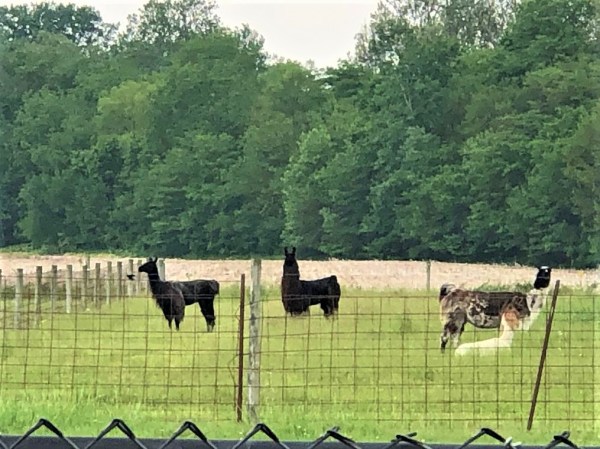
We saw a small group of llamas over the weekend. Some ignored us, however the large black male did not lower his head while we were stopped watching these animals.
The Thomas Family Winery in downtown Madison, Indiana is housed in, appropriately, a vintage 1850’s old stable and carriage house. The interior is most welcoming, with tables set amidst a rustic motif, and there are outside tables as well for your pleasure.


This winery takes a bit of a different philosophy concerning their wine creations than other establishments. From the Thomas Family Winery website: “We feel that wine is food, and fills its greatest role as a mealtime beverage. We craft our wines in the European tradition of finesse, balance, and structure which particularly enhances the variety of flavors in meals.” Steve Thomas told us that they do not have any sweet wines, rather wines for pairing with meals. He expanded on their European style of wine making.

Maj tasting Gale Hard Cider

Owner Steve Thomas with our purchase
Owner Steve was most gracious and took plenty of time to explain what their winery is all about. The tastings were complimentary, and we did purchase a bottle of Niagara 2020. We did not partake of the bread and cheese offerings. That will be on another trip. We will be returning to enjoy the weekend live music. The supply of Gale Hard Cider will be restocked then as well. I liked that Cider! The Thomas Family Winery should be on your list of places to visit in Historic Madison, Indiana.
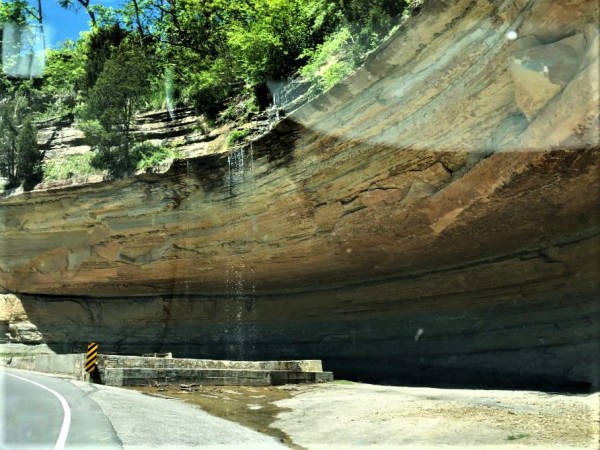
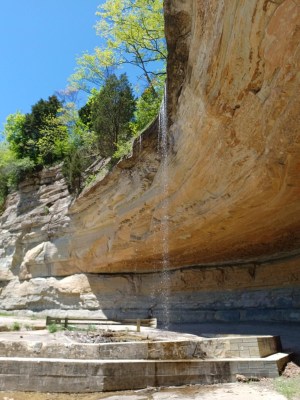 Traveling from Columbus, Indiana to Madison on the Ohio River via Highway 7 you’ll enjoy a slightly rolling countryside of farms interspersed with small towns and villages. As you approach Madison you see smoke stacks of a power plant that is right on the Indiana side of the Ohio. Soon you will see road signs warning of hairpin turns and steep grades. No lies there, Highway 7 drops very fast and twisty on the way down to the town of Madison.
Soon you come to Hanging Rock. There on the north side of the road is a quite impressive rock cliff complete with an active waterfall. Hanging Rock has been an important landmark in Madison since, well, when the first winding path snaked its way from the top of the hill down to the river. Today there is a pull out that allows uphill traffic to drive behind the falling water. Even during droughts the water always cascades down the cliff. The feature was formed by glaciers thousands of years ago.

A 1915 Purdue University guide to concrete fence posts
Take a drive on most any rural Indiana road or some other Midwest states and it won’t be long until you spot some rather massive concrete pillars apparently serving no purpose. These are in fact old, now abandoned concrete fence posts. Decades and decades ago almost all farmsteads raised livestock, including work horses, thus strong “cattle and horse tight” fencing was an absolute necessity.
Constructing livestock fencing that is functional and remains functional year after year is a skill that farmers and ranchers had. One of the important parts of a good fence is the end post and/or corner posts. These posts anchor the wire fence that stretches along the length of the particular fence line. If the end and corner posts do not hold, the fence wire will sag and livestock will get out, causing quite the kerfuffle.

Remnants of fence wire is still wrapped around this post
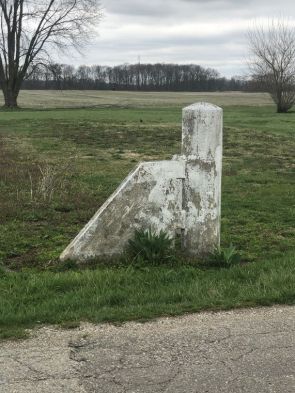
This post had white wash and weeds clipped
Old concrete fence posts can be seen alongside many roads in the country. Sometimes you can tell from the locations of these relics coupled with the position of mature trees where once stood an old house and barn yard. Some will be painted, others will be nearly covered with weed and bush growth. They do stand as a reminder of the days when all farm families raised livestock as a part of their livelihood.
This is the link to the 1915 pamphlet pictured above.


Ready for “Hello, Dolly! at Indy’s Beef & Boards
Madison, Indiana is known for it many historic buildings, including some of the best examples of Greek Revival architecture preserved in the country. The Lanier Mansion was the home of James Franklin Doughty Lanier, a banker, railroad developer and Clerk of the Indiana General Assembly. The south face of the home faces the Ohio River, and is considered the “front door” to the mansion.
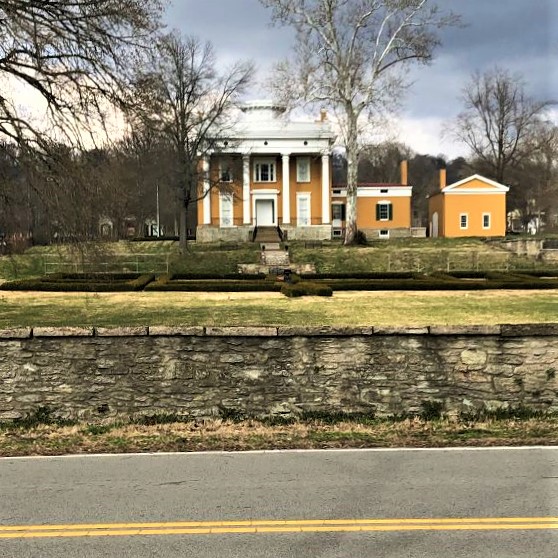
The Ohio River is behind the camera

Spiral staircase in the mansion. Photo courtesy Ind. State Museum
From an Indiana State Museum website: Francis Costigan designed the mansion with many Greek Revival features. These include its square plan, the full façade porch on the south elevation, the Corinthian columns on the south portico, the Doric pilasters that appear on several locations on the exterior, the massive exterior entablature and dentilated cornice, the ornamental anthemia, the ornamental pediments over the windows and doors, and the Ionic columns that separate the double parlors on the first floor.

West side of the mansion, Ohio River to the right
The Lanier Mansion was designed by renowned architect Frank Costigan, with the project completed in 1844. It is now part of the Indiana State Museum system as an official Historic Site. It has been referred to as the Crown Jewel of the Madison Historic District, and provides insight into the life and times of the 1840’s Indiana along the Ohio River.
In 1940 the US War Department designated 56,000 acres in southern Indiana as a future munitions testing area. In May of 1941 the first round of ammunition was fired from the firing line. Thus began the long history of the Jefferson Proving Grounds (JPG).
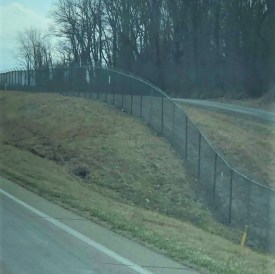
View from US Highway 421
Driving on US Highway 421 (the old Michigan Road) north of Madison, Indiana you’ll see on the west side of the road a long barbed wire topped tall chain link fence set back from the road. It runs for 17 miles. Inside the fence there will be another road, and US Govt. No trespassing signs evenly spaced on the fence. This is the old JPG site.
The JPG closed in 1995, but is still utilized by different entities. Part of the acreage is now the Big Oaks National Wildlife Refuge. Over 1000 acres is still used as a munitions training area for Indiana National Guard Aviation wings. A local railroad museum has a collection of rail stock on an old rail line within the site. Some areas are open for camping and seasonal permit hunting.
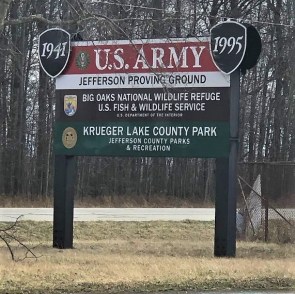
Signage on US 421

Boarded up original gate house
The following is from a Site Status Summary from this USNRC website: “JPG was established in 1940 for the purpose of production and specification testing of all types of ammunition, projectiles, propellants, cartridge cases, primers, fuses, boosters, bombs, and grenades. From 1941-1995, over 24 million rounds of conventional explosive ammunition were fired.” To this day there are areas within the old firing range that still contain millions of rounds of unexploded ordinance making those areas extremely dangerous.
Madison, Indiana was founded in 1809 on the Ohio River between Cincinnati and Louisville. The entire downtown has been designated part of a National Historic District. One part of this town’s fascinating history is the story of the Fair-Play Fire Co. Firehouse.
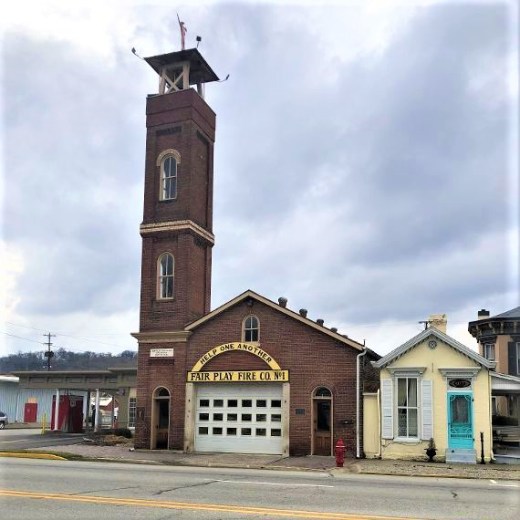
From a National Park Service article: “The Union Volunteer Fire Company organized in 1830 to help protect Madison’s citizens from fire, a very serious threat to 19th century communities. Several years later, the City of Madison voted to fund a paid municipal fire department, but within ten months the service was cancelled and the responsibility again rested on volunteer forces. In 1841, about 100 men, who originally were members of the Union Volunteer Fire Company, organized the Fair Play Fire Company No. 1, which is now the oldest volunteer company in Indiana.”


This is one of several active Volunteer Fire Departments protecting Madison, Indiana. Fair-Play Fire Company first saw action as a bucket brigade. They bought a hand drawn piece of equipment in 1851, and it is still owned by the department. The tall tower on the firehouse was built to hang hoses to dry. Go to the NPS article, link above, for more details about the history of this fire company.
 Roadtirement