
We are here with family from Ohio and Seattle enjoying this neat arcade and bar.
We are here with family from Ohio and Seattle enjoying this neat arcade and bar.
This is a post we published in March, 2020, after the Indiana Governor’s Executive order to shut down the state.
Our local NBC station showed a video on their noon news of the city of Indianapolis. The video was in black and white and showed scene after scene of the city with no people, cars, buses or any sign of life. Totally empty streets and parking lots made the shots look like they came right out of the last scene of the movie “On the Beach”, an apocalyptic movie from 1959.
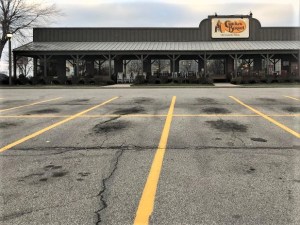
Carry out only
Sher and I and our son were commenting on the video which led to the discussion of the quiet nature that has become our neighborhood. It seems as though most of the neighbors are paying attention to the Indiana declaration of “stay at home and work from home”. Very little traffic, even the guy with the extra loud Harley is not to be heard recently.
Then we heard someone starting up their lawn mower. Wow who would ever think that the usually obnoxious noise from a Briggs and Stratton engine would provide a twisted sense of normalcy to this COVID -19 pandemic abnormal situation. Thus the title of this post.
At times the pandemic lockdown feels like years ago, at times it seems like yesterday.

One of two pylons on Indiana side of the bridge.
This bridge carries U.S. 50 Business across the Wabash River from Vincennes, Indiana to Lawrence County, Illinois. The east end of the bridge is in the George Rogers Clark National Historic Park. At this entrance to the bridge you will find two large pylons made of granite, each with a raised sculpture depicting a Native American Chief.
The bridge is what is called a deck arch design, and has two traffic lanes and wide pedestrian walks on each side of the roadway. It was opened to traffic in September, 1933, the same year that the George Rogers Clark Memorial was completed. President Franklin D. Roosevelt dedicated the monument in 1936.
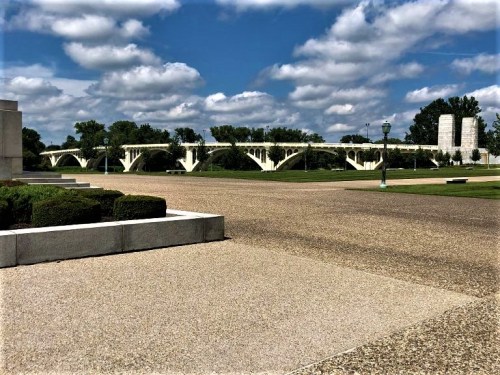
View from the George Rogers Clark Monument

Wabash River walk, Illinois is on the other side of the river
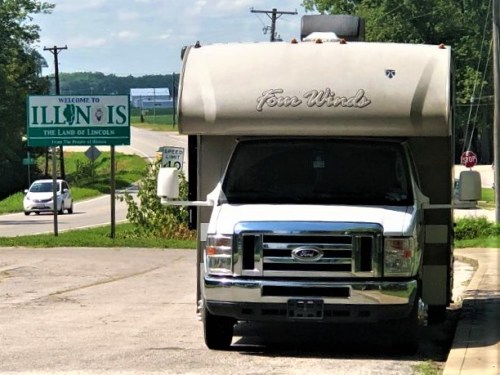
Parked after crossing the bridge
This was one of the attractions we enjoyed on our trip to Vincennes, Indiana in August of 2020, during the height of the pandemic. We had a spot at a nearby RV Park, and were able to maintain the then acceptable “social distance” and had masks available.


It is always fun when travelling to come across an interesting attraction. We found this striking likeness of the famous Chief Tecumseh near the Wabash River levee in Vincennes, Indiana. The statue is the creation of Peter “Wolf” Toth, a Hungarian artist, and is the most recent addition (the 74th) to the “The Trail of Whispering Giants” series of statues scattered across the country.
 Lincoln’s tomb is in the huge Oak Ridge Cemetery in Springfield, Illinois. This is a State historic site, not a National property. The impressive structure is on top of a hill in roughly the center of the cemetery grounds.
You enter the tomb into a small round room. There were two volunteers in the room answering questions. The tomb itself is reached via a marble lined hall way with different bronze statues of Lincoln along the way.

You enter the tomb via the small door seen on the lower right of the structure.

The entry room has a small version of the Lincoln Memorial statue in Washington DC
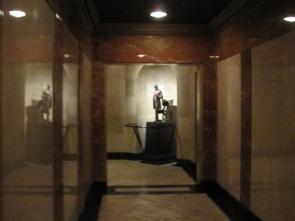
Not a clear photo, but this shows the hall leading to the tomb.
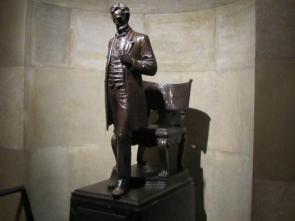
One of several depictions of Lincoln in various places in the walkway.
Once you have seen the marker for Lincoln and the internment wall behind which are Lincoln’s wife and children you continue out another hallway. This was a very somber and, for me, emotional time. All of Lincoln’s history, the tragedy of the Civil War and his untimely death seemed to rush to the forefront of my thinking.
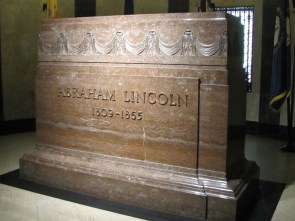
Lincoln’s casket is actually behind and 10 feet below this massive marker. It is encased in steel reinforced concrete.
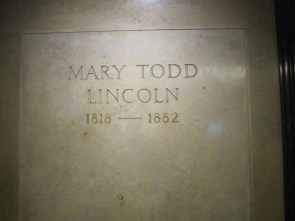
Lincoln’s children are also here next to Mrs. Lincoln
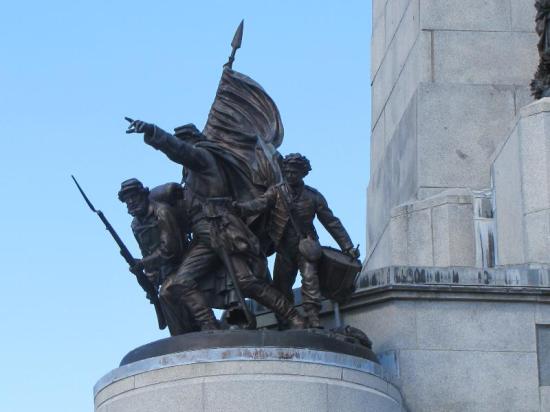
One of four statues representing the Infantry, Cavalry, Artillery and Navy that fought in the Civil War, and that Lincoln commanded.
The photos do not really do justice to the magnificence of the exterior and the interior of tomb. This is a true must visit site if you are near Springfield.
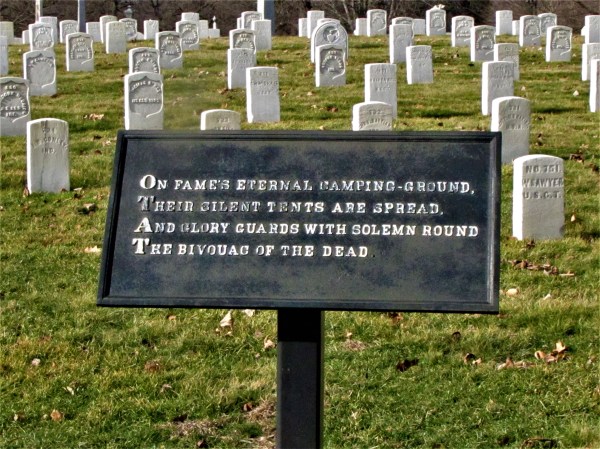
O’Hara’s quatrain posted at one of two National Cemeteries in Crown Hill Cemetery, Indianapolis
Theodore O’Hara (1820 – 1867) was a poet, lawyer, soldier and adventurer from Kentucky. He penned a haunting poem honoring the dead from Kentucky killed in the Mexican War of 1847. At the end of the Civil War it became a memorial to Confederate dead, however the second quatrain of the first stanza has become an honor to any soldier killed in battle. That quatrain can be found in cemeteries across the nation and even the gateway to Arlington National Cemetery bears an inscription from O’Hara’s most noted poem.
“BIVOUAC OF THE DEAD”
The muffled drum’s sad roll has beat
The soldier’s last tattoo;
No more on life’s parade shall meet
That brave and fallen few.
On Fame’s eternal camping-ground
Their silent tents are spread,
And Glory guards, with solemn round,
The bivouac of the dead.
No rumor of the foe’s advance
Now swells upon the wind;
Nor troubled thought at midnight haunts
Of loved ones left behind;
No vision of the morrow’s strife
The warrior’s dream alarms;
No braying horn nor screaming fife
At dawn shall call to arms.
Their shriveled swords are red with rust,
Their plumed heads are bowed,
Their haughty banner, trailed in dust,
Is now their martial shroud.
And plenteous funeral tears have washed
The red stains from each brow,
And the proud forms, by battle gashed
Are free from anguish now.
The neighing troop, the flashing blade,
The bugle’s stirring blast,
The charge, the dreadful cannonade,
The din and shout, are past;
Nor war’s wild note nor glory’s peal
Shall thrill with fierce delight
Those breasts that nevermore may feel
The rapture of the fight.
Like the fierce northern hurricane
That sweeps the great plateau,
Flushed with the triumph yet to gain,
Came down the serried foe,
Who heard the thunder of the fray
Break o’er the field beneath,
Knew well the watchword of that day
Was “Victory or death!”
Long had the doubtful conflict raged
O’er all that stricken plain,
For never fiercer fight had waged
The vengeful blood of Spain;
And still the storm of battle blew,
Still swelled the gory tide;
Not long, our stout old chieftain knew,
Such odds his strength could bide.
Twas in that hour his stern command
Called to a martyr’s grave
The flower of his beloved land,
The nation’s flag to save.
By rivers of their father’s gore
His first-born laurels grew,
And well he deemed the sons would pour
Their lives for glory too.
For many a mother’s breath has swept
O’er Angostura’s plain —
And long the pitying sky has wept
Above its moldered slain.
The raven’s scream, or eagle’s flight,
Or shepherd’s pensive lay,
Alone awakes each sullen height
That frowned o’er that dread fray.
Sons of the Dark and Bloody Ground
Ye must not slumber there,
Where stranger steps and tongues resound
Along the heedless air.
Your own proud land’s heroic soil
Shall be your fitter grave;
She claims from war his richest spoil —
The ashes of her brave.
Thus ‘neath their parent turf they rest,
Far from the gory field,
Borne to a Spartan mother’s breast
On many a bloody shield;
The sunshine of their native sky
Smiles sadly on them here,
And kindred eyes and hearts watch by
The heroes sepulcher.
Rest on embalmed and sainted dead!
Dear as the blood ye gave;
No impious footstep shall here tread
The herbage of your grave;
Nor shall your glory be forgot
While fame her records keeps,
Or Honor points the hallowed spot
Where Valor proudly sleeps.
Yon marble minstrel’s voiceless stone
In deathless song shall tell,
When many a vanquished ago has flown,
The story how ye fell;
Nor wreck, nor change, nor winter’s blight,
Nor Time’s remorseless doom,
Shall dim one ray of glory’s light
That gilds your deathless tomb.
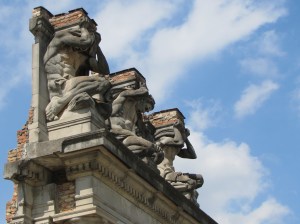 Holliday Park is a city park located in the near north-side of Indianapolis in one of the more higher end neighborhoods. The park is a beautiful setting with hundreds of trees, flowers and wildlife. In addition to the natural features of this inner city recreation site you will find an eclectic display affectionately tagged “The Ruins”.
The centerpiece of this ‘artwork’ is a structure that is the home of three massive sculptures atop a brick and mortar conglomeration of various architectural details. The three statues are called “The Races of Man”, are carved from (fittingly) Indiana limestone and represent Caucasian, Asian and African ethnic groups. Karl Bitter was the sculptor.
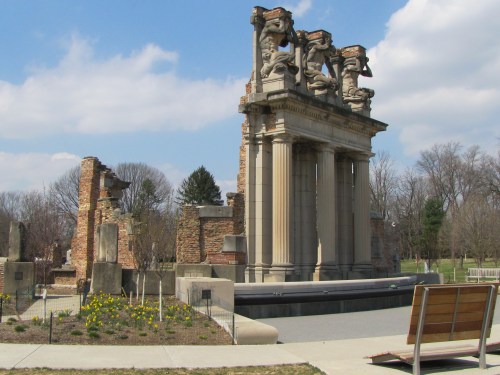
View of the whole display

Entrance of structure in 1898 showing the 3 statutes and columns
The original home of the three statues was the St. Paul building in downtown New York. The building was the work of famed architect George B. Post (1837-1913) who was the architect of many of the most important landmarks in New York City, including the New York Stock Exchange. At the time of the completion of the St. Paul building in 1898 it was 315 feet tall and the tallest in New York City.
The original St. Paul building was torn down in 1958 to make way for a new skyscraper. The building’s owner, Western Electric, held a contest among US cities for the rights to have the sculptures. Long story short, Indianapolis won the competition. It took two decades and tons of money to bring “The Ruins” to a condition suitable for public use. For a while Western Electric considered retrieving the statues. Then Mayor of Indianapolis Richard Lugar pushed the completion of the project, which included the three original entrance columns, in the mid 1970’s.

Detail of one of the statues
When we visited the park we frankly were amazed. What a beautiful setting! The Ruins were fascinating to see. It was fun walking the grounds and touring the extensive nature center as well. Note that there was adequate parking for RV’s and buses, making access very easy.
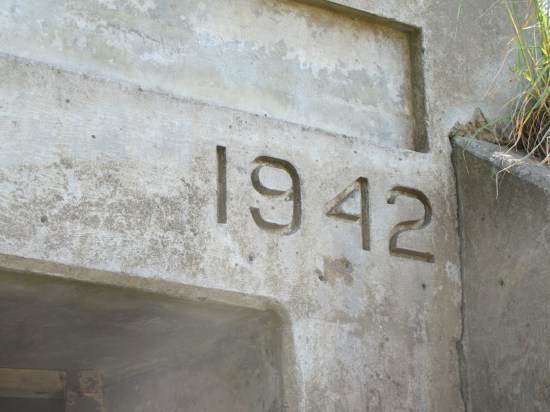
Date on the main bunker entrance

Forward observation post facing Puget Sound

One of the remaining two gun turret foundations
In 1892 the first Sacred Heart Catholic Church was built in Galveston, Texas. Unfortunately it was completely destroyed in the horrific hurricane of 1900. A replacement church was constructed during 1903-1904. Like the Bishop’s Palace across the street, famed Galveston architect Nicholas J. Clayton designed this, the second church on the site.

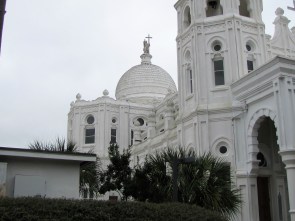
Note the dome, center
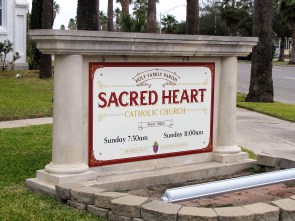
The beautiful church marquee
Following is a quote from a 1981 Texas Historical Commission Historical Marker placed at the church: “The present building, the second for the parish, was constructed in 1903-04 during the pastorate of the Rev. D. J. Murphy. A prominent landmark in the city, it features ornate octagonal towers, flying buttresses, elaborate ornamentation, and a variety of arches. The design reflects influences of the Moorish, Byzantine, Gothic and Romanesque styles. The building’s original dome, damaged in a 1915 hurricane, was redesigned by Nicholas Clayton.”

A tiny fraction of the pumpkin picking area available.
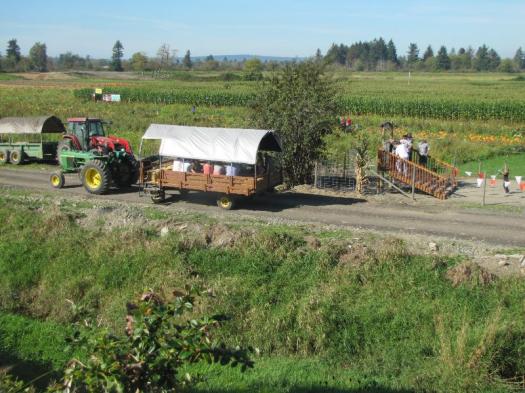
Hay ride to the pumpkin patch! (That is the kids zip line on the right.)

What a variety!
A U-Pick-It pumpkin farm in the Snohomish Valley north of Seattle. It provides a fun outdoor activity for young and old alike. This area has several farms offering pumpkin patches, corn mazes and Halloween spooky stuff too.
 Roadtirement