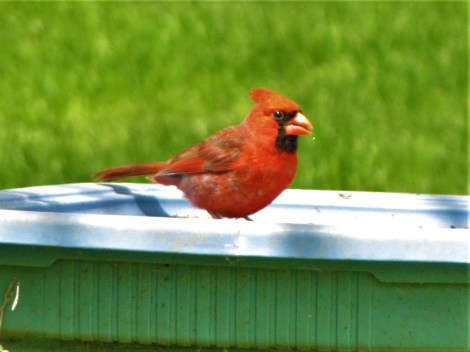
The Cardinal is one of the most well known and recognized birds. It is the official state bird for Illinois, Indiana, Kentucky, North Carolina, Ohio, Virginia, and West Virginia. That is the most states having the same bird. Cardinal brings a striking splash of color whenever he comes into our yard.
Adult on left feeding juvenile, second juvenile, right, looks on
Remember the post about the Starling kids bugging parents for food? Well, this behavior continued today everywhere in our yard. The change noticed today was that there were even more juvenile starlings hanging close to adults, waiting and begging for food. The groups were seen on the ground like yesterday, and now in the trees and even the utility wires overhead. One juvenile even approached a squirrel that was munching on some peanut suet. Wrong move, juvenile! That squirrel was not going to feed you! Squirrel jumps up and at the bird. A moment of hilarity.
Today there were many more juvenile starlings in evidence. In addition the chatter from the young starlings was incredible, and the birds actually sounded agitated and anxious. It was not a calm day.
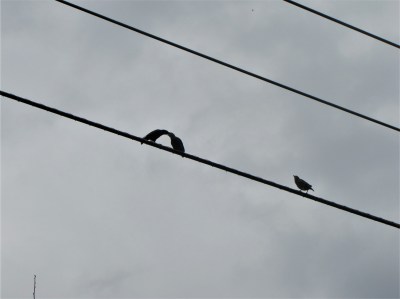
It’s really neat to see a breeding pair of birds together. Yesterday we saw a pair of Cowbirds. There is a very interesting way that Cowbirds “raise” their young.
Male on the left, female on the right
The Brown-headed Cowbird is known as a “Brood Parasite” The Brown-headed Cowbirds do not make nests. Females put all energy into egg production, up to 3 dozen a season. Yes, you guessed it, the females lay their eggs in other birds nests. The eggs hatch before the host nest eggs do, giving the Cowbird young a head start. Some birds recognize these imposters and pitch the trespassers out of their nests. Some people consider Cowbirds a nuisance bird, as they are responsible for the destruction many songbird eggs.
Having spotted this pair, we can now surmise that somewhere nearby another unsuspecting bird family is wondering why that one chick is so much larger than the rest of their brood.
The only North American woodpecker that stores and then hides the stored food.
The Red-headed Woodpecker is one of the most striking birds you’ll find in the forest, or, in our case, the backyard. Today Sher spotted a beautiful male on the tube feeder. He was hanging on the bottom of the feeder poking into the openings. This magnificent bird blessed us with his presence for a few minutes. We hope he’ll feel comfortable enough to return soon.
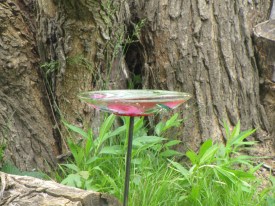
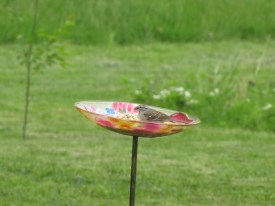
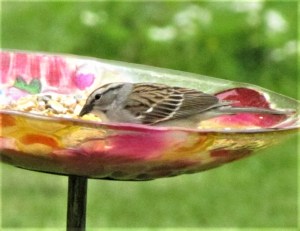
Sher spotted some small but pretty bird baths in a local store’s ad flyer. We decided that they would be a nice addition to our backyard. We thought that we’d use one of the glass receptacles as a true water filled bird bath. The second, however, for now we put bird feed in the second one as a shelf feeder.
Glass bowl bird bath
2nd bird bath as a shelf feeder
We have been thrilled with the number of different species of birds that have been gracious enough to visit our backyard.
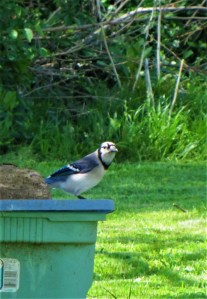
A brash Blue Jay
Chipping Sparrow in the new feeder
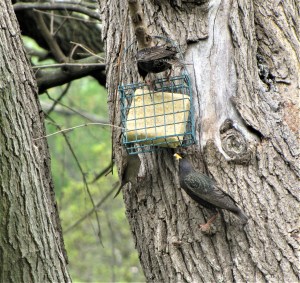
Two Starlings enjoying the suet
We have so enjoyed sitting in our backyard watching the birds coming and going from the bird feeders, now scattered across our backyard. We will keep the bird and critter photos coming as we capture them.
At an RV Park in central Florida we met the local resident Sandhill crane.
This crane obviously owned the park, as we saw him walking down the center of roads and blatantly ignoring the accepted RV park protocol of not walking through another camper’s site. I was only about 3 feet from him for the close up head shot.
Here’s some more images of some plants around the yard. We did get a nice thunderstorm this afternoon. I won’t have to water anything today.
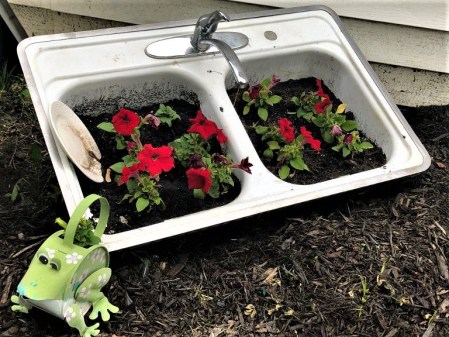
We decided to use both sink compartments for flower plantings. We’ll get another something for a bird bath. Since we have put up the bird feeder our backyard has become very popular with the neighborhood avian population.
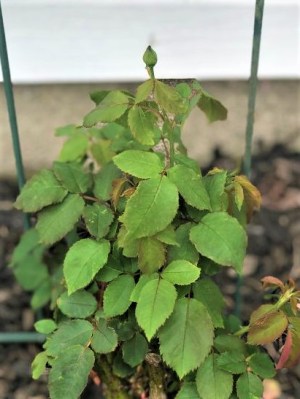
The rose bush is new, just got it planted a few days ago. We were surprised and happy to see the new bloom at the peak of the bush! Roses are so pretty…
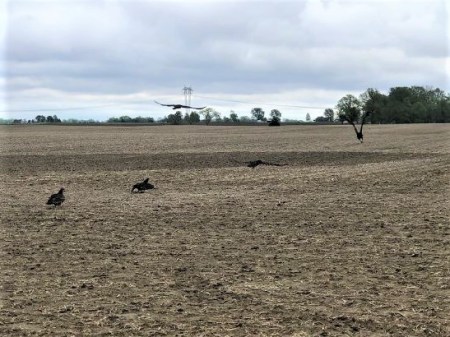
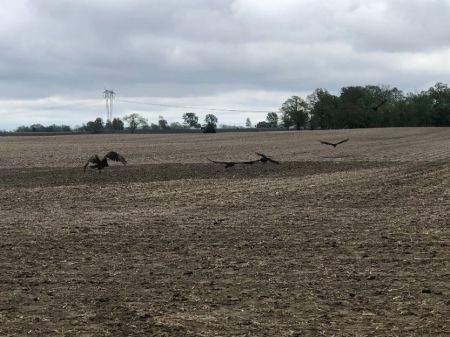
On a drive today we saw many large black birds in a field next to a rural county road. I had my son stop the car for a better look and a photo op. The committee of vultures started to move away from the road, some walking and some flying close to the ground before they settled down again.
And by the way, there are three different names for a group of vultures. Different circumstances dictate what name applies at the time. A committee is a group resting on the ground or in trees. A wake is a group feeding. And when you see lots of vultures soaring in the sky, wings outstretched with little or no flapping, well that is called a kettle of vultures.
This robin was enjoying a romp in the mulch looking for worms
There are lots of robins in neighborhood, and we are seeing lots of young, still growing birds in the yard. We have tilled up sod for our flower garden, and this freshly exposed soil has become a worm buffet for the robins and other birds.
Our bird feeder has really become a center of feathered activity. We are seeing an almost constant stream of birds feeding from the feeder. The larger birds, too big for the feeder’s small perches, are enjoying feeding on the ground where the seeds have fallen from the feeder. We daily see cardinals, starlings, doves and the occasional Blue Jay. We saw a red headed woodpecker one day hanging from the bottom of the feeder. I was surprised to see a woodpecker on the seed feeder.
Don’t jump the gun as businesses start to open up again. Remember to follow the guidelines: masks, distancing, sanitizers and hand washing. Be safe and stay healthy!