Mary Gray Bird Sanctuary from the Indiana Audubon Society

The Mary Gray Bird Sanctuary is located south of Connersville in Fayette County, Indiana.  Alice Green Gray gave the initial 264 acre property to the Indiana Audubon Society in 1943 as a living memorial to her daughter Mary, who preceded her in death. Another Gray relative and Society members have made possible the acquisition of more property so that the Sanctuary now has 723 acres.
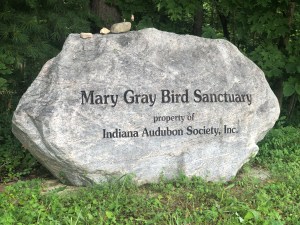
Clearly marked entrance
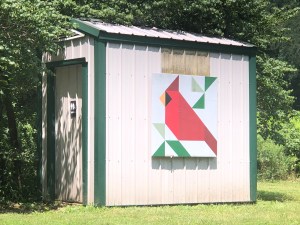
Storage building appropriately decorated
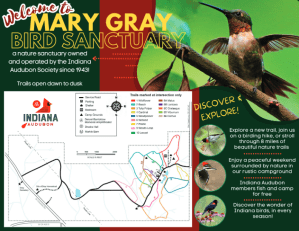
Page from MGBS brochure


The entrance to the sanctuary is well marked with a dramatic and large stone sign. Once you are in the initial parking area, you realize that you are in a delightful part of Nature’s birding paradise. This is an off the beaten path sanctuary worthy of your exploration. Take you camera and binoculars.

There are many features within this sanctuary. There is a bird watching blind where you can observe the many stocked feeders and not be seen. Ponds and native trees provide a perfect chance to immerse yourself in communing with Earth and the natural history of Indiana. Interesting programs and meetings take place at the amphitheater. Self-guided hiking tours covering many topics are an extra bonus to visitors of the MGBS. Click here for the MGBS website.


A yearly backyard favorite

Who hasn’t seen this early bird  getting the worm in the morning in your yard? This classic backyard favorite bird ranges from coast to coast in the US and Canada.

Did you know robins can raise three broods each season? Probably a good thing, as only 40% of the nests successfully produce young. People say that robins are a sign of spring. They actually winter over, however and spring is when you’ll see “the first” robin in your yard!


Red-headed Woodpeckers are nature’s show birds

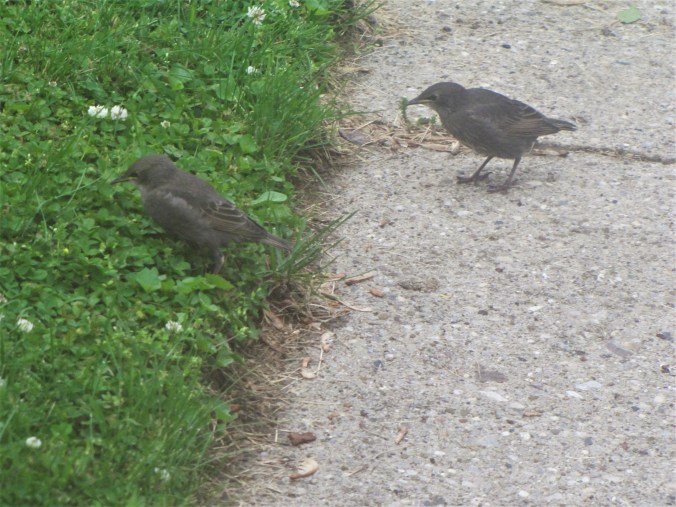
Today was a little wild with all the new young starlings leaving their nests, and their apparent feeding frenzy with the adults.

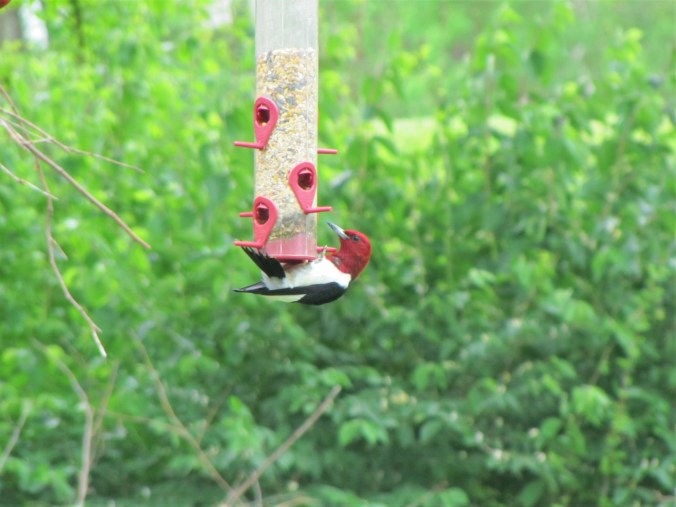
Then suddenly Sher and I witnessed the arrival of one of the most striking birds in North America. The Red-headed Woodpecker has beautiful crimson head plumage accompanied by a pure white body and wings that are half white and half ink black. These birds are striking both at rest and in flight. This one was kind enough to stick around on the feeder long enough for the capture you see above.

Mom, Dad, get back here!

We noticed a behavior in starlings that we had not seen before. Adult starlings were moving through the yard, doing their normal grazing thing.

Some adult feathers are beginning to show on the backs of these two starling juveniles

What was different was the sight of juvenile starlings, one or two per adult, staying amazingly close. Every time the adult moved, the juvenile stayed right with the adult. We watched as the adult would grab a worm or grub an give it to the youngster. When the adult flew away the youngster would squawk and carry on very loudly. This parent/young interaction went on for minutes at a time.

A pair of Pileated Woodpeckers

If you’ve seen some of our previous posts, you’ll know that we have been enjoying feeding birds in our backyard. It is always fun to see different birds and to watch the antics of them all. But sometimes we just have to say “Wow! Look at those!”

That time came when a mating pair of Pileated Woodpeckers showed up at our tree with suet feeding stations. The male is on the left, female on the right. (We call them Woody and Wilma) We had seen the female before, but this was our first sighting of the male. And yes, to us, this was a thrilling event!

Ah, you might want to duck

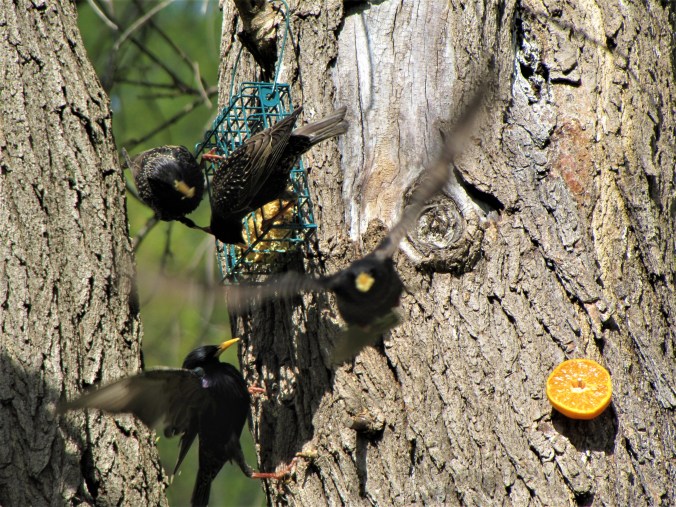
Here he comes, center of picture

Look closely, there is a starling who just left the suet feeder heading right towards the camera. The yellow beak is in the center of the black body, and the out stretched wings are very blurry. We see the starlings getting a beak full of suet and flying off to, we assume, their nests. According to one of our resources the young starlings should be leaving their nests anytime now.