No singing here

That is right. Downy Woodpeckers do not sing like most birds. They communicate by “pecking” or drumming on wood or even metal. Surprisingly these woodpeckers make very little or no sound when going after their insect prey. They are capable of feeding on insects that larger woodpeckers cannot catch, like fly larvae in weed stems.
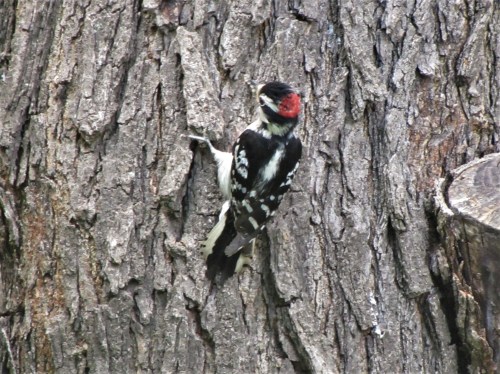
Male Downy, the female does not have the red on her head

We see both male and female Downy Woodpeckers quite often in our backyard. They like the suet feeders, and we have spotted a male on our hummingbird feeder. Like the White-breasted Nuthatch, Downy Woodpeckers like to flit from branch to branch, lighting on the suet feeder, grabbing a bite or two and then off they go.

A colorful White-breasted Nuthatch

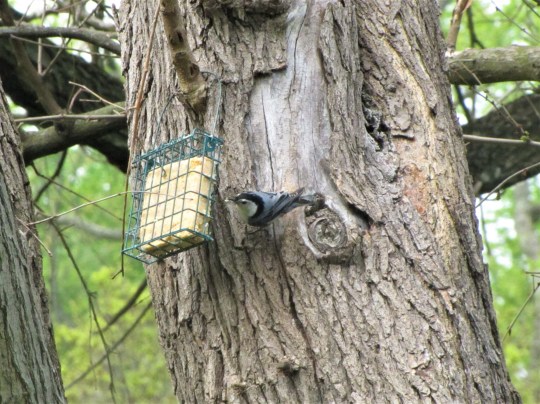
This little guy has a beautiful song and quite a loud one at that. He likes to come to the feeders (really likes the suet) several times a day. He doesn’t stay long, regardless of how many other birds are around at the time. He likes to flit around from branch to branch, grabs some morsels and then off he goes.

The common name Nuthatch comes from a unique behavior. The primary diet is insects and large meaty nuts. They will take large nuts and acorns and jam them into the bark of trees. Then with their sharp bills they peck open the nuts, or “hatching” them.  They are also known for storing seeds and nuts in tree bark in preparation for winter.

Blue Jay blue

The Blue Jay is a very striking, large and loud songbird. It is one of those birds that we always enjoy seeing in our yard and  at our feeders.  Jays like shelf feeders over hanging feeders.

In the picture you can see the bird’s crest is down. This is common when Blue Jays are feeding peacefully or interacting with their family groups.

Feeding frenzy, starling style

Today the juvenile starlings were at it again: following parents around everywhere looking for the food handout. Today the youngsters figured out that they didn’t have to stay on the ground. Looking at the short video, you can see the gray colored youngsters in the tree, waiting for the parents to grab a piece of the suet and then feed them.

The din produced by the constant loud squawking of the youngsters was there all morning.

Red-headed Woodpeckers are nature’s show birds

Today was a little wild with all the new young starlings leaving their nests, and their apparent feeding frenzy with the adults.

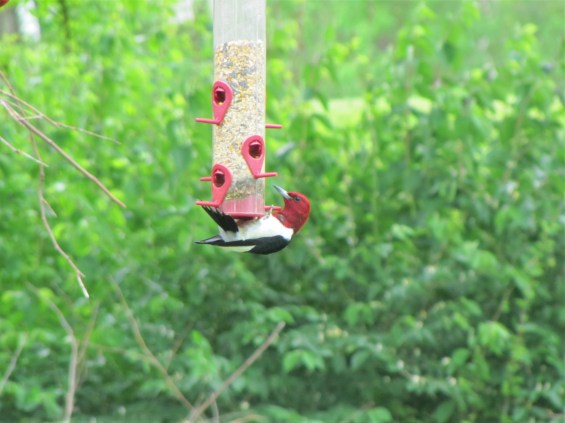
Then suddenly Sher and I witnessed the arrival of one of the most striking birds in North America. The Red-headed Woodpecker has beautiful crimson head plumage accompanied by a pure white body and wings that are half white and half ink black. These birds are striking both at rest and in flight. This one was kind enough to stick around on the feeder long enough for the capture you see above.

More starlings leaving the nests

Adult on left feeding juvenile, second juvenile, right, looks on

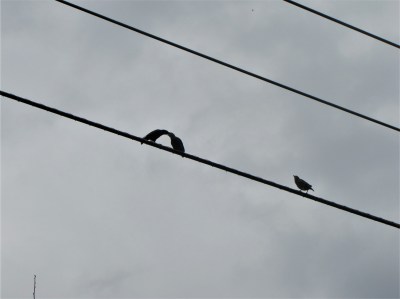
Remember the post about the Starling kids bugging parents for food? Well, this behavior continued today everywhere in our yard. The change noticed today was that there were even more juvenile starlings hanging close to adults, waiting and begging for food. The groups were seen on the ground like yesterday, and now in the trees and even the utility wires overhead. One juvenile even approached a squirrel that was munching on some peanut suet.  Wrong move, juvenile! That squirrel was not going to feed you! Squirrel jumps up and at the bird.  A moment of hilarity.

Today there were many more juvenile starlings in evidence. In addition the chatter from the young starlings was incredible, and the birds actually sounded agitated and anxious. It was not a calm day.

Mom, Dad, get back here!

We noticed a behavior in starlings that we had not seen before. Adult starlings were moving through the yard, doing their normal grazing thing.

Some adult feathers are beginning to show on the backs of these two starling juveniles

What was different was the sight of juvenile starlings, one or two per adult, staying amazingly close. Every time the adult moved, the juvenile stayed right with the adult. We watched as the adult would grab a worm or grub an give it to the youngster. When the adult flew away the youngster would squawk and carry on very loudly. This parent/young interaction went on for minutes at a time.

Sher and I were serenaded today

Nothing like getting photobombed by a twig!

It was a beautiful Thursday afternoon with mostly sunny skies and a very light breeze with temps near 65. The birds and a couple of squirrels were taking advantage of the food we had set out for their use.

We have been thrilled with the variety of species that have come to our feeders. Today we spotted a new little bird, a Carolina Wren, one we haven’t seen before . He decided to flit up into the tree and serenade us with a beautiful song!

Listening to our backyard friends is as fun as watching them,.