This ferry ran from 1802 to 1978

Aurora, Indiana and Petersburg, Kentucky were connected for nearly two centuries by ferry that transported people, vehicles and goods back and forth across the Ohio River. From the first two horse powered days until the 15 car ferry in service at the end, the Aurora Ferry Company provided uninterrupted service seven days a week.

The history of the ferry

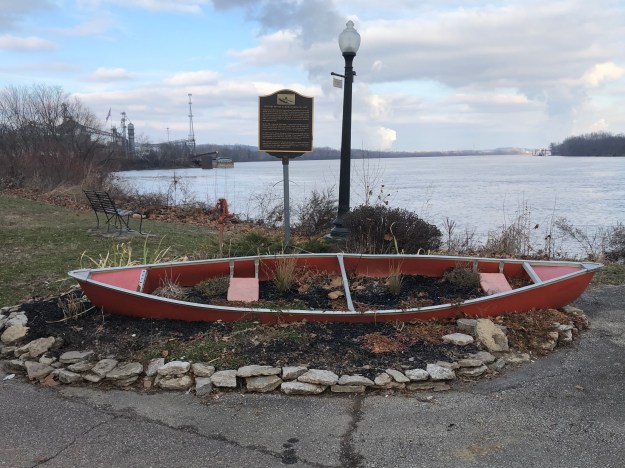
This canoe with the accompanied bronze plaque makes up a memorial marker for a long time icon of the Ohio River. From 1802 to 1978 a ferry ran back and forth across the Ohio. You can see this on the Ohio River Scenic Highway that runs along the river through Aurora, Indiana. The bridge that killed the ferry is out of sight in the background.

The first real snow of the season

It is not much, but at least it is enough to record. 

Won’t use the swing or table today

The rose looks a little forlorn this morning

We usually always post our photos as the camera takes them, with no editing or special effects. These two snow shots, however, are presented for your viewing pleasure with color editing, so in black and white. The post header photo is not edited, and is of our sage plant in the herb garden.

Historic 1930’s art deco building

The historic building survives with a new use

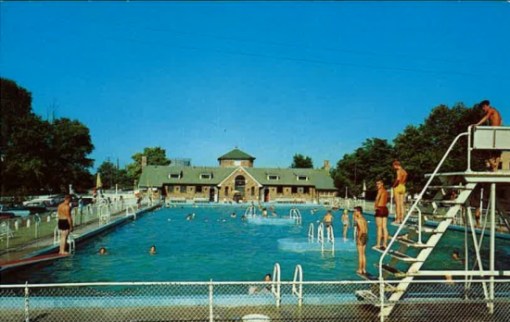
This historic building in Shelbyville, Indiana was originally the bath house for what was for decades the town’s public swimming pool.  The William A. Porter Memorial Swimming Pool Bathhouse was built to honor the memory of the son of a Shelbyville family. This Art Deco building was dedicated in 1930.

Sometime in the 1960’s showing pool and back of the building

The pool was closed in 1998 and subsequently was demolished. The building is currently being used by the local Chamber of Commerce and serves as the Shelby County Tourism & Visitors’ Bureau. It is located on the north side of town and is one of the first structures that visitors see when they come into town.

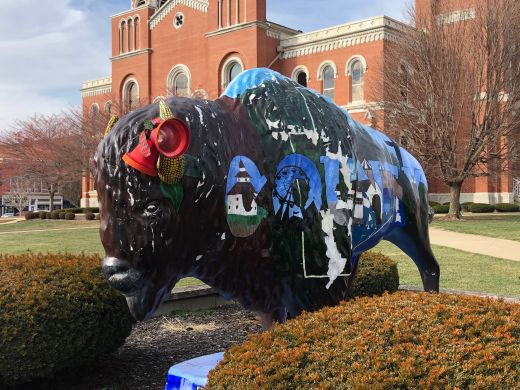
A Bison-tennial statue in Decatur County

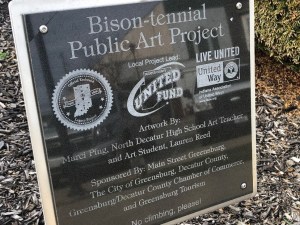
Indiana’s Statehood Bicentennial was celebrated in 2016. The remnants of that celebration can be seen all over the state in the form of 5 feet tall fiberglass bisons. The in.gov website states:  “Indiana Association of United Ways was the proud sponsor of the statewide Bison-tennial Public Art Project. This legacy project helped celebrate Indiana’s 200th birthday by decorating and displaying 5-foot-tall fiberglass bison with an end goal of at least one – if not a herd – of bison on display in each of Indiana’s 92 counties.”

Courthouse with Tower Tree in background

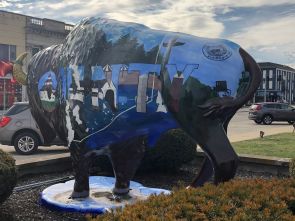
This side says DECATUR

This side says COUNTY


This Bison-tennial beast has scenes from Decatur County painted on the hide. Most of the ones in counties around the state have some depictions of local places, schools or attractions. We’ve seen a few of these colorfully decorated statues around the state, as each of the 92 counties received one or more to custom decorate. This one we found at the center of Greensburg on the Decatur County Courthouse grounds, and is pictured above with its information sign. Note that the header photo show the bison in the raw as they were delivered back in 2016.

Let’s Talk: Avalanche Safety

Very informative.

Maria's avatarThe Road Goes Ever On

Let me start this post with a disclaimer – I am a newbie to avalanche terrain and only have level 1 training. I am not a reliable resource for avalanche safety. I decided to write this post anyways because I think a lot of people go out into the backcountry in the winter without understanding the risk. I went snowshoeing and camping for 3 years and told myself I was safe because I “checked the forecast” and only went on popular or “safe” trails. I was pretty conservative, but in retrospect, I didn’t actually know how to read the avalanche bulletins and I was unknowingly venturing into avalanche terrain. Without taking a course, I feel it’s hard to get the proper education on identifying avalanche terrain and my main goal with this post is to convince you to take the AST1 course. If your internal reasoning sounds anything like mine…

View original post 1,306 more words

Stainless steel public art

Shelbyville, Indiana is a small Hoosier town southeast of Indianapolis. Recently it has developed the Blue River Trail, a hiking and bike trail that runs from one end of town to the other. As part of the celebration of the trail, the city commissioned a large public art piece on the north end of town.

Blue River-Wind, Rain and Water

The title Blue River – Wind, Rain and Water is inspired by the river basins of the Big and Little Blue rivers, which run through Shelby County. The two come together within about 100 yards of this artwork placement. According to the informational plaque, the sculpture is inspired by the rivers’ courses and the wind and rainstorms that keep the water flowing.

This statue was the winner of a contest that was held where many artists proposed a piece at this location. An artist from Shelbyville, Michael Helbing, was chosen for the project. The 40 foot tall stainless steel sculpture is the result. It was erected in 2018.

Call 911 that tree is on fire

Sycamore on fire on backside

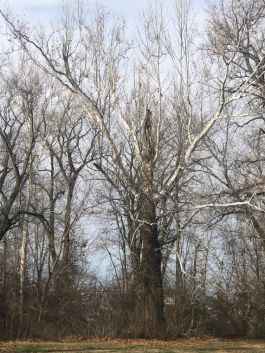
Today was the first day in about a week when the sun was out and the temperature was above freezing. We were driving on a road next to a city park when our son noticed what looked like smoke  coming from the tree line at the edge of the park. Not thinking much of it,  we drove on, and saw lots of geese on the river past the park. But, we all kept taking about that smoke we saw. We circled back around and drove into the park where the small column of smoke still billowed.

Our son walked over to the tree line and found that an old sycamore tree was in fact on fire! I walked over to the tree and saw actual flames and several square feet of charred trunk surface.  We called the Fire Department Admin office who directed us to call 911. We did.

Lots of equipment for one tree
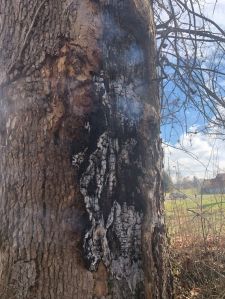
Well, a few minutes later here came one of the city’s large aerial ladder trucks.  Two firefighters got out of the truck, one with a water extinguisher and went to our smoking tree. Long story short, they determined that the tree was hollow, and the “blaze” no doubt started by homeless people. Two other trees in this park had also had evidence of a fire started at the base.

They kind of knocked down the embers on the charred trunk. The Street Department was called. Those two fellows said they were ok if they let it burn, and eventually it would fall into the river. The Fire Department agreed. So there is now an old hollow sycamore tree slowly burning on the edge of a city park. Hope the city is right and it will fall towards the river instead of into the park.

Greensburg Indiana’s unique tower tree

In the early 1870’s in the then small town of Greensburg, Indiana, some citizens noticed some odd greenery on the roof of the Decatur County Courthouse Tower. As the years went on, the green tree seemed to thrive as it grew. Local officials began to be concerned that the tree could cause structural damage to the apex roof of the tower. Legend says that in 1888 a steeplejack was hired to “trim the tree”. He was said to have found not one, but two individual Large Tooth Aspen trees growing quite nicely on the roof.

Decatur County Courthouse and Clock Tower

Word spread rapidly that Greensburg had two trees growing out of the courthouse clock tower roof. The tree drops leaves seasonally like all deciduous trees. Mystery surrounds the origin of the first Aspen seed that sprouted in the roof. Large Tooth Aspens are not native to Central Indiana. Thus history and legend began to grow around this Indiana town.  For over 130 years trees have sprouted, grown and perished in a cycle that continues to this day. No, the tree you see today is not 130 years old. But Greensburg remains a National Treasure for its oddity known as the famous Tower Tree.

Greensburg is on I-74 between Indianapolis, Indiana and Cincinnati, Ohio. Oh, and by the way, do you know how the tree gets water?  Answer: From the spring in the clock.   (cue rimshot)