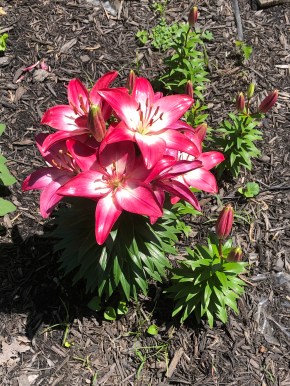
These were transplanted from our front flower beds to our herb and flower garden in the back. They have done well, and are preparing to bloom. Note the sage behind the lilies.

These were transplanted from our front flower beds to our herb and flower garden in the back. They have done well, and are preparing to bloom. Note the sage behind the lilies.
That is right. Downy Woodpeckers do not sing like most birds. They communicate by “pecking” or drumming on wood or even metal. Surprisingly these woodpeckers make very little or no sound when going after their insect prey. They are capable of feeding on insects that larger woodpeckers cannot catch, like fly larvae in weed stems.

Male Downy, the female does not have the red on her head
We see both male and female Downy Woodpeckers quite often in our backyard. They like the suet feeders, and we have spotted a male on our hummingbird feeder. Like the White-breasted Nuthatch, Downy Woodpeckers like to flit from branch to branch, lighting on the suet feeder, grabbing a bite or two and then off they go.

These four sparrows enjoyed a meal together on the feeder. It is most enjoyable watching the birds on the feeders and picking through the seeds on the ground as well.
This little guy has a beautiful song and quite a loud one at that. He likes to come to the feeders (really likes the suet) several times a day. He doesn’t stay long, regardless of how many other birds are around at the time. He likes to flit around from branch to branch, grabs some morsels and then off he goes.

The common name Nuthatch comes from a unique behavior. The primary diet is insects and large meaty nuts. They will take large nuts and acorns and jam them into the bark of trees. Then with their sharp bills they peck open the nuts, or “hatching” them. They are also known for storing seeds and nuts in tree bark in preparation for winter.

The starling parent, below, has a morsel ready for to feed its juvenile, above. The youngster is perfectly flight capable, and follows the parent around demanding to be fed.


This is a Chipping Sparrow peeking through the grass. Notice the cute little red cap on its head. We see this sparrow quite often in our yard, and this guy likes to feed on the ground instead of the feeders.
Seen in our backyard…

The Cardinal is one of the most well known and recognized birds. It is the official state bird for Illinois, Indiana, Kentucky, North Carolina, Ohio, Virginia, and West Virginia. That is the most states having the same bird. Cardinal brings a striking splash of color whenever he comes into our yard.

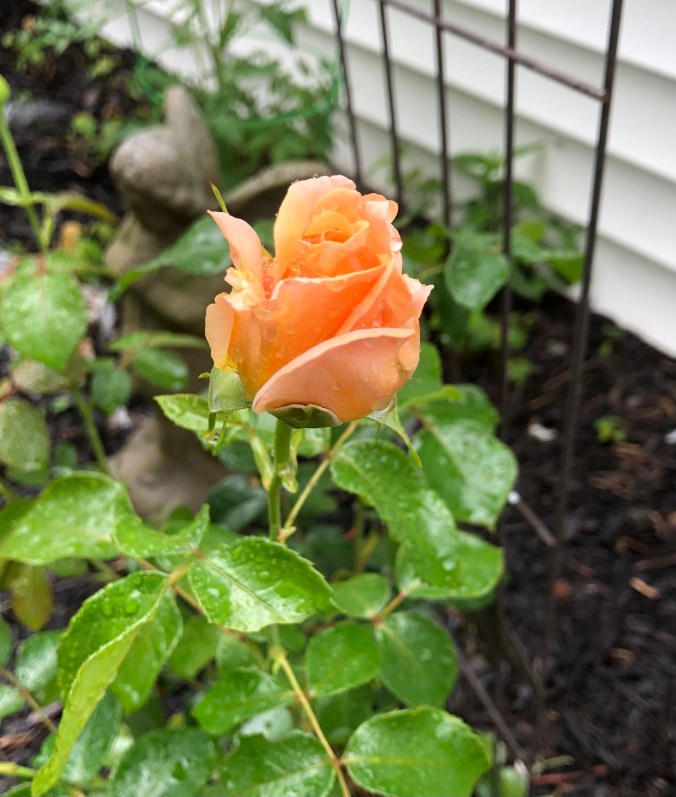
The dense morning fog deposited a multitude of water droplets on the leaves of our rose bushes. Every square inch was touched with a moisture laden blessing.

This unique butterfly was spotted in our screen room tent right outside of the back door. This butterfly is interesting as it will winter over by hiding in protected spaces. It lives on tree sap, rotting fruit and animal droppings. It only drinks nectar as a last resort. We’ve never seen one before.