The historic Bartholomew County Courthouse in Columbus, Indiana

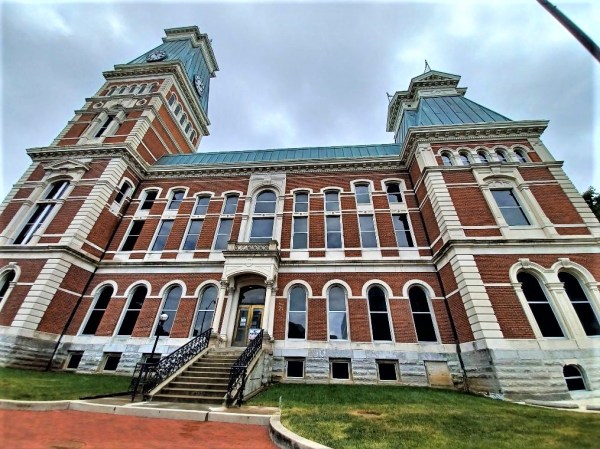
Bartholomew County, Indiana is south of Indianapolis and is known for its architecture, public art and well known and long running industry. Columbus is the county seat, and thus is home to the County Courthouse. This striking edifice was designed by noted Indiana architect Isaac Hodgson. The building was constructed from 1871–1874 at the cost of (then)$250,000. The courthouse was put on the National Register of Historic Places in 1979.
A panorama view

The following Court House description is from Wikipedia: It is a three-story, Second Empire style red-brick building trimmed in limestone. It features a mansard roof, corner pavilions, Corinthian-order portico, and a six-level clock tower.  The clock tower is 154 feet tall. A six-inch thick, 10-ten clock bell was installed in 1875. The clock’s weighted mechanism were replaced with an electric motor in 1940 and a 900-pound weight fell.

We visited on a Saturday, so the building was closed. It would be interesting to see inside this county government building.
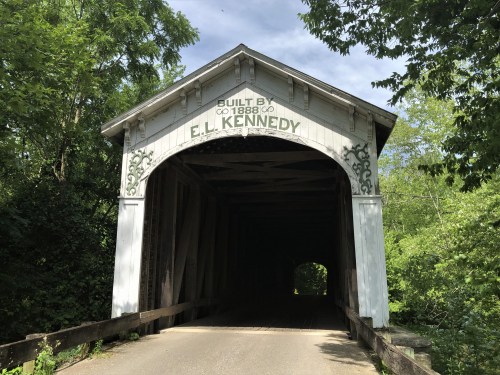
The Forsythe Covered Bridge, aka Forsythe Mill Bridge

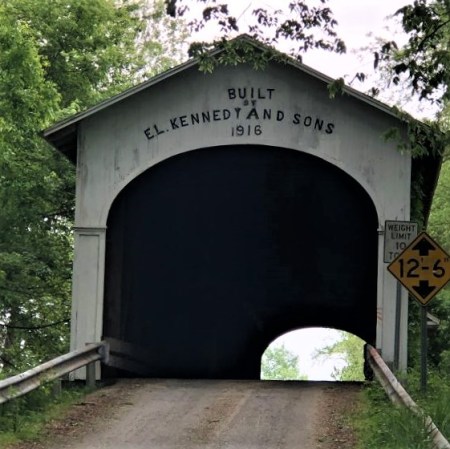
We found yet another one of those magnificent 1880’s covered bridges, this one again in Rush County, Indiana. The Forsythe Bridge, also known as the Forsythe Mill Bridge spans Big Flatrock River in the southeast corner of the county. This bridge was built by E. L. Kennedy bridge building company. Emmet Kennedy was one of the sons of Archibald M Kennedy, premier bridge builder from Rush County.

The Forsythe Bridge over Big Flatrock River

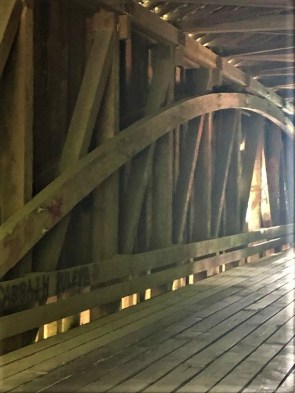
A long view of the Burr- Arch truss system

A look outside over the river below


We spotted Maj shooting the video of the river and the bridge

This bridge is 196 feet long, as noted designed with the typical Burr-Arch truss system. This bridge was one of six bridges that all were registered on the US National Registry of Historic Places. All six of the bridges were constructed by the Kennedy family, and were registered at the same time in 1983.


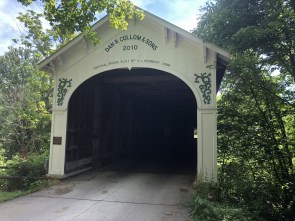
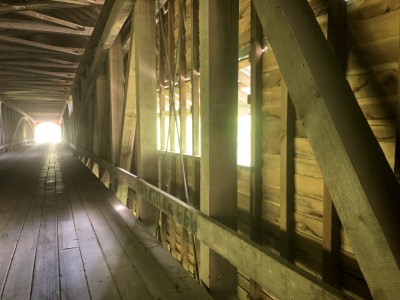
The 1886 Moscow Bridge rebuilt in 2010

In June of 2008 an F3 tornado ripped through the small town of Moscow in Rush County, Indiana. Tragically one life was lost, several homes were destroyed and the 1886 Kennedy covered bridge was ravaged and tossed into the river below. Through the heroic effort of the community, businesses and others, a reconstruction project was begun. Original pieces of the bridge were salvaged. With the balance of new materials, a faithful reproduction of the original E L Kennedy double-span Burr-Arch bridge was rebuilt by the Don Collom and Sons company from Bridgeton, Indiana. It was dedicated in September, 2010.


The Moscow Covered Bridge remains the heart and soul of not only the town, but a valuable part of the history of Rush County as well.

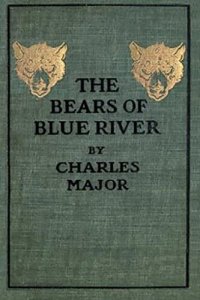
The Bears of Blue River by Charles Major

Vintage book cover

When I was in 4th grade I, like most every other 3rd to 5th grader in Indiana was introduced to and told to read The Bears of Blue River by author, lawyer and politician Charles Major. The website Yesterday’s Classics shares a concise summary of the book: “Balsar, a pioneer lad, enters manhood at the age of 13 when he encounters a great bear while fishing on the river and proves his mettle. This book, full of harrowing adventures, great danger, and many acts of valor, tells of Balsar’s subsequent encounters with bears, wolves, Indians and the legendary one-eared ‘demon’ bear, offering a dynamic portrait of the daily life in Indiana during the 1820s.”
Charles Major lived most of his life in Shelbyville, and his influence has been most appreciated in the community for years. Major’s first book was published in 1898, When Knighthood Was In Flower which was very successful, having been adopted into both theater and film. He published The Bears Of Blue River in 1901.

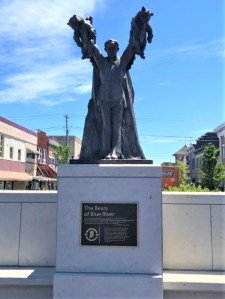
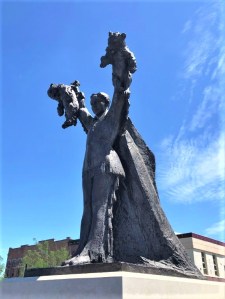
The statue of Balsar holding his pet bear cubs Tom and Jerry was placed in front of an elementary school named for the author. After the school was demolished in the sixties, the statue remained in storage until it was placed on the town square years ago. Once the new downtown project to redo the square was designed, the statue of Balsar and the cubs was restored and placed in the center of the structure housing the fountain and nice seating.
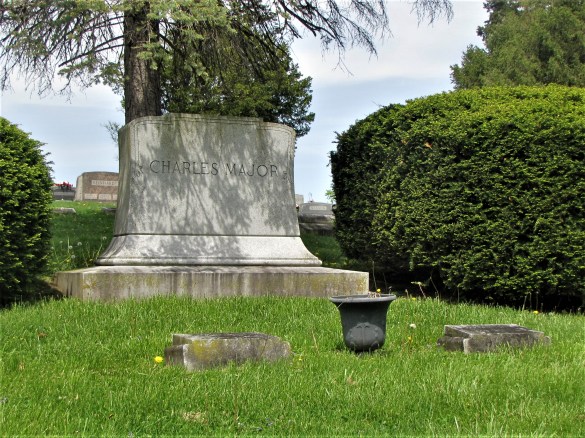
Graves of Charles Major and his wife, Alice, in Forest Hill Cemetery, Shelbyville

Back when Sher and I were in elementary school, reading The Bears of Blue River was a requirement. I so remember being totally absorbed while reading the book. What a series of adventures Balsar enjoyed. I’ll always remember the excitement and danger of the stories. (Wait ’til you read about the Fire Bear!) I’d suggest if you have family in the 7 to 10 year old range, get them a copy of The Bears of Blue River. Heck, get one for yourself. You might enjoy an exciting trip back to Indiana in the 1820’s.

A refurbished local landmark back in service

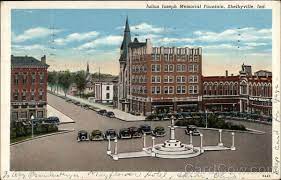
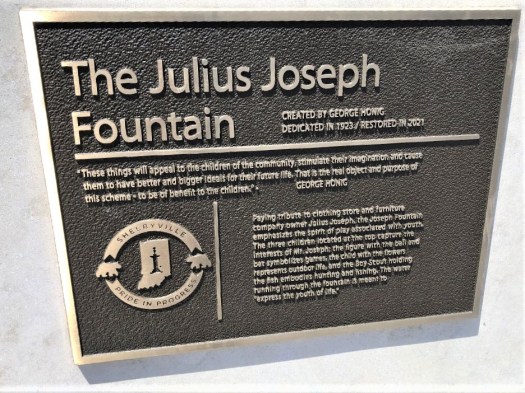
The Joseph Fountain was first dedicated in 1923 on the center of the town square in Shelbyville, Indiana. It has been the center of the “square” (as the center of town has been known for decades by the locals) and has supported the Christmas Trees and for one year in the 1950’s it was covered  with cornstalks in the fall.

Vintage photo showing the Fountain in the center of the square

New information plaque placed at the rededication of the fountain

During the years 2020-2021 a massive project completely reconstructed the square, entrance streets, sidewalks and parking. There the fountain, after complete restoration, was replaced in its historic location. With water again flowing freely, the fountain is once again the center of the square delighting young and old alike.


Oliver P. Morton, Indiana’s “War Governor”

Unveiled in 1907, this statue of Morton stands in front of the Statehouse. It was sponsored by Union veterans

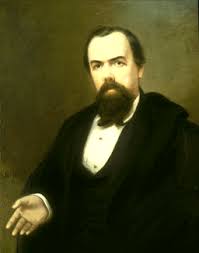
Vintage portrait of Morton, courtesy in.gov

Oliver P. Morton was Governor of Indiana during the Civil War. He was chief executive of the state from 1861 to 1867. He took office a mere 90 days before the war began with the Confederate attack on  Fort Sumpter. As soon as he heard of the attack, he rushed the following dispatch to President Lincoln: “On behalf of the state of Indiana, I tender you for the defense of the nation and uphold the authority of the government, 10,000 men.”

Indiana was the first of the western states to send soldiers to join the Union Army. Initially the legislature provided funds for the Indiana troops. Later on when controversy arose, Morton also helped to raise funds to insure that Indiana troops had the best and newest uniforms and weapons.  Morton was known by Indiana Civil War veterans as “the soldier’s friend”. A 12 foot statue of Morton in front of the Indiana Statehouse was placed in 1907.

E.L. Kennedy covered bridges

This was the last covered bridge built in Rush County

A look at the Burr-Arch truss system

Opening with overhang looks on the river

150 feet long, one lane wide and a 10 ton load limit

E. L. Kennedy and Sons bridge builders are part of the three generations of Kennedy Bridge builders in Indiana. Emmett came out of retirement after the great flood of 1913, which wiped out many covered bridges in central Indiana. He and his two sons Karl and Charles R. built the 150 foot long Norris Ford bridge over the Flat Rock River in Rush County.

There are not near as many of these bridges left as there were even 30 years ago. Those that are left should be saved. They are an important part of our history.

Thomas Family Winery

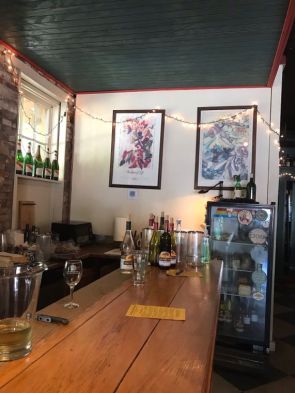
The Thomas Family Winery in downtown Madison, Indiana is housed in, appropriately, a vintage 1850’s old stable and carriage house. The interior is most welcoming, with tables set amidst a rustic motif, and there are outside tables as well for your pleasure.


This winery takes a bit of a different philosophy concerning their wine creations than other establishments. From the Thomas Family Winery website: “We feel that wine is food, and fills its greatest role as a mealtime beverage. We craft our wines in the European tradition of finesse, balance, and structure which particularly enhances the variety of flavors in meals.” Steve Thomas told us that they do not have any sweet wines, rather wines for pairing with meals. He expanded on their European style of wine making.

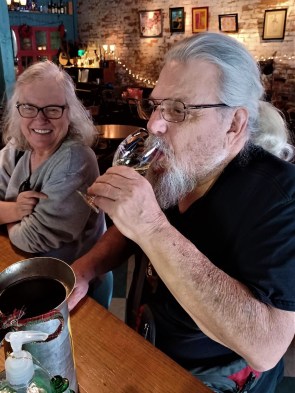
Maj tasting Gale Hard Cider

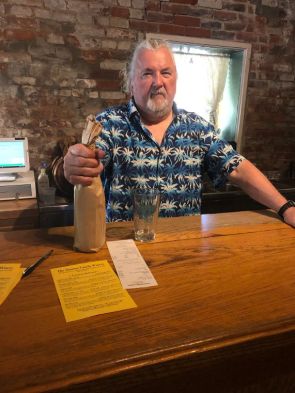
Owner Steve Thomas with our purchase

 
Owner Steve was most gracious and took plenty of time to explain what their winery is all about. The tastings were complimentary, and we did purchase a bottle of Niagara 2020. We did not partake of the bread and cheese offerings. That will be on another trip. We will be returning to enjoy the weekend live music. The supply of Gale Hard Cider will be restocked then as well. I liked that Cider! The Thomas Family Winery should be on your list of places to visit in Historic Madison, Indiana.

Old concrete fence posts dot the Midwest

A 1915 Purdue University guide to concrete fence posts

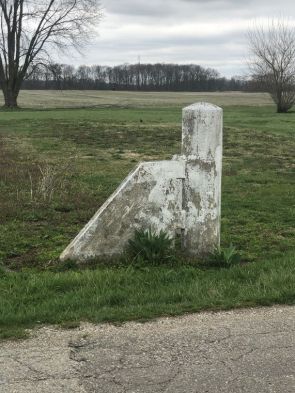
Take a drive on most any rural Indiana road or some other Midwest states and it won’t be long until you spot some rather massive concrete pillars apparently serving no purpose. These are in fact old, now abandoned concrete fence posts. Decades and decades ago almost all farmsteads raised livestock, including work horses, thus strong “cattle and horse tight” fencing was an absolute necessity.

Constructing livestock fencing that is functional and remains functional year after year is a skill that farmers and ranchers had. One of the important parts of a good fence is the end post and/or corner posts. These posts anchor the wire fence that stretches along the length of the particular fence line. If the end and corner posts do not hold, the fence wire will sag and livestock will get out, causing quite the kerfuffle.

Remnants of fence wire is still wrapped around this post

This post had white wash and weeds clipped


Old concrete fence posts can be seen alongside many roads in the country. Sometimes you can tell from the locations of these relics coupled with the position of mature trees where once stood an old house and barn yard. Some will be painted, others will be nearly covered with weed and bush growth. They do stand as a reminder of the days when all farm families raised livestock as a part of their livelihood.

This is the link to the 1915 pamphlet pictured above.