Parke County, Indiana, Covered Bridge Capital of the World

Park County Indiana is home to two Indiana State Parks and the 2,110 acre Raccoon Lake State Recreation Area. In addition Parke County is home to 31 covered bridges, more than any other county in the nation. Rockville is the county seat and also is the starting point for 5 different well marked self driving road tours to see most of the 31 bridges.
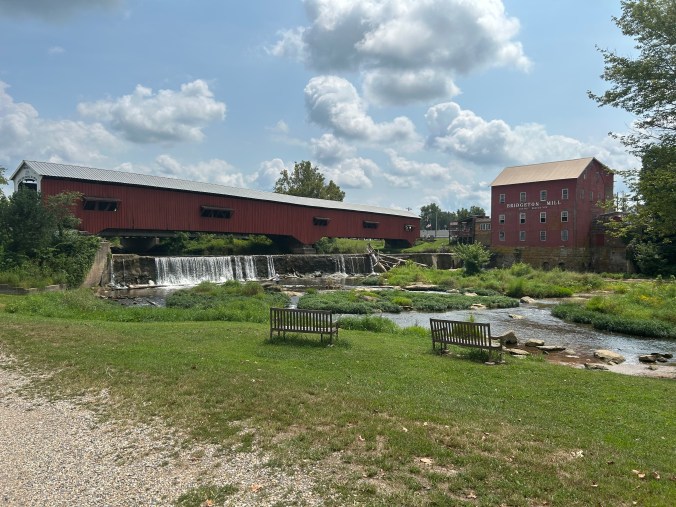
The 245′ Bridgeton Bridge and associated mill, The bridge was burned by arson in 2005, rebuilt in 2006.

These historic bridges are fairly evenly scattered over the 444 square miles of the county. Every October over two million visitors converge on Parke County for the world famed 10 day Covered Bridge Festival. People come to see the bridges and shop any of the thousands of vendors who occupy building’s or temporary tents that sprout up allover the county.
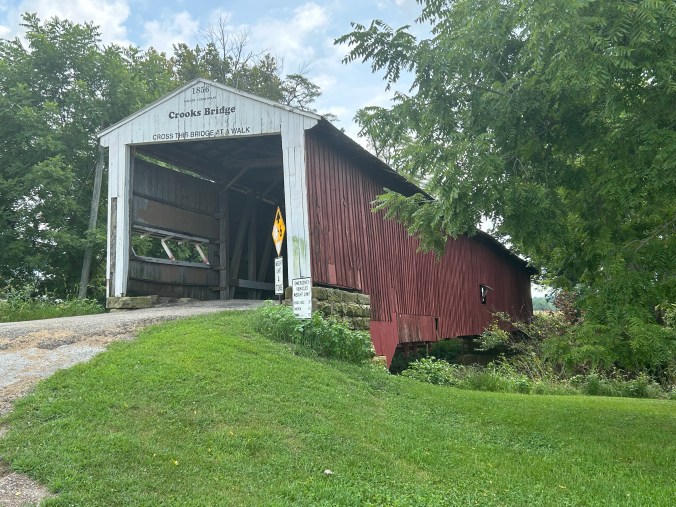
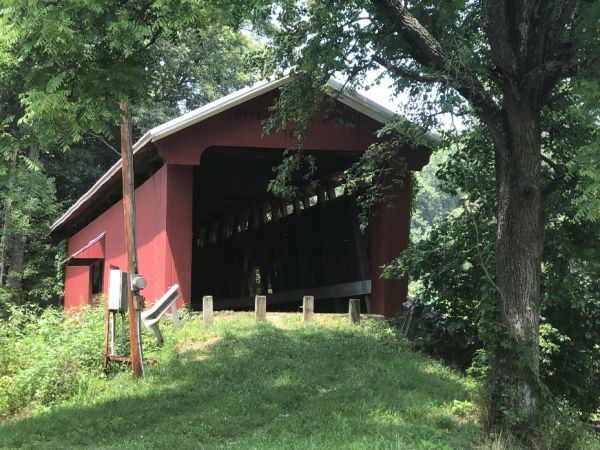
Crooks Bridge, 132′ long, built in 1856 by Henry Wolfe
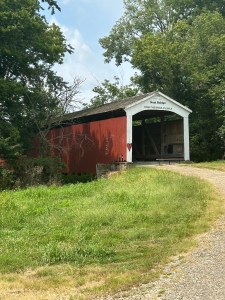
Neet Bridge, 125′ long, was built in 1904 by JJ Daniels
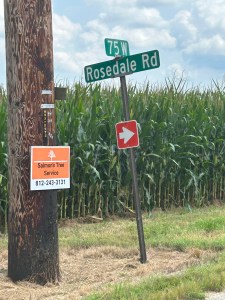
Note the Red Arrow. This shows the easy self driving tour routes.


We took the 34 mile long Red Route starting at the Rail Road Depot in Rockville. This drive brought us up close and personal to eight old covered bridges. Some we could drive across, some were closed to traffic with a new roadway running next to the bridge.
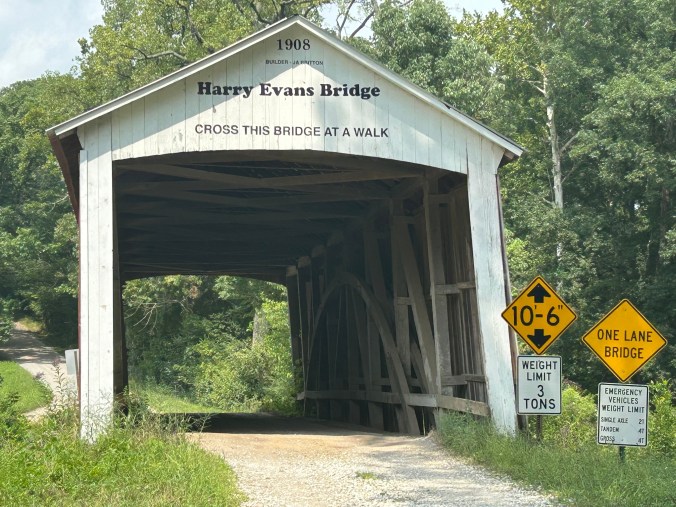
Harry Evans Bridge, 65 ‘ long, built by JA Britton in 1908
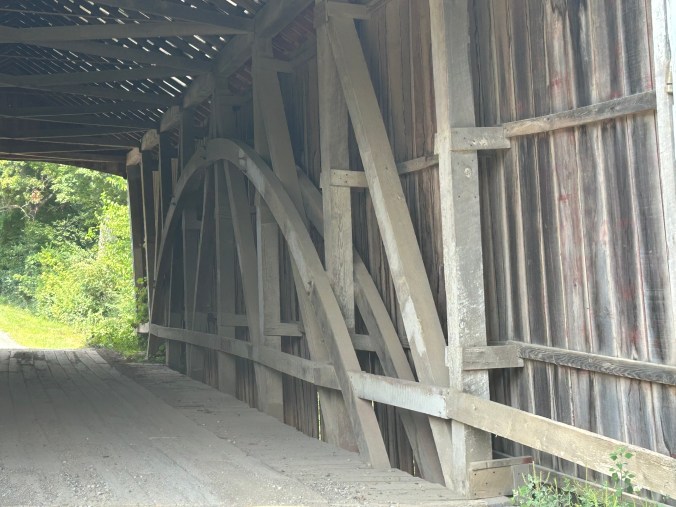
Showing the Burr-Arch support design of the Evans bridge. This design is found in 30 of the Park County bridges including one double Burr-Arch.

Our road trip to Parke County was, in our opinion, most successful. Along with our drive along the Red Route of covered bridges, we also had some other stops that we’ll share in other articles here. Just know this: a road trip to Parke County Indiana offers country roads and viewing historic bridges, enjoyable dining and shopping opportunities. Click here for the Park County Visitor’s Center website.

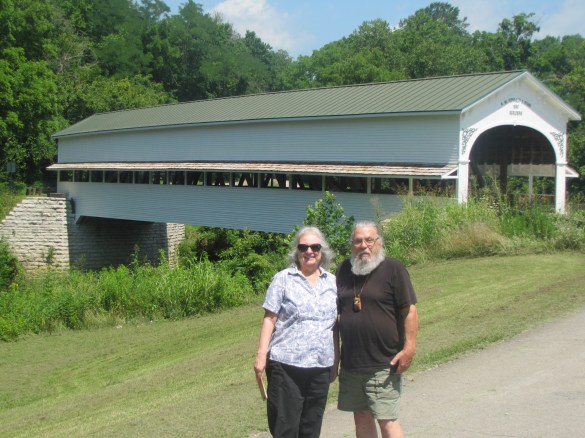
Columbus Indiana’s award winning Mill Race Park

Columbus Indiana’s Mill Race Park is located on a flood plain on the west side of downtown. The award winning design takes that in account, for example, the restrooms are made to allow the annual flooding to flow through the glass block buildings with no damage.

Inside showing bridge trusses

One of my favorite parts of the park is the beautiful relocated covered bridge. Originally built in 1840 over the White River, it was rebuilt in 1995 at Mill Race Park. It remains the only Long Truss Structure in the state.

Well maintained and well lit Kennedy covered bridge

Just east of Westport, Indiana, a small community in Decatur County you will come to a beautifully maintained covered bridge. Painted white with a green roof, some will immediately recognize this as a bridge constructed by the Kennedy family of bridge builders, in this case A.M. Kennedy and Sons Builders.

We’re appreciating another magnificent late 19th century bridge

Constructed in 1880, this bridge is a typical Kennedy work utilizing a single span Burr-Arch truss system. This bridge is 130 feet long as it crosses over Sand Creek on Laughton Road. It was actually bypassed in the early 1970’s when a new bridge and road improvements were made on CR 1100S, just downstream from the bridge. The bridge underwent a total restoration in 2004.

Looking upstream towards the bridge

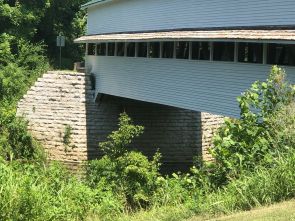
Shows massive abutment the bridge rests on

Typical Kennedy lettering and scroll work

Some have to leave initials. Note the lights…

1945 photo (courtesy bridgehunter.com)

Burr-Arch truss system. Lots of lights everywhere!

As noted in the post title, there are strings of Christmas lights all over the bridge members. Strings of white “twinkle” lights are stretched across the top chords of the structure. Multi-colored lights are placed along the sides of the bridge, and also are draped following the curved Burr-Arches on either side. There is a timer hooked to power on one end, and the lighting seems to be a permanent installation. We talked and said we’d love to come back at night to see this bridge all lit up.


Otter Creek covered bridge

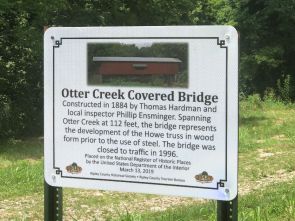
In what some may say is an area “out in the middle of nowhere” in Ripley County, Indiana, travelers will stumble upon a unique and historic covered bridge. Built in 1884 by Thomas A. Hardman, this bridge has a unique history as well.

Closed to road traffic in 1996, it is now open only to foot traffic.

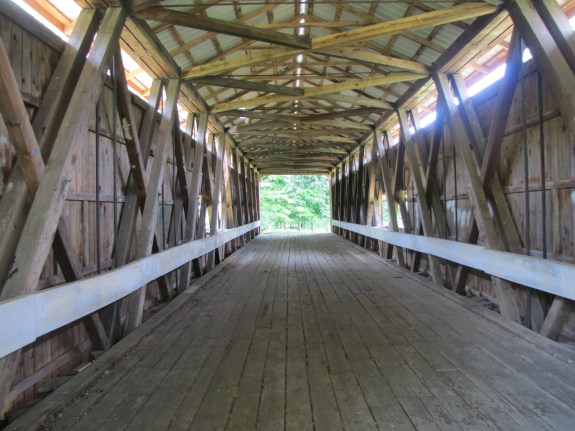
The Otter Creek Bridge, also known locally as the Holton Bridge, is constructed with the Howe truss system. This design was invented by a William Howe, an American architect born in 1803. The Howe truss design, patented in 1840, became one of the most popular structural designs and continued to see use in later metal bridge designs.

View of the 113 foot bridge over Otter Creek

Maj examining the deck timber supports

A good view of the Howe truss system, and the roof supports as well

Nice information signage!

The bridge is in excellent condition

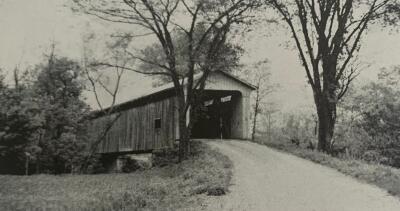
The bridge in 1943 (courtesy bridgehunter.com)

The bridge roof was partially ripped off during a straight line wind storm just months after it was placed on the National Register of Historic Places. Repairs were completed quickly and the structure again opened to pedestrian traffic. This piece of American history is located in a peaceful and beautiful setting and worth the drive to see.


The Forsythe Covered Bridge, aka Forsythe Mill Bridge

We found yet another one of those magnificent 1880’s covered bridges, this one again in Rush County, Indiana. The Forsythe Bridge, also known as the Forsythe Mill Bridge spans Big Flatrock River in the southeast corner of the county. This bridge was built by E. L. Kennedy bridge building company. Emmet Kennedy was one of the sons of Archibald M Kennedy, premier bridge builder from Rush County.

The Forsythe Bridge over Big Flatrock River

A long view of the Burr- Arch truss system

A look outside over the river below


We spotted Maj shooting the video of the river and the bridge

This bridge is 196 feet long, as noted designed with the typical Burr-Arch truss system. This bridge was one of six bridges that all were registered on the US National Registry of Historic Places. All six of the bridges were constructed by the Kennedy family, and were registered at the same time in 1983.


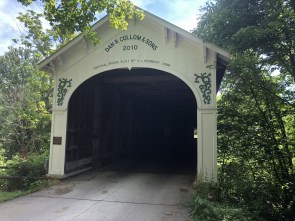
The 1886 Moscow Bridge rebuilt in 2010

In June of 2008 an F3 tornado ripped through the small town of Moscow in Rush County, Indiana. Tragically one life was lost, several homes were destroyed and the 1886 Kennedy covered bridge was ravaged and tossed into the river below. Through the heroic effort of the community, businesses and others, a reconstruction project was begun. Original pieces of the bridge were salvaged. With the balance of new materials, a faithful reproduction of the original E L Kennedy double-span Burr-Arch bridge was rebuilt by the Don Collom and Sons company from Bridgeton, Indiana. It was dedicated in September, 2010.


The Moscow Covered Bridge remains the heart and soul of not only the town, but a valuable part of the history of Rush County as well.

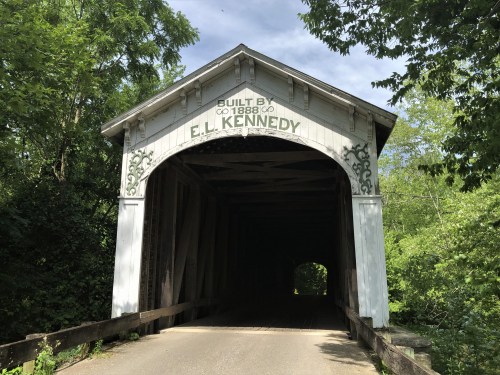
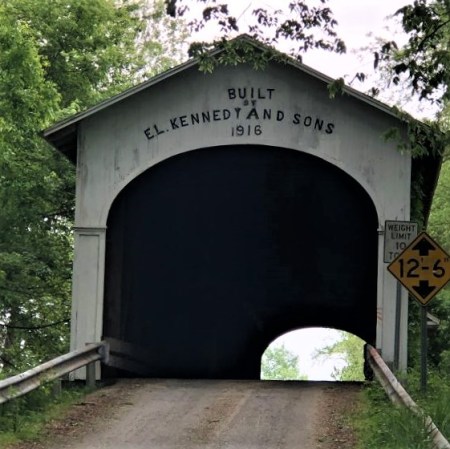
E.L. Kennedy covered bridges

This was the last covered bridge built in Rush County

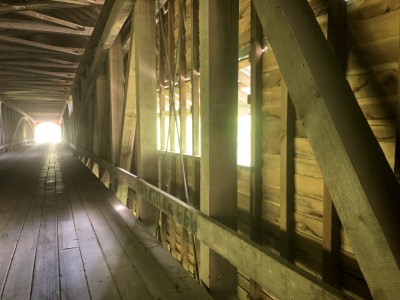
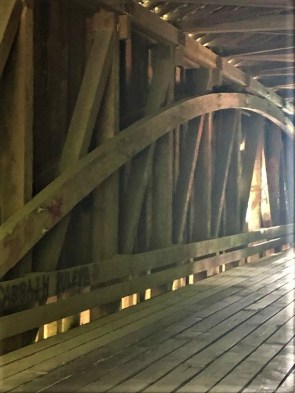
A look at the Burr-Arch truss system

Opening with overhang looks on the river

150 feet long, one lane wide and a 10 ton load limit

E. L. Kennedy and Sons bridge builders are part of the three generations of Kennedy Bridge builders in Indiana. Emmett came out of retirement after the great flood of 1913, which wiped out many covered bridges in central Indiana. He and his two sons Karl and Charles R. built the 150 foot long Norris Ford bridge over the Flat Rock River in Rush County.

There are not near as many of these bridges left as there were even 30 years ago. Those that are left should be saved. They are an important part of our history.