Historic Seagram’s Distillery in Lawrenceburg

Driving along US 50 through Lawrenceburg, Indiana, it is hard to miss the large complex of tall red brick buildings and multiple silver tanks that are part of the former Seagrams Distillery plant that straddles the Lawrenceburg and Greendale city boundaries. The current owner/operator of the facility is now MGP Ingredients, based out of Kansas.

This building has multiple floors of aging racks for 550 pound barrels of whisky

The Cincinnati Magazine published a fascinating and detailed story about the history of the Seagram’s Distillery, its current owners, and the ins and outs of the distillery business around the country. Read that article here. 

This paragraph is from the Cincinnati Magazine article.  “According to (Master Distiller Greg) Metze, it all starts with the water. MGP Ingredients sits on an aquifer, just a short walk from the Ohio River (most of the facility is actually in Greendale). That 56-degree water—low in sulfur and iron, high in calcium, and limestone-filtered—lets MGP make a lot of whiskey, and also have a continuous source for cooling the equipment. That’s why there were so many distilleries in Lawrenceburg in the 1800s. MGP’s began life as the Rossville Union Distillery in 1847; after Prohibition, in 1933, it was purchased by the legendary Canadian company Seagram. Right next door was Squibb, which opened in 1846 (though another distillery, Dunn and Ludlow, was on that patch of land in 1807) and became part of the Delaware company Schenley in 1933.”

More aging racks, and the tower houses multi-story continuous column stills

We were on a day trip to southern Indiana, the Ohio River and Lawrenceburg. The Seagram’s facility is huge, and we decided to drive over to the site, having never done that before.   Unfortunately we discovered that the new owners do not offer public tours of this historic distillery. At one time the Seagram’s plant employed over 2800 at the distillery and bottling plant. It is truly an iconic business with a rich and colorful history.


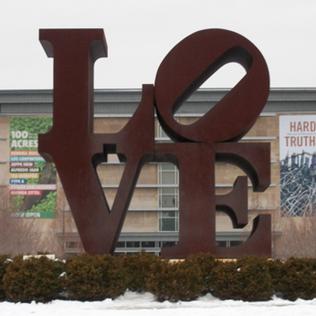
LOVE statue is now 53 years old

LOVE outside at the IMA in the early years

Robert Indiana was born in 1928 as Robert Clark. He changed his name to Indiana in 1958 to show his roots in the Midwest. His first widespread use of the stacked four letters of “LOVE” was a Christmas card in 1964 for the New York Museum of Modern Art. This design creation led to the LOVE sculpture constructed of Cor-ten steel in 1970. LOVE in steel was first put on display at the Indianapolis Museum of Art. It made the rounds of several American cities for five years until it returned to the IMA. After needed restoration was performed due to weathering of the steel, it is now displayed inside the museum building to protect it from the elements.

Permanent display inside the IMA

Remember 8 cent stamps?

The design was also the inspiration of a USPS 8 cent stamp in 1973. Countless copies of the statue were made and sold over the years, however Robert Indiana had failed to copyright his design, thus he did not reap the benefits. He died at the age of 89.


The Indianapolis AES 500 Festival Parade

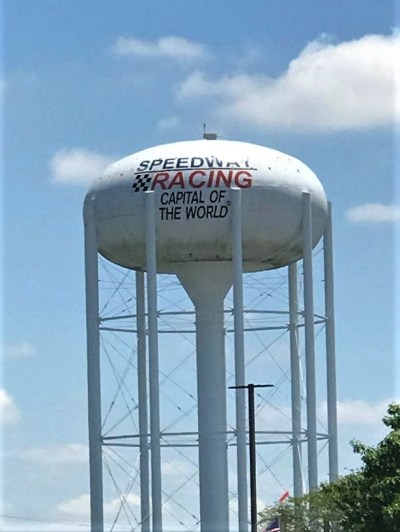
The month of May in the Indianapolis area is one reminder after another that the famed Indy 500 Mile Race is coming. Local companies use checkered flags, references to racing, and any other connection to the race that they can think of. Media covers the events of the month including not only activities at the track, but also beauty pageants, balls, concerts, half marathons and of course the parade. All celebrates the 2023 version of the “Greatest Spectacle in Racing”.

The 500 Festival Parade again is sponsored by Indy’s electric service company, AES. This parade is one of the original festival events and is one of the highlights of the month of May in Indianapolis. The parade courses through downtown Indianapolis with over 200,000 spectators lining the streets. The parade is filled with floats, giant helium balloons, award-winning bands, celebrities and dignitaries,  and all 33 of the drivers in this year’s Indy 500. One of the premier parades in the country, it stands with the Pasadena Tournament of Roses Parade and the Macy’s Thanksgiving Day Parade.

The 2023 AES 500 Festival Parade will take place on Saturday, May 27, in downtown Indianapolis. The Parade will be broadcast locally on WTHR(NBC), and nationally on Peacock.


Wright Brothers first flight in North Carolina

The National Park Service operates the National Memorial to the Wright Brothers located on the Outer Banks of North Carolina, specifically the Kitty Hawk/Kill Devil Hills area.

Hands-on life size sculpture of the plane

Almost everyone has heard of the first manned flight in a powered airplane. Any trip to the area of the Outer Banks should include a visit to this dramatic Memorial. We arrived late in the day, and thus did not have time to visit the Visitors Center. We did, however, enjoy the massive monument and the life sized reproduction of the original Wright flier and associated sculpture field.

Monument on the hill where the first flight occurred

The massive monument is on top of the large sand dune hill where the flights occurred. In the 1920’s the dune was seeded with grass to stabilize the hill in preparation for the construction of the monument.

Wilbur to the right: original photo

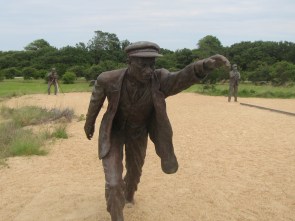
Statue of Wilbur running alongside the plane piloted by Orville


Originally from Ohio, the Wright brothers found that the sand dunes of the outer banks would be a perfect place for them to design the gliders and finally the engine powered airplane. Sand dunes provided a relatively safe place to test fly: sand is soft, protects the pilots and lessens potential damage to the aircraft.

The monument

Personnel from the local US Lifesaving Service offered help and on December 17, 1903 several were at the site of the flight.  At the memorial there is a marvelous sculpture field including a life sized reproduction of the plane as well as bronze sculptures of the men who were there at the time. This is a most impressive view that immediately takes you back to that famous December day in 1903.

Plan on visiting this marvelous piece of U.S. history. Here is the NPS website with details and some great information. Note: our National Parks Service Senior Pass saved us the entrance fees to the site. (Seniors 62 and older can get this pass here: NPS lifetime Senior Pass website)


Mt Baker Theatre both historic and haunted

Ghost light on center stage at Mt.Baker Theatre

The historic Mt. Baker Theatre in Bellingham, Washington is reported to be  haunted, similar to most old theater’s claims. We took a theater tour and saw the ghost light which burns on center stage at all times there is no production going on. Ghost lights are a tradition among theaters and actors. The lights provide a means to placate ghosts who either want to perform or who want to watch.

The best well known spirit at Mt Baker Theatre is Judy, an amorous young lady. It seems Judy lost her house (or boarding house room, as some say) when the theater was built in 1926-1927. She is reported to be interested in young male projectionists, actors, or ushers. One theater staff member told me Judy is a flirt! Others ghosts who haunt the theater include a well dressed fellow named Geoffrey who appears in either a fancy pin-striped suit or a tuxedo. Another theater staffer said there is a ghost feral cat that haunts and hunts the basement.

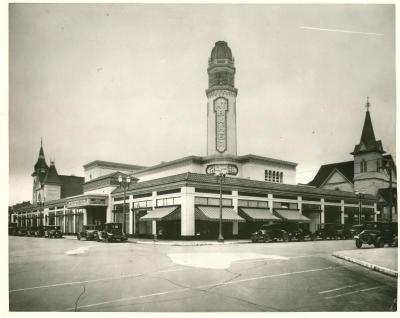
1927 photo shared by the Theatre archives

This really is a magnificent old structure, built in 1926 by the 20th Century Fox group. It was listed on the National Register of Historic Places in 1978. The interior was restored in the 1980’s back to its original ornate beauty. Here is a link to the history of the theater. The theater is still very active, hosting shows on stage, live music concerts and other events supporting the arts in the Pacific Northwest.


Unique White Bronze cemetery monuments

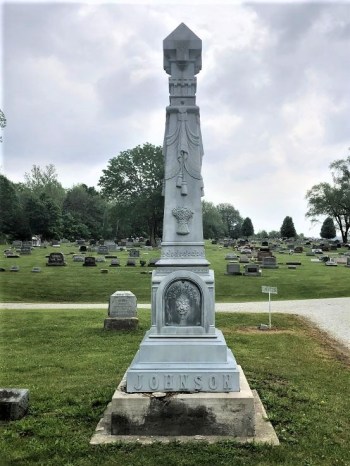
White Bronze metal monument

When you come across a blueish colored grave monument you can’t help but wonder how it has maintained its lettering and clarity of the dates. No, it is not a later replacement, it is the original zinc metal grave marker. Manufactured by the Bridgeport, CT. Bronze Company, these long lasting  but somewhat fragile monuments were custom made from 1876 until 1914.

When you tap on the surface of these monuments you can immediately tell it is metal. The seams where the individual pieces are joined are also obvious.  Each piece was cast in Bridgeport and then shipped to the cemetery for installation. Customers dealt with sales reps armed with multiple catalogues with unlimited possibilities for choice of monuments.
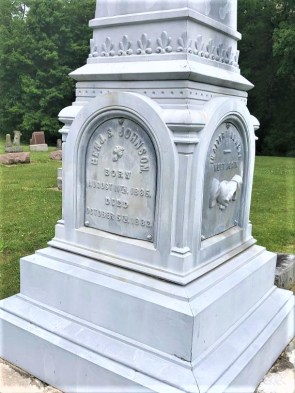
Name/dates of deceased and panel with “Shaking Hands”
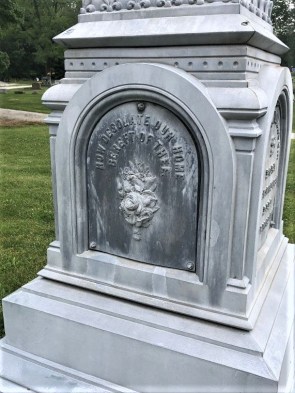
“HOW DESOLATE OUR HOME BEREFT OF THEE”


The zinc-tin alloy used in the castings did not rust and resisted the growth of mold or algae. Each monument was custom ordered, so all are one of a kind. The designs included panels that were screwed in and could even be changed at a later date, if desired.  These were perfect for symbols like the shaking hands, sheaves of wheat or personal messages in addition to the name and dates of the deceased.
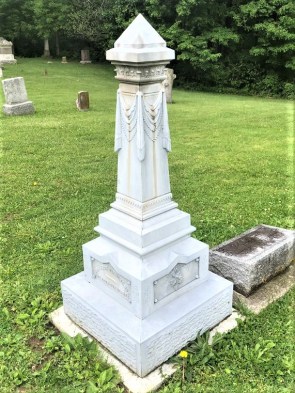
A smaller monument
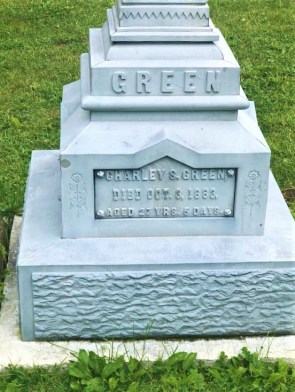
Name/date still legible after nearly 140 years


The material of these was advertised as White Bronze. White Bronze doesn’t exist. These are made with a zinc-tin alloy. The company, however, felt that White Bronze is a much classier and sophisticated name than zinc. They also claimed (of course!) that their monuments would outlast any stone monument. In a way that was true, however these zinc beauties were susceptible to breakage from, for example, falling trees. In addition, very tall monuments could suffer over time from settlement of part of the bases.
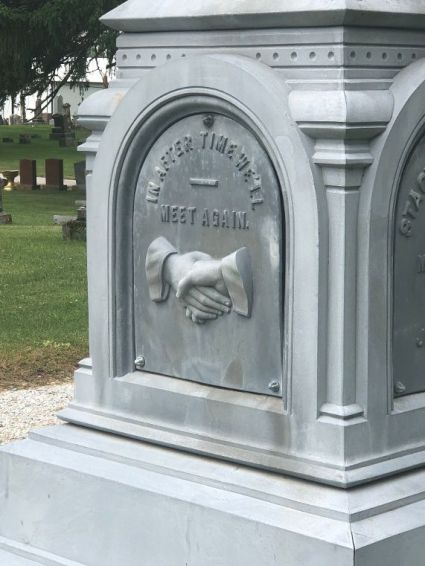
This panel would have been custom ordered for the monument

The next time you are enjoying a relaxing walk through a cemetery or graveyard keep an eye out for different looking monuments. Go have a look, it just might be a one of a kind White Bronze monument that was cast in Bridgeport, Connecticut between 1876 and 1914. The photos in this post were taken in the Arlington East Cemetery  in Rush County, Indiana.
 

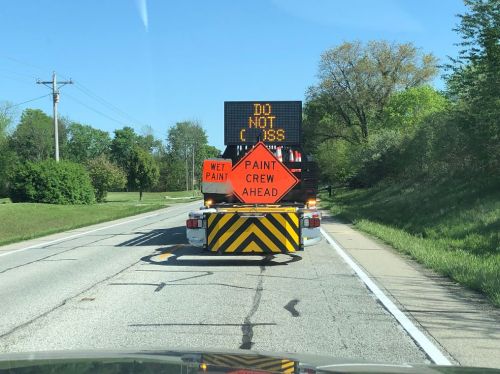
Caught behind a slow moving vehicle

Sometimes you run into an interesting traffic situation. Such was our morning drive today when we came upon a moving sign truck courtesy INDOT. The declared line painting truck was at least 500 yards or so ahead of the parade we found ourselves in.

Within a few minutes we were leading a long line of cars, trucks and semi’s crawling along at a blistering 10 MPH behind the bright yellow digital sign board mounted on the truck. The signs let us know to NOT pass or drive over a freshly painted line. We peeled off right as soon as we hit a cross road to avoid continuing the snail’s pace of the sign truck. We still enjoyed our country drive.

Seattle’s Space Needle

From the official website of the 605 feet tall Seattle Space Needle comes a to the point introduction to this world famous attraction: The Space Needle is one of the most recognizable landmarks in the world and is a treasured Seattle icon. Built for the 1962 World’s Fair … whose theme was “The Age of Space”. 

See views of downtown Seattle, Mount Rainier, Puget Sound, and the Cascades and Olympic mountain ranges from the tower

On our first trip to Seattle we went up in the Space Needle. At that time there was a restaurant that rotated a full 360 degrees in an hour. In 2017 a large reconstruction project revamped the entire top of the tower. Now the restaurant is gone, but a lounge, cafe and a wine bar with glass floors lets you look straight down to the ground over 500 feet below you! The rotation still gives you a chance to sit and view the total 360 view of Seattle.

Spoils of war

My maternal grandfather, Rex R. Forsyth, volunteered to serve in the United States Army Ambulance Corp in 1917. His unit was attached to the French Army. His unit operated Ford Model T ambulances. His time overseas included being part of the army of occupation after the was ended. His unit was billeted in Kaiser Wilhelm’s castle in the Black Forest. Rex brought back many photographs, personal items and quite a few things taken from Bosch (German) POW’s.

Pickelhaube, Bosch “Spiked Helmet”

Another Pickelhaube

Bosch officer’s epaulettes

Belt buckle says “God With Us” (Gott Mit Uns)


Granddaddy Rex did share stories of his time overseas with me as I was growing up. He never spoke of the horrors of war that I know he witnessed, but he did share day to day activities. He told me that when Bosch (German) POW’s were brought to holding areas they were stripped of helmets, medals, belts and even uniform epaulettes. He did share that one time a Bosch soldier tossed a grenade while he was standing in line. Fortunately it was a dud, and a Poilu (French soldier) “dispatched him right away”.

The Obverse side of a Bosch Iron Cross medal. The “W” stands for Wilhelm.

The Reverse side of the Iron Cross medal


We have many examples of these spoils of war. Note that the belt buckle states “Gott Mit Uns” which translates “God With Us”. Seems like it is common in warfare that both sides claim the high ground and Divine support. The term “Bosch” is one that was used to refer to German soldiers and personnel during WWI, aka The Great War. While some consider the term to be derogatory, it is how my grandfather always referred to the Germans. It seems strange to realize that WWI ended over 100 years ago.