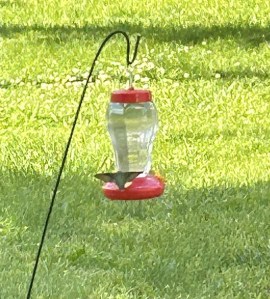
This is one of five hummingbird feeders that we have installed in our backyard. We put these out the first week of April. No hummingbirds showed up until the first week of May and we were glad because we were thinking we might not see any this year. On a podcast we saw a report suggested these feeders for $1.50 at Dollar Tree.
Glad to report that as we enjoy sitting in our yard swing hummingbirds come to all five of our feeders. This is backyard birding at its best.
We had been out picking up some items we had bought at an online auction last Saturday. Sher had already checked for “Things to do in Connersville” and an interesting bird watching place popped up. So after we picked up the items from the auction we had a 25 minute drive through farmland. The auction was north of town, and the birding place was south. It seemed like our destination was truly out in the middle of nowhere.
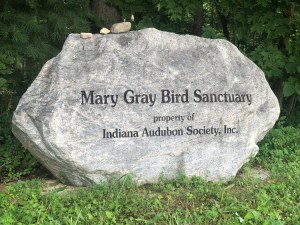
Easy to spot entrance
The Mary Gray Bird Sanctuary is located south of Connersville in Fayette County, Indiana. Alice Green Gray gave the initial 264 acre property to the Indiana Audubon Society in 1943 as a living memorial to her daughter Mary, who preceded her in death. Another Gray relative and Society members have made possible the acquisition of more property so that the Sanctuary now has 723 acres.
The road into the sanctuary grounds is a fairly long drive which immediately puts you in the middle of a semi dense woods. It truly allows you to prepare for atonement with Nature.
It was extremely hot that day. In fact an official weather service Heat Advisory was in effect. It became apparent as soon as we got out of the car that it was going to be a very unpleasant day to successfully do any birdwatching. In addition to the heat, a plethora of insects was present and quite annoying buzzing around.
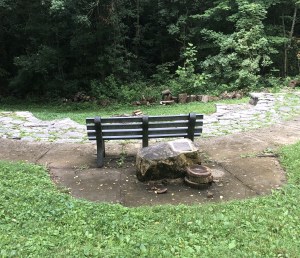
Bench seating at the amphitheater
We will definitely return when the conditions are much more conducive to for a comfortable and safe bird watching adventure. There are many features within this sanctuary. There is a bird watching blind where you can observe the many stocked feeders and not be seen. Ponds and native trees provide a perfect chance to immerse yourself in communing with Earth. Click here for the MGBS website.
Here are a couple of videos we took and some facts about these eye catching forest birds. Pileated Woodpeckers are crow-sized birds (16 – 19 inches long) with a flame-red crest on top of their head. Their wingspan can be up to 30 inches.
The Pileated Woodpecker’s primary food is carpenter ants, along with other ants, woodboring beetle larvae, termites, and other insects such as flies, spruce budworm, caterpillars, cockroaches, and grasshoppers.
Pileated Woodpeckers stay with the same mate for life. Pairs claim forest territories up to 150 acres or larger. They loudly drum on trees with their beaks all year long to announce the boundaries of their territories.
The brightly colored Baltimore Oriole received its name from the resemblance of the male’s colors to those on the coat-of-arms of 17th-century Lord Baltimore.
We saw this Baltimore Orioles in our backyard enjoying nectar
The Baltimore Orioles’ diet is mainly insects, berries, nectar as well as sugar water. In summer it feeds mostly on insects, especially caterpillars. It also eats beetles, grasshoppers, wasps, bugs plus spiders and snails. Orioles also eat berries and sometimes cultivated fruit.
Lots of activity at the river yesterday! Soon after we saw the snake swimming along this duck decided to cross the shallow backwater to a stick covered sand bar. She found a suitable path across the bar to the river, making sure to shake her tail in the process!
We’ve been watching a pair of robins constructing and setting on a nest in the crook of the old maple tree outside our back door. We had yet not seen any blue egg shells on the ground. Discarded shells often indicate that the clutch has hatched.
At least two hungry mouths visible demanding food
Today while taking a break on the swing after some weeding I saw one of the robins returning to the “empty” looking nest. Immediately little wide open beaks appeared wanting to be filled with some tasty morsels. No more wondering: we have a clutch of baby robins. We’ll try to get some more photos soon.