St. Peter’s UCC is a beautiful country church

St. Peter’s United Church of Christ is a lovely church in Ripley County, Indiana. While it has an Osgood address, it is actually closer to Napoleon.

Front of the church

The steeple
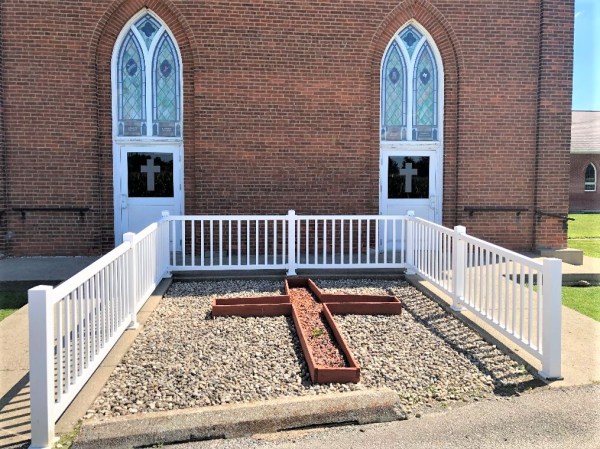
Unique double entrance doors

There is a decent sized graveyard behind the church building. Of note is the interesting iron graveyard gate signage over the entrance drive to the graveyard. Also seen is an additional smaller gate entrance piece that has been mounted over a sidewalk entrance to the back of the fellowship hall of the church. It could be guessed that both of these structures have been relocated for original placements.

View of the graveyard

Fancy iron entrance signage
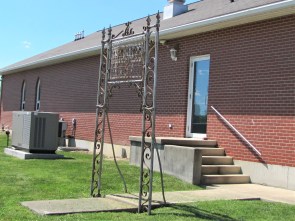
Smaller iron gate arbor


This church is located on the south east corner of the intersection of W County Rd 700 N and N Fink Road in Ripley County, Indiana.

 

Mud Pike Baptist Church and Cemetery

We were off on another daytrip in south east Indiana. We did have a couple of specific destinations, but as usual we did enjoy just coming upon interesting sights. One of these surprises was the Mud Pike Baptist Church and Cemetery which we came upon on, you guessed it, East Mud Pike Road. The church is roughly equidistant from Napoleon and Osgood, Indiana, both on US Highway 421, aka Michigan Road.

Pretty white church edifice

Remounted bell and one side of the cemetery

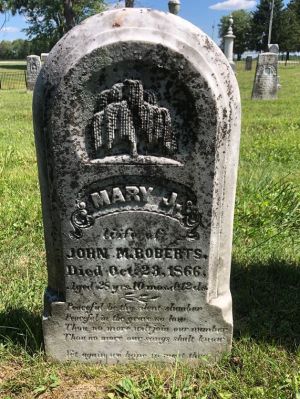
Notice the “Weeping Willow” tree in Mary’s tombstone

The grave of thirty two year old Sarah, passed in 1878

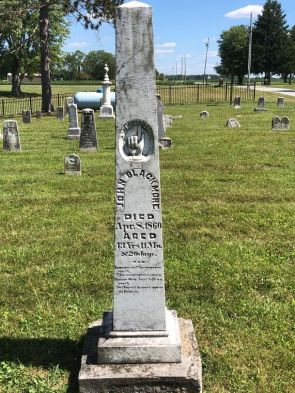
Grave of John Blackmore, Charter Member and church land donor

The bell remounted

Originally Delaware Baptist started in 1842 with 12 members, and Charter Member John Blackmore donated the ground for the church in 1844. In 1911 the bell was mounted in the belfry of the structure. A  fire devastated the church in 1996, resulting in the bell crashing to the floor. It now is mounted in a place of honor next to the flagpole and bench. The church was renamed Mud Pike Baptist Church in 1938, and it celebrated its 175th anniversary in 2017.

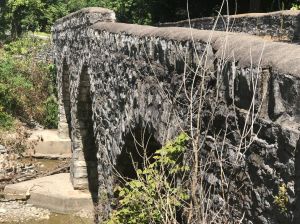
Finks Road stone arch bridge

Ripley County, Indiana is allegedly home to 11 stone arch bridges. The Fink Road bridge spans a branch of Laughery Creek, one of the main waterways in the county. This is a smaller single arch bridge that is not really obvious from the road.

Hard to see the stone arch through the vegetation

All you see are guardrails

Courtesy bridgehunter.com by Anthony Dillon

Stonework in B&W

This bridge was probably built around 1900 and refurbished in 1993. This turn of the century time frame saw many stone arch bridges constructed. The Fink Road Bridge, while only 60 feet long, has an unusual full 19 feet wide two lane spacing. It shows the high degree of craftsmanship typical of the times.


A lovely four-span stone arch bridge

Ripley County Indiana is a scenic land of rolling hills, wooded tracts interspersed with farming enterprises. Amongst the unique sites include a wonderful stone arch bridge just outside the tiny village of Friendship. This bridge was constructed in 1909 on the Olean Road where the road crosses Raccoon Creek.

From a distance

The approach to the bridge

Nearly perfect stonework


Side view of the stone work arches


The stonework on the four arches is really a stone mason’s dream. This bridge has spans over 20 feet. The deck is nearly 15 feet wide over the 103 foot length. Stone arch bridges were a very common design for many rural stream and river and there are eleven still standing in Ripley County alone, according to records.

Raccoon Creek is typical of southern Indiana hill country drainage streams. Usually running, it can go dry in droughts. The bubbling sound of the passing of the water adds to the serenity of this environment.


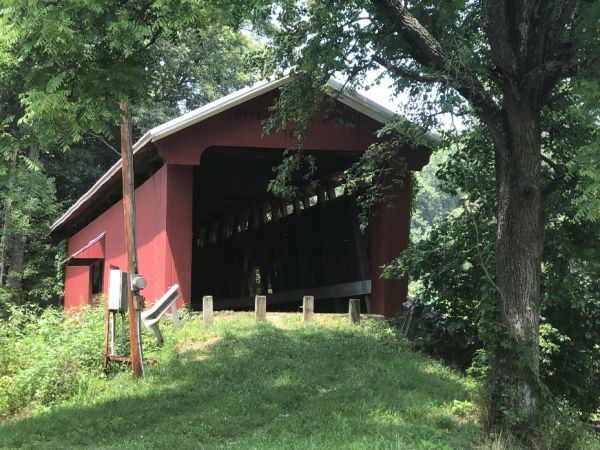
Otter Creek covered bridge

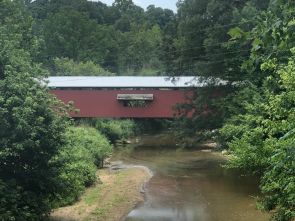
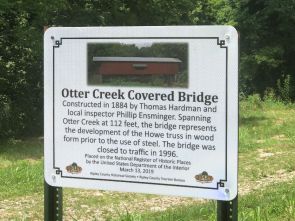
In what some may say is an area “out in the middle of nowhere” in Ripley County, Indiana, travelers will stumble upon a unique and historic covered bridge. Built in 1884 by Thomas A. Hardman, this bridge has a unique history as well.

Closed to road traffic in 1996, it is now open only to foot traffic.

The Otter Creek Bridge, also known locally as the Holton Bridge, is constructed with the Howe truss system. This design was invented by a William Howe, an American architect born in 1803. The Howe truss design, patented in 1840, became one of the most popular structural designs and continued to see use in later metal bridge designs.

View of the 113 foot bridge over Otter Creek

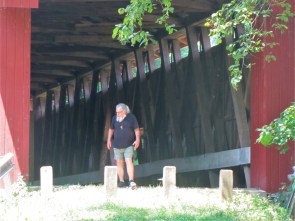
Maj examining the deck timber supports

A good view of the Howe truss system, and the roof supports as well

Nice information signage!

The bridge is in excellent condition

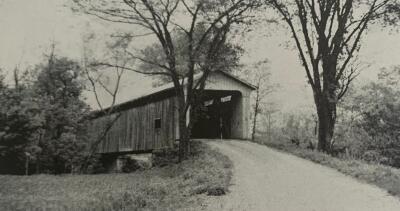
The bridge in 1943 (courtesy bridgehunter.com)

The bridge roof was partially ripped off during a straight line wind storm just months after it was placed on the National Register of Historic Places. Repairs were completed quickly and the structure again opened to pedestrian traffic. This piece of American history is located in a peaceful and beautiful setting and worth the drive to see.