Snoqualmie Falls Washington

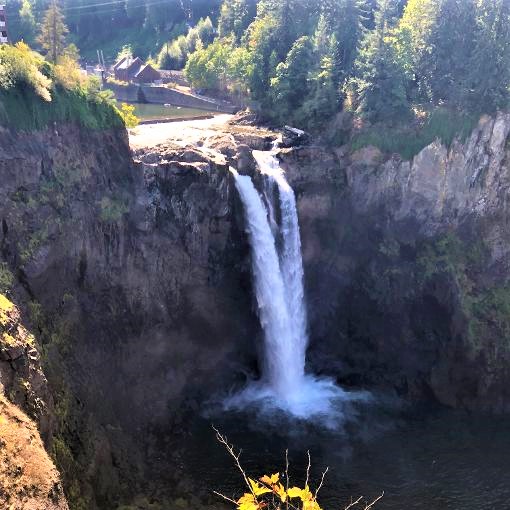
One of the most popular attractions in the Seattle area is the Snoqualmie Falls, a 269 foot single drop waterfall. The falls are near the town of Snoqualmie, which also offers interesting attractions to tourists and locals alike.

View from the observation deck

The area became an active logging site in the 1870’s with logs actually floated over the falls. In 1889 a railroad was built, opening the logging trade further. The town of Snoqualmie was platted in 1889 as well, and by the 1890’s Charles Baker had constructed an underground hydroelectric plant at the falls. Some of the original generators still function today.


It is very easy to gain access to the falls. Free parking is available, and an easy walk on the pedestrian bridge leads to the concrete paths to observation decks. If you prefer, for $7.00 you can park next to the gift shop next to the observation decks.

Salish Lodge, note the wedding tent

Beautiful scenery from the observation deck


The Salish Lodge and Spa offers high end accommodations, spa, and dining. Many use the striking views as a place for weddings. It overlooks the river, the generating plant and the top of the falls.

The walk to the observation decks is easy with only a couple of places with widely spaced steps. There were quite a few people enjoying the sights, but we felt comfortable and not crowded. The layout was very nice, and all of the paved paths and safety fencing was kept in excellent condition. It is easy to see why Snoqualmie Falls is one of Washington state’s most popular scenic attractions.

Colonial is good Bread says the door

Old advertisements have always been popular, it seems. Keep your eyes open and you never know when you’ll spot a piece of pure Americana.

The back of the oval sign says “Thank You”

We found a nice example of a vintage (pre 1958) functional advertisement in the form of a working wooden/screen door on the Whistle Stop Cafe in Osgood, Indiana.  The well worn metal cross piece proudly announces that “Colonial is good Bread”. Colonial Bread began in 1928 in Oklahoma City. The name was changed to Rainbo Bread in 1958 when the recipe was changed.

Complete Colonial Bread screen doors are bringing quite a lot on the online sites like eBay, Pinterest and Etsy. Just the signs without doors also command high prices. By the way, the meals are delicious and affordable at the Whistle Stop Cafe.


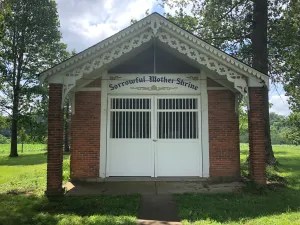
Oldenburg Indiana 1871 Sorrowful Mother Shrine

Oldenburg Indiana is known for its rich religious history. Founded in 1837 by German settlers, it is known as the “Village of Spires” due to the multiple church steeples that make up the town’s skyline.

Located about a mile outside the town limits visitors will find the beautiful Sorrowful Mother Shrine, erected in 1871 by Siegfried Koehler, who had arrived in Oldenburg from Alsace, France in the late 1830’s.

The Altar

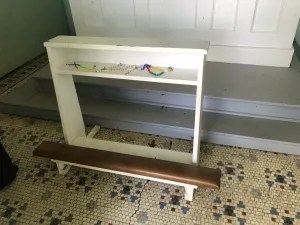
Prayer bench


The statue on the altar is actually a plaster cast of the original that Koehler brought with him on the ship from France. The original was found to be hand carved from black walnut, and now is in the Holy Family Catholic Church in Oldenburg to protect it from vandalism.

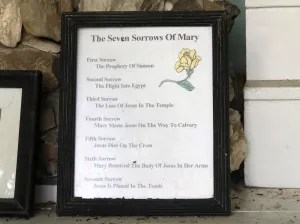
The Seven Sorrows of Mary

Seven Sorrows pictured


The shrine is found on a country road, and is in a beautiful setting. Trees, lawns and a stone bench ad to the ambience. While it can be locked, the shrine was open the day we visited. This is a Holy and Sacred place, and you can feel peace and serenity at the location of the shrine.

Old concrete fence posts dot rural Midwest country roads

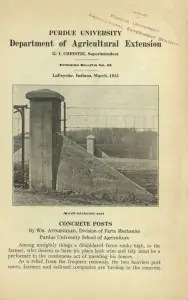
A 1915 Purdue University guide to concrete fence posts

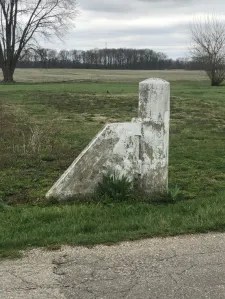
Take a drive on most any rural Indiana road or some other Midwest states and it won’t be long until you spot some rather massive concrete pillars apparently serving no purpose. These are in fact old and now abandoned concrete fence posts. Decades and decades ago almost all farmsteads raised livestock, including work horses, thus strong “cattle and horse tight” fencing was an absolute necessity.

Constructing livestock fencing that is functional and remains functional year after year is a skill that farmers and ranchers had. One of the important parts of a good fence is the end post and/or corner posts. These posts anchor the wire fence that stretches along the length of the particular fence line. If the end and corner posts do not hold, the fence wire will sag and livestock will get out, causing quite the kerfuffle.

Remnants of fence wire is still wrapped around this post

White wing to the left of the post keeps the post from leaning from the tension of the fencing wires.


Former large entrance to a fancy farmstead

Old concrete fence posts can be seen alongside many roads in the country. Sometimes you can tell from the locations of these relics coupled with the position of mature trees where once stood an old house and barn yard. Some will be painted, others will be nearly covered with weed and bush growth. They do stand as a reminder of the days when all farm families raised livestock as a part of their livelihood.

Link to a 1915 Purdue University guide to concrete fence posts


Ancient tree stump at Smokey Point I-5 Rest Stop

Usually interstate rest areas are straight forward: a truck and RV parking lot and a separate car parking lot. In between are the restrooms, vending machines and a scattering of picnic tables and a “pick up after your dog” park.

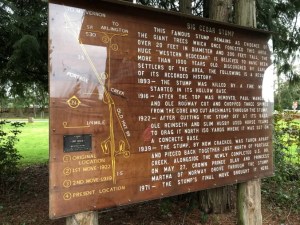
The Story

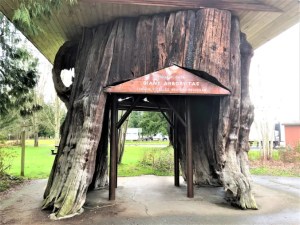
However, the Northbound I-5 Smokey Point Rest Stop at mile marker 207 north of Seattle has the above mentioned features (including an RV dump station) and a huge tree stump. Yes, it is a piece of local history. The story of this artifact is fairly well documented on the story board. The striking size of the stump is obvious in the photo.

The Stump

When I first saw this I thought that it was some kind of new picnic table shelter. Then I saw the story board. Strange but true are the things you find when traveling!

Travel US 40 the historic National Road

Why they celebrated the new concrete paving!

One journey that is enjoyable is following portions of the Old National Road, aka US 40. It was built between 1811 and 1834 and was the first federally funded road in U.S. history. The whole route runs an approximately 820-mile-long path through Illinois, Indiana, Maryland, Ohio, Pennsylvania, and West Virginia.

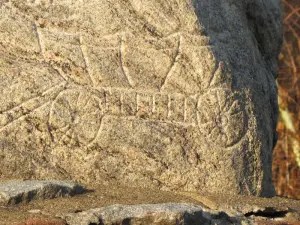
Anyway, near Brownsville, Ohio, east of Columbus, you’ll find the Eagle’s Nest Monument. It was erected around 1916 after a 29 mile stretch of the then unimproved and often nearly impassable road was replaced with concrete. The stretch of highway ran from Zanesville to Hebron. The large granite rock has some great markings, including a primitive Conestoga wagon.

The Eagles Nest monument

Conestoga wagon etched into the granite


You are 220 miles from the start of the National Road in Cumberland, MD.

Get off the interstate and travel the Old National Road anywhere along the route in any state. The signage is excellent and easy to follow, and you won’t be bored!

A 1909 four-span stone arch bridge

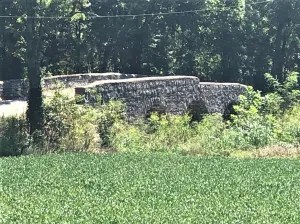
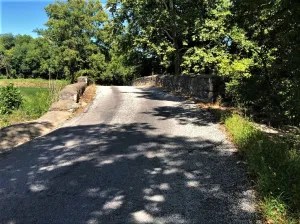
Ripley County in southern Indiana is a scenic land of rolling hills, wooded tracts interspersed with farming enterprises. Amongst the unique sites include a wonderful stone arch bridge just outside the tiny village of Friendship. This bridge was constructed in 1909 on the Olean Road where the road crosses Raccoon Creek.

From a distance

The approach to the bridge

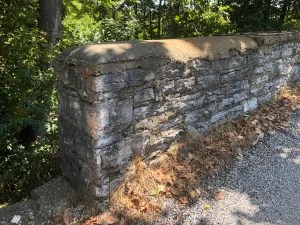
Nearly perfect stonework

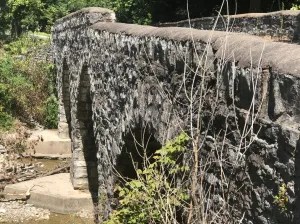
Side view of the stone work arches

The stonework on the four arches is really a stone mason’s dream. This bridge has spans over 20 feet. The deck is nearly 15 feet wide over the 103 foot length. Stone arch bridges were a very common design for many rural stream and river crossings. There are eleven still standing in Ripley County alone, according to records.

Raccoon Creek is typical of southern Indiana hill country drainage streams. Usually running, it can go dry in droughts. The bubbling sound of the passing of the water adds to the serenity of this environment.

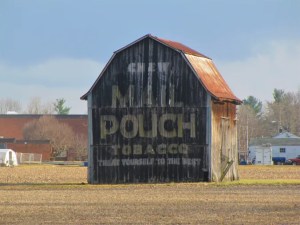
Treat yourself to the best

This barn’s Mail Pouch paint job is fading fast.

A Mail Pouch Barn is a barn with one or more sides painted with the slogan:

CHEW

MAIL POUCH

TOBACCO

TREAT YOURSELF TO THE BEST

Starting in 1890 the Bloch Brothers Tobacco Company of Wheeling West Virginia began offering farmers a bit of cash and a years supply of their Mail Pouch chewing tobacco in exchange for painting at least one side of their barn with their slogan. Even without the cash or product, a free coat of paint helps keep your barn siding protected, and this deal would look inviting.

The advertising campaign continued until the mid 1990’s. Over 20,000 barns in 22 Midwest and Southeastern states were painted during that 100+ year run. If you have any of these in your area or when you spot one while traveling, take a look. They won’t be around forever, and are an interesting slice of American rural history.


Erick Oklahoma Route 66 attractions inspired Pixar’s Tow Mater

When traveling east on Interstate 40 into Oklahoma from Texas you should take Exit 7 and head south into the town of Erick and Old Route 66. This former boom town was founded in 1901 but fell into trouble after WW II. The main street is filled with several nice old brick buildings that unfortunately are mostly empty.

Sand Hill Curiosity Shop covered in antique relics

Of special interest in Erick is the relic adorned “City Meat Market” building. This brick is covered in old signs the likes of which would make any antique picker green with envy. This is the current home to the Sand Hill Curiosity Shop. We did not hit Erick on a day that the shop was open, which was too bad.

Remember S&H Green Stamps?

A local shared that the shop is owned and operated by a pair of characters named Annabelle and Harley, AKA the Mediocre Musicians. They will play and sing for you if you catch them there.  He also said that the Sand Hill Curiosity Shop served as the primary inspiration for Disney’s Pixar “Cars”, specifically responsible for the character Tow Mater and the Radiator Springs Curios shop.

Central Indiana polygonal barn built in 1910

In 1910 a Mr. George Rudicel constructed a rather unusual barn. It has twelve sides, thus the name polygonal. The cone shaped roof is capped with a polygonal cupola and it topped by a square smaller cupola. There is also a large dormer facing the road. This barn was listed on the National Register of Historic Places in 1993. It can be found  in Noble Township, Shelby County, Indiana.

Nice profile of the barn

Note the face of the dormer matches the polygonal angled panels

Christmas star on cupola

Round barns were designed for dairy farming, and were not useful for general farming use. By the late 1920’s round barns had fallen out of favor. There was a nationwide agricultural depression after WWI, and easy  to construct prefabricated barn packages were now available. There were 226 round barns in Indiana but 100 of these have vanished from the Hoosier countryside. Many round barns have been restored and are well maintained. The Rudicel barn, also known  locally as the Montgomery round barn, is in need of some maintenance and a good coat of paint.