Nature
Maple tree whirligigs

Maple seeds beginning to develop
It won’t be long until there will be hundreds (if not thousands) of those twirling, spinning maple tree seeds flying to Earth. The technical term for this winged seed is samara, but you probably refer to them as helicopters or whirligigs.
Cold day and puffed up Cardinals
Feels like -7, this pair of backyard Cardinals was enjoying the sunlight.


Turning Texas trees into Texas art
There are some impressive trees along the banks of Cypress Creek in Wimberley Texas that we saw during our trip there a few days ago. Some very talented people have turned some tree trunks into quite remarkable carvings in a popular picnic area just behind one of the buildings housing restaurants and shops.

Quite the signature…

Now that’s a stare!

Pointing skyward..

For UT Longhorn football fans

By the creek bank
It is impressive to see that a chainsaw was utilized to create such detailed works of art like these.
Lake Travis is only 35% full

This photo was taken today from a road to a Hudson Bend marina. the water level is very low…
Lake Travis is a huge lake in the Hill Country northwest of Austin, Texas. It normally has 29.5 square miles of water. That is when normal precipitation falls on the Colorado River basin areas. The whole world has seen lots of area under drought conditions. The Colorado basin and Central Texas is no exception.

That boater has to watch for shallow water not normally there!
As of today, 10/20/2023 Lake Travis Mean Water Level was 627.30 above sea level. One year ago today it was 640.76. Thus in one year the Mean Water Level has dropped 13.46 feet. Another parameter measured daily is the total surface area in acres of the lake. Today the Lake Travis surface area was 8,799 acres. Last year, same date, it was 10,746 acres. Nearly 2000 acres less one year later. Seeing the low level of the water today was quite a shock.
Wimberley, Texas beautiful bald cypress trees on Cypress Creek
Wimberley, Texas is in the Hill Country outside of Austin in the central part of the state. It is a small town that is hugely popular for its many shops and restaurants and the natural beauty of the area. There are some famous swimming holes close by too!

The Preserve entrance
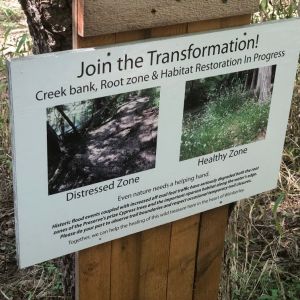
A worthy project
Cypress Creek runs right through the town, and the banks and surrounds have become popular recreational locations for locals and visitors alike. Sher and I went with our son and his family to see the town, the creek side trail and the huge bald cypress trees.
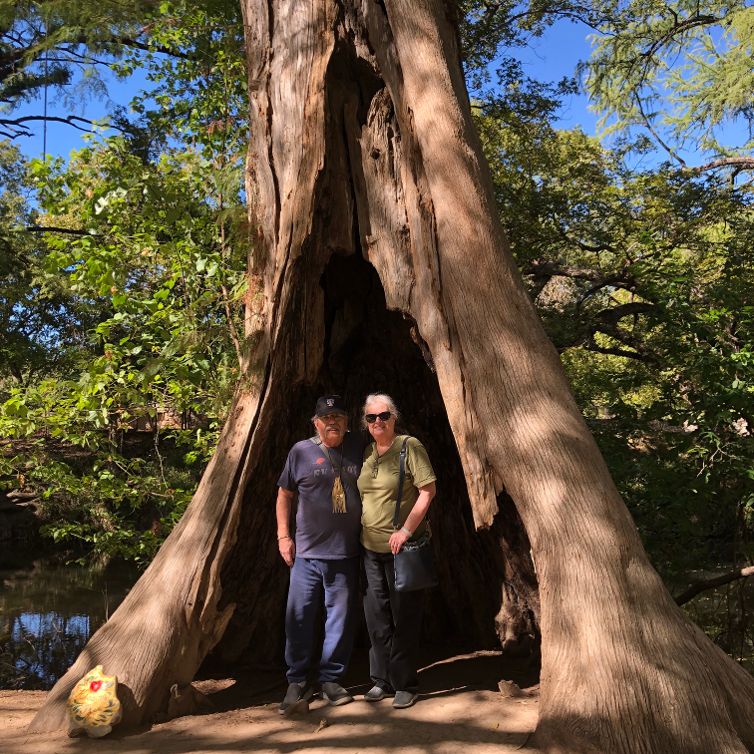
I was told this a favorite place for weddings
The cypress trees along the banks live for hundreds of years and are massive in size. One nearby tree has been dated to be from at least as far back as the year 1426. You can stand inside one tree whose base was blown out decades ago by a lightning strike We had to get our picture in that one!

Note the creek in the background

Close up detail of photo to the left
The roots of these trees run shallow and nearly parallel the ground surface both above and below. These exposed roots are fascinating to observe.

Typical shape of the cypress at the waterline

Shadows and reflections on the water

The size of these trees is impressive!
One shop owner explained to me that yes, these are the same bald cypress trees you see in Florida in the swamps. He pointed out that in Texas they don’t do as well or are as prolific because there is not enough water in the Texas Hill Country to support massive groves of the trees. They are still fascinating to see. Wimberley is fortunate to have such a lovely attraction as the Cypress Creek Nature Trail & Preserve .
No glasses but still saw the eclipse
Nope, did not have the glasses. Every store was out. However, we did see several pin hole camera type effects. One was a light ray through the curtain onto a rug.

Ok, maybe a stretch, but still look at the center and you can make out that crescent: that’s the sun partially blocked. We were at Austin, so not full eclipse. That was down at San Antonio.

Here’s another one, this was on the front sidewalk with a bunch of “pin hole camera” effects through the leaves.

See the greenish image that looks like a pin-hole type of view.
Finally, this one with the iPhone. I was holding the phone in front of my face kind of blindly snapping a couple just to see what I’d get. The above mini-green thing showed up.
Oh well, that’s what we saw at the so-called “Peak” of the eclipse at Austin, Texas.
What’s in the mop bucket?
Heard a commotion in the mop bucket. Was it a squirrel? Nope…
Honey farm in Martinsville
Martinsville, Indiana is a quaint little town south of Indianapolis in the beginnings of southern Indiana’s hill country. West of town is a family owned, fourth generation of beekeeper’s honey farm producing a multitude of products from bees.

Store signage

Honey for sale!
Hunter’s Honey Farm has 65 beautiful acres providing homes for bees, timber and Christmas trees. The family has been producing honey and honey related products in Indiana for over 100 years.

More honey products

Round table is full of samples!
The store on site is filled with anything and everything honey! Available for sale is honey, honey comb, honey mustard, honey candy, honey products, raw honey, honey sticks, and a variety of honey based soaps and lotions.

Live bees at work in an award winning display

Of course we bought some honey!
The farm also offers tours of the grounds, including trips out to the timber and Christmas Tree areas as well as bee hives and beekeeping demonstrations. Go to Hunter’s Honey Farm website for details concerning farm tours and upcoming special events. This is a great day trip destination.
Mayfly near the end of life
There are over 600 species of mayflies in the United States, and over 3000 species worldwide. They spend most of their life in the water, and come out as for a very short two or three days in order to mate.

An interesting view of this remarkable insect

Same bug, good look at the eyes
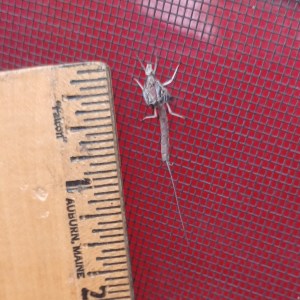
After molting, even the tail shape is retained
Mayflies have an interesting life cycle that includes molting. We spotted this insect a couple of days ago and his molted shell showed up this morning. There is lots of good information on these insects on the web. Hit up “life cycle of mayflies” on a search.
 Roadtirement