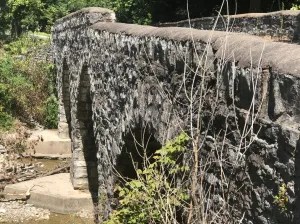
A 1909 four-span stone arch bridge

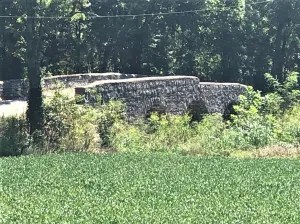
Ripley County in southern Indiana is a scenic land of rolling hills, wooded tracts interspersed with farming enterprises. Amongst the unique sites include a wonderful stone arch bridge just outside the tiny village of Friendship. This bridge was constructed in 1909 on the Olean Road where the road crosses Raccoon Creek.

From a distance

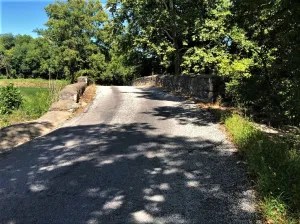
The approach to the bridge

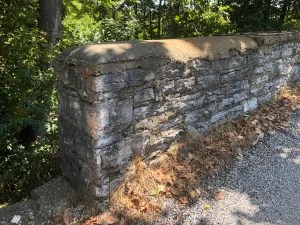
Nearly perfect stonework

Side view of the stone work arches

The stonework on the four arches is really a stone mason’s dream. This bridge has spans over 20 feet. The deck is nearly 15 feet wide over the 103 foot length. Stone arch bridges were a very common design for many rural stream and river crossings. There are eleven still standing in Ripley County alone, according to records.

Raccoon Creek is typical of southern Indiana hill country drainage streams. Usually running, it can go dry in droughts. The bubbling sound of the passing of the water adds to the serenity of this environment.

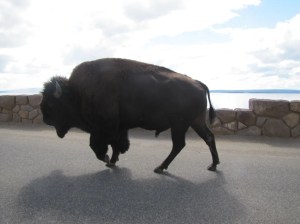
Our welcome committee to Yellowstone National Park

Our first cross county RV trip from Indiana to Seattle was a thrilling journey through totally new to us parts of the country. As we planned our route we  decided we wanted to go through Yellowstone National Park. From Cody Wyoming we drove to the East Entrance of the park. There a friendly and helpful Park Ranger gave us a map, a couple of tips and sold us our America the Beautiful Senior Pass.

He was huge! That is Lake Yellowstone in the background.

We had not been in the park very long until we saw Lake Yellowstone off to our left. Up ahead we saw brake lights and several cars stopped. I thought it must be an accident. Then we saw calmly strolling down the middle of the road the cause of the traffic jam. Coming down the road towards us was a huge bison just like he owned the road. Well, yes he did own the road! We’ll never forget the bison who welcomed us to Yellowstone!

Devils Tower: the first U.S. National Monument

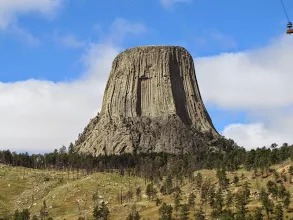
Northeast Wyoming is home to one of the most remarkable landscape features in the United States. The towering mass of volcanic rock known as Devils Tower has long been the destination of curious travelers and is the source of several Native American legends describing the origin of the rock formation. In the fall of 2014 we were on our way from Indiana to Seattle and decided to make a short detour to see this striking and beautiful gift from Earth.

One of, if not the most striking geologic feature in Wyoming

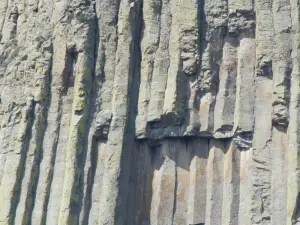
Detail image of each “column” that is about 8 feet across!

One of the legends of the origin of the tower tells the story of girls who were pursued by a huge bear. The girls prayers were answered when the Great Spirit caused the rock to raise from the ground with the girls safely on top. The bear attempted to climb the smooth sides of the rock, and his claws made the distinctive shapes we see today.

Geologists tell us that the tower was made when volcanic intrusions of lava pushed up into thick layers of sandstone, now eroded away after millions of years. The rock, an igneous basalt type, took on the shapes of columns when it cooled. Called a columnar formation, this shape is not uncommon and can be found in rocks all over the world.

The Devils Tower was the first designated US National Monument, so declared by President Teddy Roosevelt in 1906. The first Caucasians saw the tower in the 1850’s. It was also the site of the famous ending of the 1977 film Close Encounters of the Third Kind.

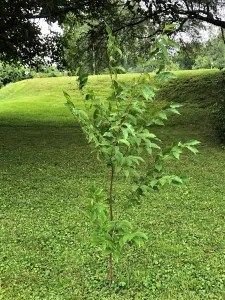
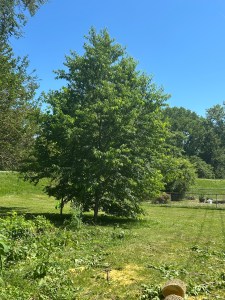
Growth of our Black Cherry Tree

Taken on June 20, 2020

Taken on June 25, 2021

Taken June 3, 2026

This Black Cherry was one we received from the Indiana DNR. The first picture was taken on June 20, 2020 shortly after being planted. The sapling was then in a cage for protection, and the top visible rung on the cage is less than 2 feet high.  The second picture was taken on June 25, 2021. The tree was a little over 6 feet tall. The third was taken June 3, 2026 this year.

Black Cherry trees normally take 8 to 10 years of growth before they produce cherries. We’ll report back to you in June, 2030 hopefully with a picture of a basket full of black cherries.

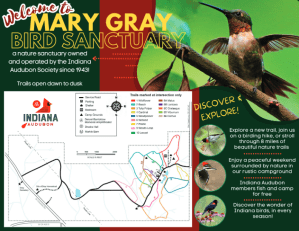
Mary Gray Bird Sanctuary from the Indiana Audubon Society

The Mary Gray Bird Sanctuary is located south of Connersville in Fayette County, Indiana.  Alice Green Gray gave the initial 264 acre property to the Indiana Audubon Society in 1943 as a living memorial to her daughter Mary, who preceded her in death. Another Gray relative and Society members have made possible the acquisition of more property so that the Sanctuary now has 723 acres.

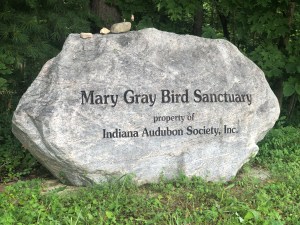
Clearly marked entrance

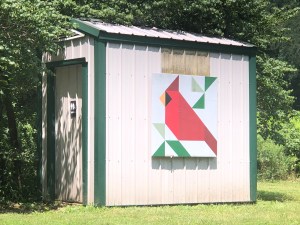
Storage building appropriately decorated

Page from MGBS brochure


The entrance to the sanctuary is well marked with a dramatic and large stone sign. Once you are in the initial parking area, you realize that you are in a delightful part of Nature’s birding paradise. This is an off the beaten path sanctuary worthy of your exploration. Take you camera and binoculars.

There are many features within this sanctuary. There is a bird watching blind where you can observe the many stocked feeders and not be seen. Ponds and native trees provide a perfect chance to immerse yourself in communing with Earth and the natural history of Indiana. Interesting programs and meetings take place at the amphitheater. Self-guided hiking tours covering many topics are an extra bonus to visitors of the MGBS. Click here for the MGBS website.


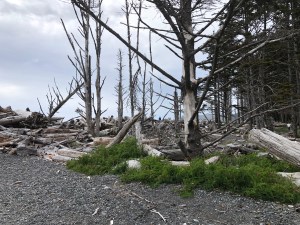
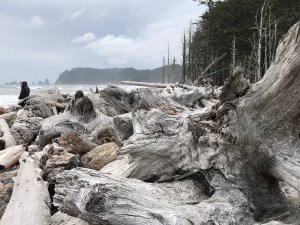
Huge old driftwood logs in Olympic National Park

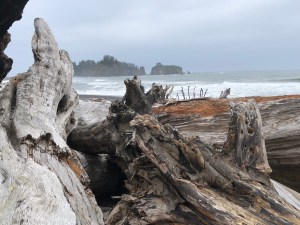
Washington State Olympic National Park is on the Pacific coast in the north part of the state.  This national park has stunning scenery and beautiful coastlines. Dramatic “sea stacks”, rocks remaining after ocean weathering, are visible from the shore. Highway 101 follows this coast and near the north end of the park it runs next to Ruby Beach.

On the shore line

Islands in the background


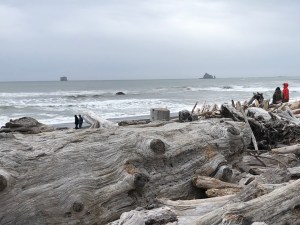
Ruby Beach is one of a few Olympic National Park beaches that have massive amounts of driftwood stacked randomly by the tides on the shore. Tidal currents have for centuries been responsible for the migration up and down the coastline  of these driftwood logs. Many of these weather worn logs have no doubt been on different parts of the beach over the decades.

Huge driftwood log, Sea Stacks in background

Old driftwood logs, shore in background


The Olympic National Park covers nearly a million acres. It protects a vast wilderness, thousands of years of human history, and several distinctly different ecosystems. Ruby Beach and other ocean views from Highway 101 show just a fraction of the park’s acreage. The Olympic Peninsula is a remarkable part of our United States. Visit there someday, you will not  be disappointed.


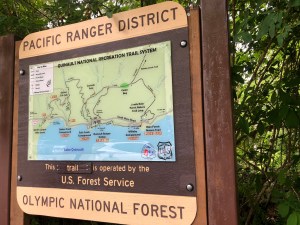
Quinault National Recreation Trail System

Traveling in the Olympic Peninsula of Washington State provides an awesome chance to view up close and personal the famed scenery of the Pacific Northwest. The huge Olympic National Forest is home to millions of acres of Natures’ wonders.

Trail map

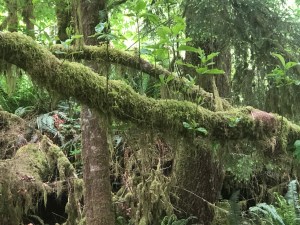
Typical vegetation of the rain forest

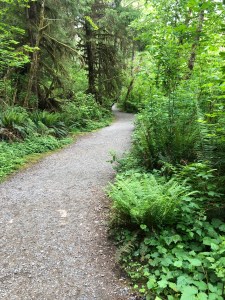
The Quinault National Recreation Trail System on the shore of Lake Quinault is an opportunity to easily explore the magnificent rain forests. We stopped at one of the parking lots for the trail, and were easily able to walk several hundred yards into the forest on a well defined and clear trail.

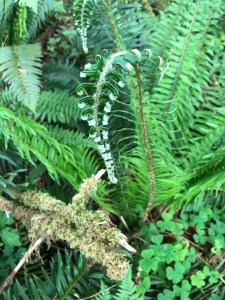
Nature’s delicate beauty

Easy walking trail


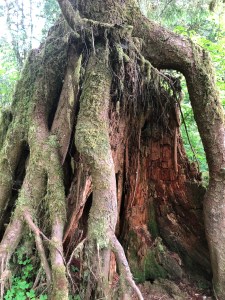
Massive tree base

Being in the actual rain forest was an eye opening adventure that brought us close to, and for a short time, part of this slice of the Pacific Northwest. The plants covering the forest floor were a deep green and covered in delicate leaves. Moss covered previously fallen branches added to the degree of total vegetation that filled the scene. This was a chance to really engage with the rain forest.

Renaissance Faire in Central Indiana

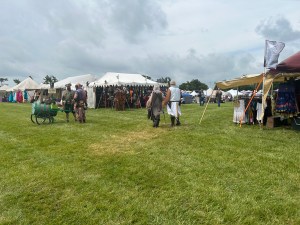
This weekend was the first of two weekends when several acres of the Johnson County Park, Nineveh, Indiana transformed into a setting right out of Renaissance Europe. Scores of tents, wagons and other structures have sprung up on the grassy fields.

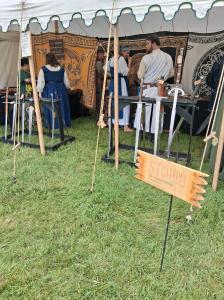
Some of the vendor tents

The Indiana Renaissance Faire is one of several similar events during the year. With the same basic theme, vendors and entertainers from all over come to peddle their wares and entertain the crowds of all ages that enjoy these Faires.

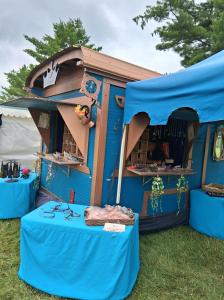
Vendor “wagon” plus tent

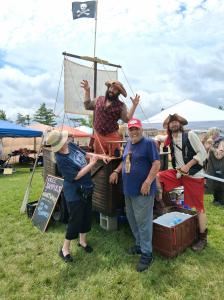
Watch out for the pirates (but buy their mead)


Anything and everything you would need to dress in period costume is available at the vendor displays in the tents. Musical instruments, belts, bags, tunics, even correct footware.

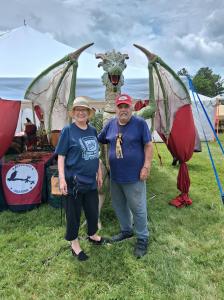
Every faire needs a dragon

Yes that is a real sword shop.


And speaking of costumes, it seemed like more than half of the people in attendance were is some kind of costuming. We saw elves, wizards, fairies, warlocks, pirates, knights, tradesmen and many others.

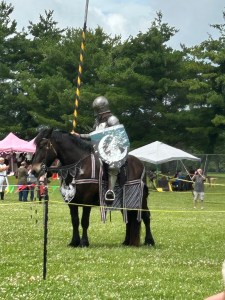
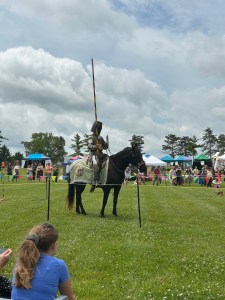
Knight at the ready

Lance ready for the joust


Entertainment was everywhere. We got there in time to catch the 12 noon Jousting demonstration. Two knights in armor on horse back showed their skill in the use of the long joust. Foot soldiers in support of the knights demonstrated small arm weaponry.

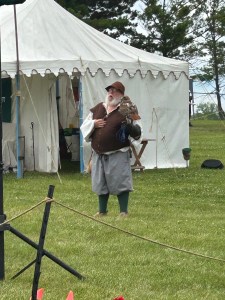
Holding RedTail Hawk

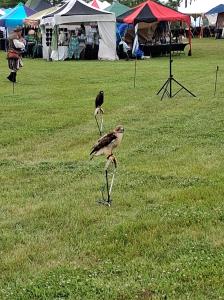
Two birds waiting their turn


Another unique and fascinating offering presentation was by a chap who brought hawks and falcons to show and explain. A most fascinating  demonstration.

The Renaissance Faire will be open next weekend, June 20 – 21st for two more days of revelry, music, food and fun. Huzzah!


Duke Energy takes a huge Mulberry tree from our yard

Over the years our local electric utility has twice in the past stopped and announced they were going to remove a very large Mulberry tree from our yard. It’s growth was a hazard to multiple powerlines. Finally third time is the charm, as Duke Energy worked the past two days to remove this massive tree.

Large trunks flaring out from the base heading in all directions

Bucket truck reached in from overhead

First day started using a bucket truck for higher branches. This tree cluster had five large trunks that grew out from a center area. The crew had two men on large chain saws supported by six or seven ground workers moving the branches and waste up the steep bank to a road that runs on top of the flood control levee.

Hauling branches to the chipper

Lots of wood for hauling off the levee road

Lots of stump left to cut up

The large trunks were carefully felled to the ground. Once downed, the saw operators cut the branches for removal to the road above for processing in the chipper machine. It took great effort for the crew to haul all the branches and trunk wood to the road on top of the levee.

Lots of space opened up!

The finished product. Seems like we just gained 1/4 acre!