Central Indiana polygonal barn built in 1910

In 1910 a Mr. George Rudicel constructed a rather unusual barn. It has twelve sides, thus the name polygonal. The cone shaped roof is capped with a polygonal cupola and it topped by a square smaller cupola. There is also a large dormer facing the road. This barn was listed on the National Register of Historic Places in 1993. It can be found  in Noble Township, Shelby County, Indiana.

Nice profile of the barn

Note the face of the dormer matches the polygonal angled panels

Christmas star on cupola

Round barns were designed for dairy farming, and were not useful for general farming use. By the late 1920’s round barns had fallen out of favor. There was a nationwide agricultural depression after WWI, and easy  to construct prefabricated barn packages were now available. There were 226 round barns in Indiana but 100 of these have vanished from the Hoosier countryside. Many round barns have been restored and are well maintained. The Rudicel barn, also known  locally as the Montgomery round barn, is in need of some maintenance and a good coat of paint.


Old concrete fence posts dot the Midwest

A 1915 Purdue University guide to concrete fence posts

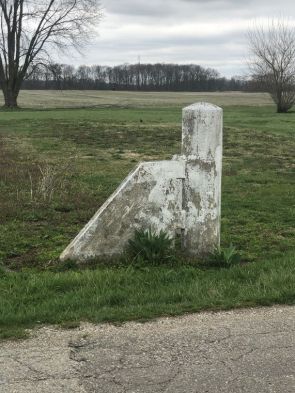
Take a drive on most any rural Indiana road or some other Midwest states and it won’t be long until you spot some rather massive concrete pillars apparently serving no purpose. These are in fact old, now abandoned concrete fence posts. Decades and decades ago almost all farmsteads raised livestock, including work horses, thus strong “cattle and horse tight” fencing was an absolute necessity.

Constructing livestock fencing that is functional and remains functional year after year is a skill that farmers and ranchers had. One of the important parts of a good fence is the end post and/or corner posts. These posts anchor the wire fence that stretches along the length of the particular fence line. If the end and corner posts do not hold, the fence wire will sag and livestock will get out, causing quite the kerfuffle.

Remnants of fence wire is still wrapped around this post

This post had white wash and weeds clipped


Old concrete fence posts can be seen alongside many roads in the country. Sometimes you can tell from the locations of these relics coupled with the position of mature trees where once stood an old house and barn yard. Some will be painted, others will be nearly covered with weed and bush growth. They do stand as a reminder of the days when all farm families raised livestock as a part of their livelihood.

This is the link to the 1915 pamphlet pictured above.