Cemetery Road Bridge has a “new” home

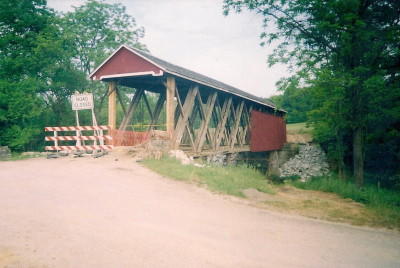
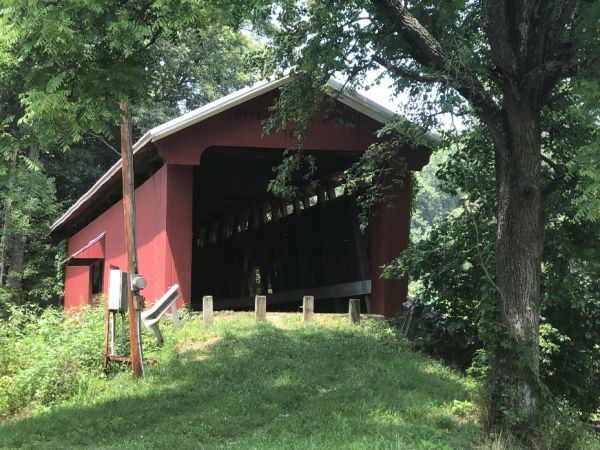
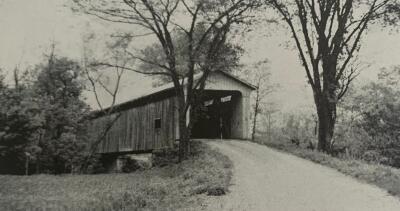
The Cemetery Road Covered Bridge started its existence in 1886 after bridge builder Henry Hebble completed the construction of the original 129 foot long span over the Anderson Fork of Caesar Creek. In the 1970’s a new lake was planned and that lake when filled would have inundated and destroyed this bridge.

The sign on the entrance

Name plate on bridge

Side of bridge showing abutments

The Reader’s Digest version of the story is that The Army Corp of Engineers ended up giving the bridge away to anyone that would move it. The middle 60 foot section was cut away, and the bridge did get moved, very slowly, to its new home in the Glen Helen Nature Preserve. The trip took two days and necessitated moving some traffic signal lights for clearance as the bridge on wheels was moved through towns.

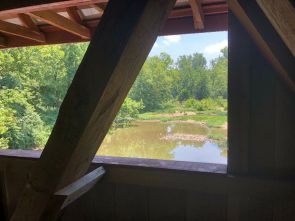
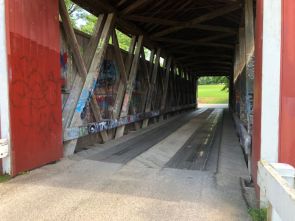
View through the bridge deck

The bridge, once it was placed on its new location spanning the Yellow Springs Creek, did require substantial repairs including some new deck boards, siding and quite a bit of roof repairs. It was opened for pedestrian traffic only, and is off the road a hundred yards or so in the Glen Helen Nature Preserve.

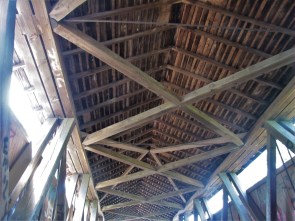
Henry Hebble utilized the Howe through truss design

Even the bridge deck got graffitied


Since the opening  in 1975 the bridge has been the victim of serious and widespread vandalism in the form of graffiti over a high percentage of the wood members of the structure. It seems like lots of covered bridges fall victim to this kind of desecration. But, that said, it was great that at least a portion of this fine old bridge was saved from a watery demise.

 

The 1887 Stockheughter Covered Bridge

This covered bridge is in Franklin County, Indiana on the Enochsburg Road. The bridge was built by the Smith Bridge Company from Toledo, Ohio. The Smith Bridge Company was a large and very prolific bridge construction company, building bridges all over the Midwest.

Also known as the Enochsburg Road Bridge

Graffiti is a problem on this bridge

Top chords and roofing details


Note the diagonal deck boards under the wheel tracks

Photo credit Tom Hoffman, 2009 restoration project

This bridge is not very long, at just over 100 feet in length. The covered Howe through truss system used by Smith was also used by other builders, including Hardman. The bridge spans over Salt Creek on the Enochsburg Road. It was constructed in 1887 and underwent an extensive “rehabilitation” project in 2009. It was placed on the National Register of Historic Places on March 20, 2002

An 1885 Thomas A. Hardman covered bridge

This looks like the bridge was just plopped down on the edge of a forest

We visited another one of Hardman’s bridges at Versailles, Indiana. Hardman uses the Howe truss system, as opposed to the Burr-arch trusses that the Kennedy builders use. This bridge is called the Busching bridge, and is 182 feet long with a 14.1 foot wide deck. It spans Laughery Creek on Ripley County CR 40 South.

Notice this design has an overhang at each end

Busching Bridge name and build date

A look at the Howe truss system

Scenic view of Laughery Creek

Photo taken by Bryan E. Ketcham On Apr. 22,1946 at 10:35 a.m.

Another view with details of the Howe truss system

This is another fine example of a Thomas A. Hardman built bridges. It was restored in 2005 and is well maintained. The bridge was posted to the National Register of Historic Places on March 19, 2019. Coming from Versailles on CR 40 you cross the bridge and enter the valley. The entrance to the Versailles State Park and the new park offices are to the left after you leave the bridge.

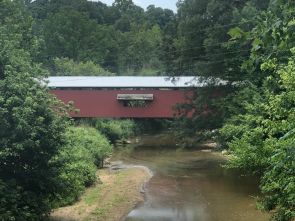
Otter Creek covered bridge

In what some may say is an area “out in the middle of nowhere” in Ripley County, Indiana, travelers will stumble upon a unique and historic covered bridge. Built in 1884 by Thomas A. Hardman, this bridge has a unique history as well.

Closed to road traffic in 1996, it is now open only to foot traffic.

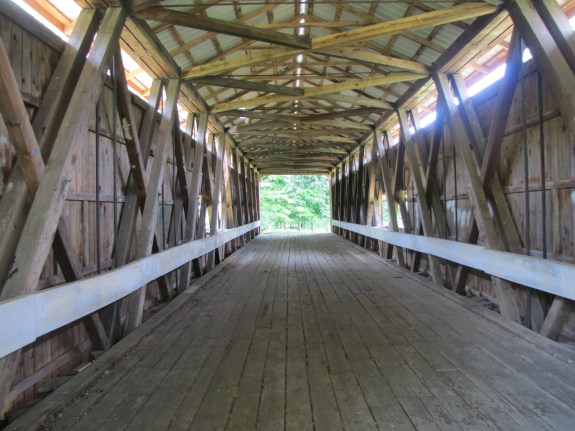
The Otter Creek Bridge, also known locally as the Holton Bridge, is constructed with the Howe truss system. This design was invented by a William Howe, an American architect born in 1803. The Howe truss design, patented in 1840, became one of the most popular structural designs and continued to see use in later metal bridge designs.

View of the 113 foot bridge over Otter Creek

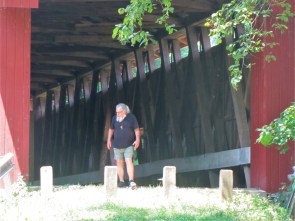
Maj examining the deck timber supports

A good view of the Howe truss system, and the roof supports as well

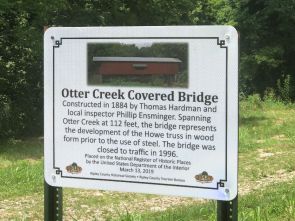
Nice information signage!

The bridge is in excellent condition

The bridge in 1943 (courtesy bridgehunter.com)

The bridge roof was partially ripped off during a straight line wind storm just months after it was placed on the National Register of Historic Places. Repairs were completed quickly and the structure again opened to pedestrian traffic. This piece of American history is located in a peaceful and beautiful setting and worth the drive to see.