The day we saw the Border Wall

One winter day when we were living at an RV resort in Harlingen, Texas, Sher and I decided to head out and see if we could see the border wall between Mexico and the United States. We also wanted to see the Rio Grande River, which is of course the actual US/Mexico border.

We started our trek on US Highway 281 south of Pharr, Texas. We headed east on 281, which for this stretch towards Brownsville is also the route of the Military Highway, another historic route in the Lone Star State.

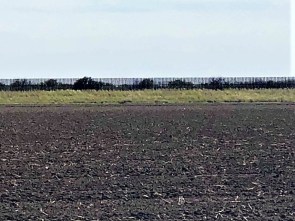
Border fence seen across a farm field

Closer to Hwy 281, with graffiti


We spotted some of the border wall sections that were pretty far from the road. We were closer to the fence between Los Indios and La Paloma. The vertical metal slats were mounted in a large concrete foundation.

What we didn’t get, however, was why the wall/fence stopped out in the middle of nowhere. It seemed odd that it seemed to be random as to where the fences had been constructed and where there were none.

We continued our drive into downtown Brownsville into the historic commercial part of town. What a treat to see all the colorful store fronts and signage in Spanish. Different for a couple from Indiana. I spoke with a Border Patrol Agent who kindly directed us to a small city park where we could see the Rio Grande river. It too had a high fence, complete with coils of razor wire on the Mexico side.

Mexico on left, Border Patrol watching the river

Looking across the river at Matamoros Mexico

Parked at the Alice Wilson Hope Park


All in all we had a very nice day. It was most interesting seeing the thousands of acres of irrigated crop ground. There were some workers in the fields, but mostly it seemed that new crops were just starting to grow, and other fields had been recently tilled in preparation for new crop plantings. Early in the year compared to our crop seasons back in the Midwest.


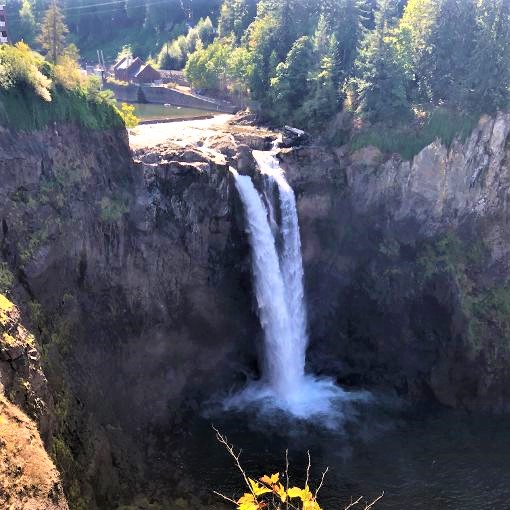
Beautiful Snoqualmie Falls

One of the most popular attractions in the Seattle area is the Snoqualmie Falls, a 269 foot single drop waterfall. The falls are near the town of Snoqualmie, which also offers interesting attractions to tourists and locals alike.

View from the observation deck

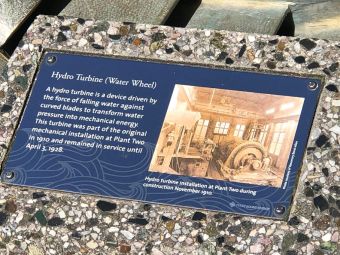
The area became an active logging site in the 1870’s with logs actually floated over the falls. In 1889 a railroad was built, opening the logging trade further. The town of Snoqualmie was platted in 1889 as well, and by the 1890’s Charles Baker had constructed an underground hydroelectric plant at the falls. Some of the original generators still function today.


It is very easy to gain access to the falls. Free parking is available, and an easy walk on the pedestrian bridge leads to the concrete paths to observation decks. If you prefer, for $7.00 you can park next to the gift shop next to the observation decks.

Beautiful scenery from the deck

Salish Lodge, note the wedding tent


The Salish Lodge and Spa offers high end accommodations, spa, and dining. Many use the striking views as a place for weddings. It overlooks the river, the generating plant and the top of the falls.

We just liked this photo

The walk to the observation decks is easy with only a couple of places with widely spaced steps. There were quite a few people enjoying the sights, but we felt comfortable and not crowded. The layout was very nice, and all of the paved paths and safety fencing was kept in excellent condition. It is easy to see why Snoqualmie Falls is one of Washington state’s most popular scenic attractions.


The old jail in Bardstown is haunted and a Bed and Breakfast

Bardstown, Kentucky is in Nelson County and is in the heart of the Kentucky Bourbon industry. Bardstown is also home to one of the oldest jails in the area. The original jail structure (now called the front jail) was erected in 1819 and was used until 1874 to house prisoners. In 1874 the “back jail” was built and held inmates until 1987. During this time the front jail was the jailer’s residence. The facility is now a Bed and Breakfast using the rooms in the old residence.

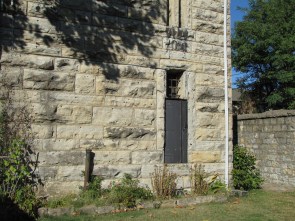
Thick walls and narrow windows of the jail

The history of this place is fascinating. You can (for a fee) take a tour of the back jail, with many of the jail cells untouched since the last prisoners left in 1987. There are original photos, some of which show the last hanging that took place in 1894 in the yard in back of the jail. Some paranormal activity has been reported and investigated.

Back of the jail where the gallows were for the last hanging in 1894

Hood and shackles for the 1894 hanging


The structure is quite the fortress! The walls are every bit of 30 inches thick with large metal bars covering the narrow windows. There are mason’s marks on the huge stones where hooks were used to move them into place during the construction. The original wall surrounding the back yard is complete with massive solid metal gates.

There are some nice RV parks in the area, including My Old Kentucky Home State Park. Be sure to check out the old jail. By the way, there are 11 (count ’em) distilleries in and around Bardstown. Go ahead and take a distillery tour while you are there.

Scott Joplin, King of Ragtime mural in Texarkana

Scott Joplin was an American composer and pianist born in Texarkana in 1868. He became famous for his ragtime compositions and was dubbed the “King of Ragtime.” During his brief career, (1895 – 1917) he wrote over 40 original ragtime pieces, one ragtime ballet, and two operas.


In 1984 a large mural was painted on the side of a building in downtown Texarkana, on Main Street a couple of blocks in from the Texas/Arkansas line, Texas side. Time took its toll, the mural faded. However in 2015 a project to restore the mural was undertaken. A local TV station reported that Joplin’s great niece dedicated the project. Joplin was a brilliant composer whose works became well known with the release of the 1973 movie The Sting.

We just happened upon this beautiful and large mural. We were lucky in that there were no cars in the parking lot blocking our view. Thus the photo of the complete mural, above. Another example of why travel is adventuresome.

We enjoyed great food and great music at The Maison on Frenchmen Street New Orleans

Sher and I visited New Orleans in January, 2018, the beginning of the 300th year anniversary of the Big Easy. On one of our evenings in town we found a great place to both have a great meal and to listen to some fabulous live jazz music. We had been to the Market and another live music bar and decided we wanted to get something to eat. I had seen The Maison on the web, so I recognized the sign.

Maison @508 Frenchmen

We were seated right away at a table just a few feet from the stage, which was already occupied with the Baby Giants Jazz Band! Doug, our waiter, appeared right away and showed us the drink menu. Sher ordered a “Dixie Revival” made with tequila and grapefruit juice and some other good stuff. Once I took a sip of hers, I had to have one myself. What a great drink!

The Giant Babies Jazz Band

Enjoying our “Dixie Revival” cocktails

We then ordered our dinners. Sher ordered the Penne Primavera, pasta with seasonal vegetables sautéed in a Creole garlic and butter sauce. I opted for the Cochon de Lait Poboy, a Cajun style slow roasted pulled pork dressed with coleslaw and drizzled with Barbeque sauce, and with a side of fries. It seemed like in no time our plates were brought to us. I actually declared “Wow” out-loud when I saw my Poboy and the huge pile of fries!

Check out that bowl of pasta and that huge Poboy and pile of fries!

The food was absolutely decadent. Sher said her vegetarian pasta was the best that she has ever had. The Poboy was my first, but I just loved the pork on that bed of coleslaw in the bun. And those fries came out almost too hot to touch, so they stayed hot and crisp throughout the meal. I don’t think either one of us could have been more pleased. Hats off to our waiter Doug who took care of us. Even when all of the tables in the room occupied he still was able to continue to serve us. We had a wonderful evening in true Big Easy style that day.


Austin’s Congress Avenue Bridge and 1.5 million bats

Back before the pandemic we were visiting our family in Austin. We all took a day trip to San Antonio one Sunday, and planned to see the bats of Austin that evening. This is a recap of that adventure.

Who would think that a winged visitor from Mexico would make such a splash in downtown Austin, Texas. Such is the story of the Free-tailed bat. These critters migrate to Austin in March and stay through November. The colony spends each day under the Congress Avenue Bridge and emerges en-mass at sunset. This daily event has become a famous local attraction in Austin.

View of the watercraft waiting for the bats

Mexican Free-tailed bat

We planned to see the bats after a day in San Antonio. Because it was a Sunday, free street parking was available if you could find it. A ten dollar garage was well worth the cost. When we got there I needed a restroom and found one at a great restaurant a block away. The restaurant staff where we had supper knew exactly what time the bats would emerge. After supper we walked the two blocks to the bridge. Because it was Sunday the crowds were not large and we walked right up to the bridge rail for a great view.

The bat colony takes flight

A viewing deck was on the river bank for a look up at the bridge. A wide variety of tour boats, canoes and kayaks were in place on the water of Lady Bird Lake waiting to see the show. And what a show it was! The first bats started to fly about 10 minutes before sunset. It didn’t take long for hundreds of thousands of bats to fly out from under the bridge. The sky was filled with masses of bats! It looked like they were flying along the river. Before the Congress Avenue Bridge was built where did the colony of bats spend daylight hours?

New Orleans’ famed above ground tombs in St Louis Cemetery No. 1

St. Louis Cemetery No. 1 was established via a Royal Spanish Land Grant in 1789. It was originally outside the city limits, and was at least twice its current size. The Archdiocese of New Orleans now has control of this cemetery. Currently the only way you can get into the cemetery is with a licensed tour guide. Unfortunately vandalism has forced this action. This cemetery was definitely on our list of things to “be sure to see” when we visited New Orleans in January, 2018.

Multiple designs for the tombs, some fancy and some plain

The famed above ground tombs and wall tombs are designed for use by generation after generation. Many of the tombs are owned by individual families. Some of the very large tombs are known as society tombs where several families or groups have combined resources. The laws dictate that a year and a day passes before an additional burial is permitted. As you would expect, there are many well-known, famous and infamous people whose tombs are located in the cemetery.

We are standing in front of the tomb of Marie Laveau, the famed Voodoo Queen. This is reportedly the most visited tomb in New Orleans.

We decided to go on a St. Louis Cemetery No. 1 and Voodoo tour put on by the Gray Line. Marcia, our tour guide, was a delightful host of our small group. As mentioned above, you must be with a licensed tour guide to gain entrance into the cemetery. Shop around, but we suggest going with the Gray Line Tour Company.

Plaque on the tomb of Marie Laveau, the most famous voodoo Priestess from New Orleans

Nicholas Cage had this tomb built in the cemetery. He says he wants to be buried here, and the IRS cannot touch a burial plot. We were told that Cage visited the tomb a year ago with his brother.

Not all tombs are as well maintained as others.

Multiple generations of the same family interred in a wall tomb.

Fort Lowell Park showcases 19th century military history of Tucson

Fort Lowell in Tucson takes you back to the days of the 19th century, primarily the military history of the Arizona Territory.

Roadtirementvintage's avatarRoadtirement

"The Chief Trumpeter" “The Chief Trumpeter”

Fort Lowell Park is now a large city park northeast of downtown Tucson. It is home to several ballparks and soccer fields. The ground is also the site of a former frontier Army fort. The original military post was opened in 1860 on the outskirts of the then tiny town of Tucson. This location was abandoned several years later and moved to the Fort Lowell site, seven miles northeast of downtown Tucson. The fort remained until it was decommissioned and abandoned in 1891.

The Fort was used as a staring point for several Army expeditions chasing down “renegade” Apache bands. Perhaps the most famous event that began at Fort Lowell was General Crook’s expedition that led to the “surrender” of Geronimo.

Today little remains of the original buildings. The old hospital building remains are the largest reminder of the original fort. The mud brick walls are now…

View original post 175 more words