Morgan County Heroes

There is a remarkable black granite three sided monument dedicated to the men of Morgan County, Indiana who gave their lives in 20th century wars. Starting with the French and Indian Wars up to and including the War on Terrorism, this monument speaks to the ultimate sacrifices made throughout the centuries. The honors are flanked by Old Glory, Indiana’s State Flag, and the black POW*MIA flag.

The Memorial is located in small plaza across street from the courthouse in downtown Martinsville, Indiana. I could not find a date of dedication, , the first reference I found was 2009.

Impressive Civil War Memorial includes an anachronism

Sitting on the north side of the Johnson County Courthouse in Franklin, Indiana is a striking memorial/fountain commemorating the valor of Union Soldiers from Johnson County during the Civil War. John Vawter was a businessman and banker from Franklin. He donated the memorial in 1905. It includes a bronze statue by artist Rudolph Schwarz.

This is a wonderful memorial to the men who served in the Civil War. The anachronism? As a history nerd who has been interested in, and studied military history, I need to point out that the arms and accoutrements on the cavalry trooper looking out over the battlefield are of a kind that did not even exist in 1861 to 1865.

Detail of the Model 1873 Trapdoor Springfield

The carbine is a Springfield “Trapdoor” that fired a 45/50 cartridge. This firearm was not invented until 1873, and was issued in both rifle and carbine lengths. The cartridge box on the trooper’s belt appears to also be from the 1870’s and designed for brass cartridges. The statue is a very good portrayal of a trooper from the mid 1870’s on.

This is an impressive memorial, complete with all branches of the services represented under the lion heads fountains. It is interesting that the statue artist picked the wrong model for his rendition of the trooper. It doesn’t take away from the honor given to the Civil War soldiers from Johnson County.

Art Deco theater once showed silent movies

Downtown Franklin Indiana is blessed to be the home of the marvelous restoration of a classic movie theater. The Artcraft Theater is on Main Street north of the courthouse. Currently owned by a local non-profit organization, all kinds of entertainment events are offered with a full schedule.

Impressive marquee over the entrance

Ticket booth and entrance. The front of courthouse is visible at the end of the street.

The Artcraft Theater in Franklin, Indiana was opened in November, 1922 as a silent movie theater and Vaudeville house. Over the years the theater saw the advent of “Talkies”, changes in seating arrangements, and a major renovation in 1948 to the “Art Deco” architecture style. There is fascinating history of the Artcraft on their website. There are tons of old photos worth seeing.

The Willard offers history, food and drink, and a ghost

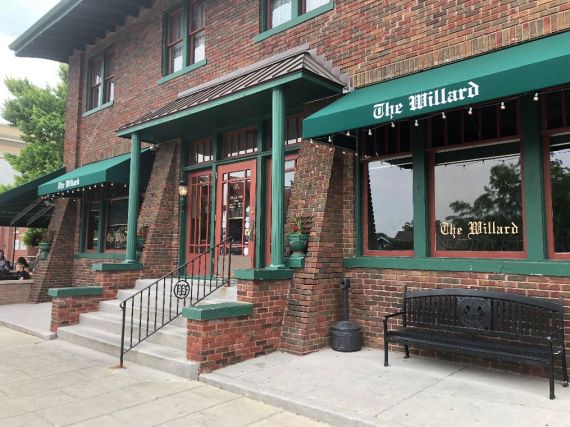
Franklin, Indiana is south of Indianapolis and is the county seat of Johnson County. One of the most noteworthy places in Franklin is The Willard, now a family friendly restaurant housed in an historic brick building a block north of the courthouse. Originally a home, the property has seen several uses and additions over the years. Check The Willard website for a detailed history.

Main entrance of the restaurant

We were in Franklin for a dental appointment and decided to try out the American cuisine at The Willard. There was a decent crowd when we got there, and as we ate there was a constant stream of customers coming in to the facility. We were seated in the main dining room, while lots of folks took advantage of the outdoor seating.

Vegetarian pizza, stuffed w/veggies

Outdoor seating visible left, background


One of Willard favorites is pizza, and Sher did order the small vegetarian pizza. As you see in the photos it was packed with veggies. I had to try the breaded tenderloin and fries. The sandwich breading was different and not as “crunchy” as most recipes. It was tasty however.

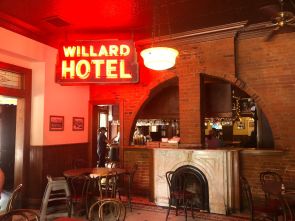
Full service bar past the arched brick wall

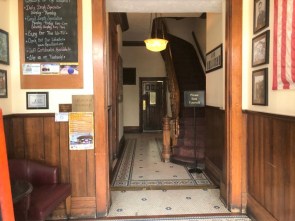
From the lobby, curved staircase visible

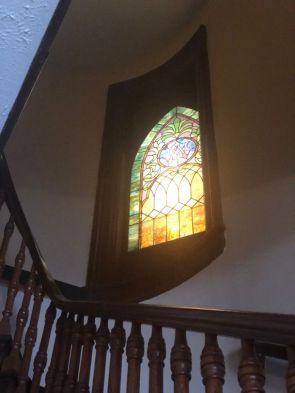
At the top of the main stair

Passageway past the bar and bistro tables


The building has been around since 1860, and quite a few old details make the place very interesting. The main curved staircase has a beautiful stained glass window at the top landing. The marble fireplace and original Willard Hotel sign compliment main dining room where we ate. And even though there is no prominent mention of her, a ghost named Eliza, a former love scorned owner of the property can be seen moving about the building in a rage. Seems she caught her fiancé in a compromising situation with her sister on a table in the kitchen.

Memorial Day haunting quatrains honoring war dead

Memorial Day in 2023 will be held on May 29th. Originally called “Decoration Day” it started after the end of the Civil War and became an official Federal Holiday in 1971. Memorial Day is observed all across the nation in towns large and small. Many courthouse lawns are decorated with crosses bearing the names of local men and women who gave their lives serving in the armed forces while protecting our freedoms.
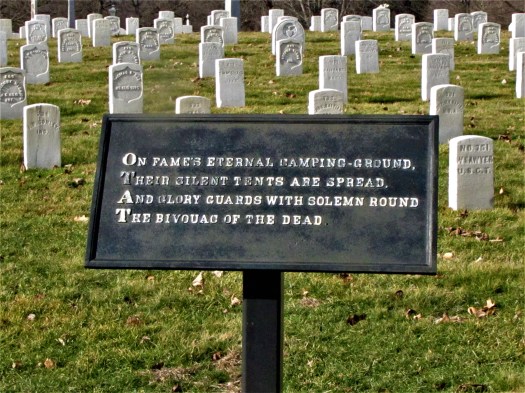
One of two National Cemeteries in Crown Hill Cemetery, Indianapolis, Indiana with 2nd quatrain, 1st stanza of O’Hare’s poem displayed

Theodore O’Hara (1820 – 1867) was a poet, lawyer, soldier and adventurer from Kentucky. He penned a haunting poem, “Bivouac of the Dead” honoring the dead from Kentucky killed in the Mexican War of 1847. At the end of the Civil War it became a memorial to Confederate dead, however the second quatrain of the first stanza has become an honor to any soldier killed in battle. That quatrain can be found in cemeteries across the nation and even the gateway to Arlington National Cemetery bears an inscription from O’Hara’s most noted poem.

Following is the complete poem, 12 stanzas with two quatrains per stanza. It is worth reading from start to finish.

“BIVOUAC OF THE DEAD”

The muffled drum’s sad roll has beat
The soldier’s last tattoo;
No more on life’s parade shall meet
That brave and fallen few.
On Fame’s eternal camping-ground
Their silent tents are spread,
And Glory guards, with solemn round,
The bivouac of the dead.

No rumor of the foe’s advance
Now swells upon the wind;
Nor troubled thought at midnight haunts
Of loved ones left behind;
No vision of the morrow’s strife
The warrior’s dream alarms;
No braying horn nor screaming fife
At dawn shall call to arms.

Their shriveled swords are red with rust,
Their plumed heads are bowed,
Their haughty banner, trailed in dust,
Is now their martial shroud.
And plenteous funeral tears have washed
The red stains from each brow,
And the proud forms, by battle gashed
Are free from anguish now.

The neighing troop, the flashing blade,
The bugle’s stirring blast,
The charge, the dreadful cannonade,
The din and shout, are past;
Nor war’s wild note nor glory’s peal
Shall thrill with fierce delight
Those breasts that nevermore may feel
The rapture of the fight.

Like the fierce northern hurricane
That sweeps the great plateau,
Flushed with the triumph yet to gain,
Came down the serried foe,
Who heard the thunder of the fray
Break o’er the field beneath,
Knew well the watchword of that day
Was “Victory or death!”

Long had the doubtful conflict raged
O’er all that stricken plain,
For never fiercer fight had waged
The vengeful blood of Spain;
And still the storm of battle blew,
Still swelled the gory tide;
Not long, our stout old chieftain knew,
Such odds his strength could bide.

Twas in that hour his stern command
Called to a martyr’s grave
The flower of his beloved land,
The nation’s flag to save.
By rivers of their father’s gore
His first-born laurels grew,
And well he deemed the sons would pour
Their lives for glory too.

For many a mother’s breath has swept
O’er Angostura’s plain —
And long the pitying sky has wept
Above its moldered slain.
The raven’s scream, or eagle’s flight,
Or shepherd’s pensive lay,
Alone awakes each sullen height
That frowned o’er that dread fray.

Sons of the Dark and Bloody Ground
Ye must not slumber there,
Where stranger steps and tongues resound
Along the heedless air.
Your own proud land’s heroic soil
Shall be your fitter grave;
She claims from war his richest spoil —
The ashes of her brave.

Thus ‘neath their parent turf they rest,
Far from the gory field,
Borne to a Spartan mother’s breast
On many a bloody shield;
The sunshine of their native sky
Smiles sadly on them here,
And kindred eyes and hearts watch by
The heroes sepulcher.

Rest on embalmed and sainted dead!
Dear as the blood ye gave;
No impious footstep shall here tread
The herbage of your grave;
Nor shall your glory be forgot
While fame her records keeps,
Or Honor points the hallowed spot
Where Valor proudly sleeps.

Yon marble minstrel’s voiceless stone
In deathless song shall tell,
When many a vanquished ago has flown,
The story how ye fell;
Nor wreck, nor change, nor winter’s blight,
Nor Time’s remorseless doom,
Shall dim one ray of glory’s light
That gilds your deathless tomb.

When it walks like a duck and quacks like a duck…

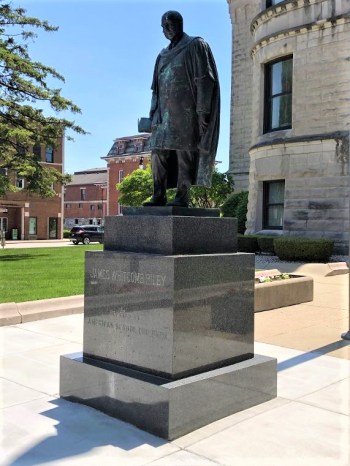
Riley statue at the courthouse

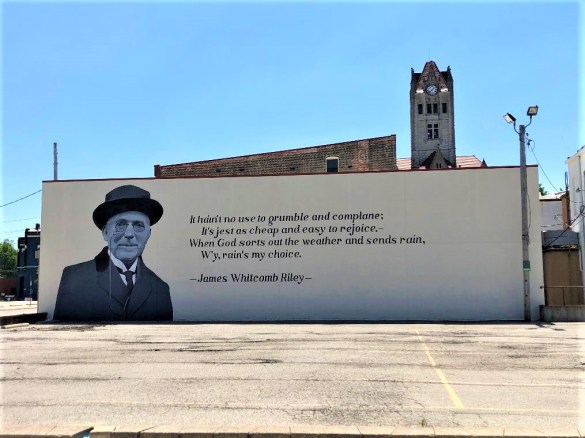
You have no doubt heard the saying “When I see a bird that walks like a duck and swims like a duck and quacks like a duck, I call that bird a duck.” That quote is from James Whitcomb Riley, the Hoosier Poet. He is from Greenfield, Indiana, a small town east of Indianapolis.

Riley was noted for his down home use of dialect that epitomized rural Indiana. He is famous for his remarkable volume of poems. He wrote and published over 1000 verses. His most popular are “Little Orphant Annie”, “The Raggedy Man,” “Our Hired Girl,” “A Barefoot Boy,” “The Bumblebee,” “Granny,” and “When the Frost Is on the Punkin.”

Mural with verses from his “Wet Weather Talk” poem

Historic Seagram’s Distillery in Lawrenceburg

Driving along US 50 through Lawrenceburg, Indiana, it is hard to miss the large complex of tall red brick buildings and multiple silver tanks that are part of the former Seagrams Distillery plant that straddles the Lawrenceburg and Greendale city boundaries. The current owner/operator of the facility is now MGP Ingredients, based out of Kansas.

This building has multiple floors of aging racks for 550 pound barrels of whisky

The Cincinnati Magazine published a fascinating and detailed story about the history of the Seagram’s Distillery, its current owners, and the ins and outs of the distillery business around the country. Read that article here. 

This paragraph is from the Cincinnati Magazine article.  “According to (Master Distiller Greg) Metze, it all starts with the water. MGP Ingredients sits on an aquifer, just a short walk from the Ohio River (most of the facility is actually in Greendale). That 56-degree water—low in sulfur and iron, high in calcium, and limestone-filtered—lets MGP make a lot of whiskey, and also have a continuous source for cooling the equipment. That’s why there were so many distilleries in Lawrenceburg in the 1800s. MGP’s began life as the Rossville Union Distillery in 1847; after Prohibition, in 1933, it was purchased by the legendary Canadian company Seagram. Right next door was Squibb, which opened in 1846 (though another distillery, Dunn and Ludlow, was on that patch of land in 1807) and became part of the Delaware company Schenley in 1933.”

More aging racks, and the tower houses multi-story continuous column stills

We were on a day trip to southern Indiana, the Ohio River and Lawrenceburg. The Seagram’s facility is huge, and we decided to drive over to the site, having never done that before.   Unfortunately we discovered that the new owners do not offer public tours of this historic distillery. At one time the Seagram’s plant employed over 2800 at the distillery and bottling plant. It is truly an iconic business with a rich and colorful history.


River ford now closed

Before the ford was closed

The 10 acres for Kennedy Park in Shelbyville, Indiana were bought and donated to the city in 1929 by Fred Kennedy. Among the features of the park included a concrete ford that crossed the Little Blue River to East Franklin Street. For years it was a place to drive across the river by car or bike. It was also a place to wash your car, which of course you couldn’t do today.

The video pans from East to West and shows the last complete concrete section of the old ford. You can also get a glimpse of the recently completed steel pedestrian footbridge over the river.

LOVE statue is now 53 years old

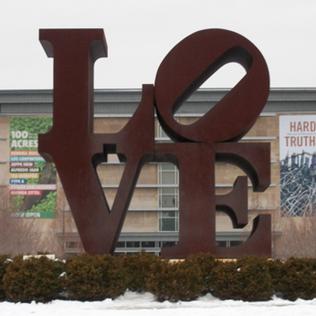
LOVE outside at the IMA in the early years

Robert Indiana was born in 1928 as Robert Clark. He changed his name to Indiana in 1958 to show his roots in the Midwest. His first widespread use of the stacked four letters of “LOVE” was a Christmas card in 1964 for the New York Museum of Modern Art. This design creation led to the LOVE sculpture constructed of Cor-ten steel in 1970. LOVE in steel was first put on display at the Indianapolis Museum of Art. It made the rounds of several American cities for five years until it returned to the IMA. After needed restoration was performed due to weathering of the steel, it is now displayed inside the museum building to protect it from the elements.

Permanent display inside the IMA

Remember 8 cent stamps?

The design was also the inspiration of a USPS 8 cent stamp in 1973. Countless copies of the statue were made and sold over the years, however Robert Indiana had failed to copyright his design, thus he did not reap the benefits. He died at the age of 89.


Wright Brothers first flight in North Carolina

The National Park Service operates the National Memorial to the Wright Brothers located on the Outer Banks of North Carolina, specifically the Kitty Hawk/Kill Devil Hills area.

Hands-on life size sculpture of the plane

Almost everyone has heard of the first manned flight in a powered airplane. Any trip to the area of the Outer Banks should include a visit to this dramatic Memorial. We arrived late in the day, and thus did not have time to visit the Visitors Center. We did, however, enjoy the massive monument and the life sized reproduction of the original Wright flier and associated sculpture field.

Monument on the hill where the first flight occurred

The massive monument is on top of the large sand dune hill where the flights occurred. In the 1920’s the dune was seeded with grass to stabilize the hill in preparation for the construction of the monument.

Wilbur to the right: original photo

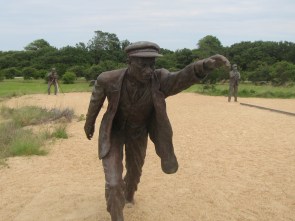
Statue of Wilbur running alongside the plane piloted by Orville


Originally from Ohio, the Wright brothers found that the sand dunes of the outer banks would be a perfect place for them to design the gliders and finally the engine powered airplane. Sand dunes provided a relatively safe place to test fly: sand is soft, protects the pilots and lessens potential damage to the aircraft.

The monument

Personnel from the local US Lifesaving Service offered help and on December 17, 1903 several were at the site of the flight.  At the memorial there is a marvelous sculpture field including a life sized reproduction of the plane as well as bronze sculptures of the men who were there at the time. This is a most impressive view that immediately takes you back to that famous December day in 1903.

Plan on visiting this marvelous piece of U.S. history. Here is the NPS website with details and some great information. Note: our National Parks Service Senior Pass saved us the entrance fees to the site. (Seniors 62 and older can get this pass here: NPS lifetime Senior Pass website)