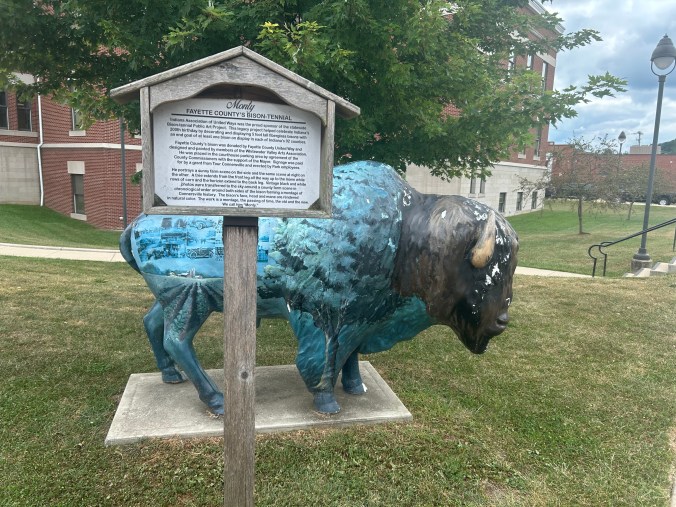
Another Bison-tennial bison in Connersville Indiana

In 2016 Indiana celebrated its bicentennial of the 1816 year of statehood. One very unique way to celebrate was the distribution of at least one fiberglass bison to each of the 92 counties in the state.

“Monty” lives next to the courthouse.

In our travels over the years Sher and I have seen many of these delightful bison around Indiana. All have custom paintjobs with a variety of environments for the location of each bison. Our road trip today to Connersville lead to yet another Bison-tennial Public Art discovery.


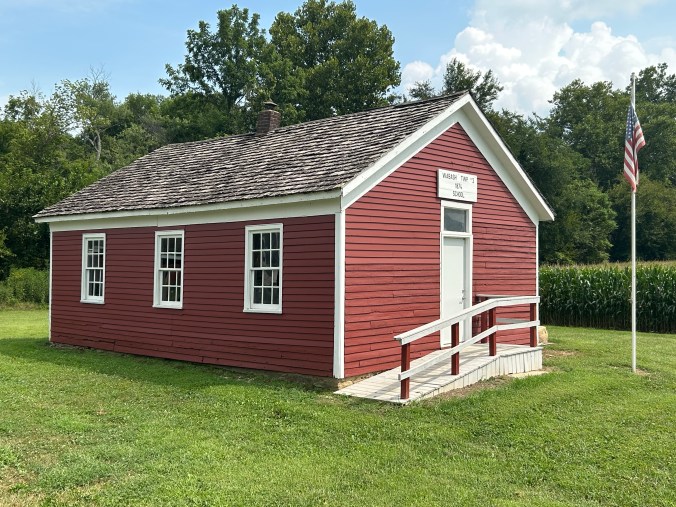
Recreated 1874 one room schoolhouse in Parke County Indiana

Recently Sher, our son and I were enjoying a road trip in Parke County, Indiana to visit some of the 31 covered bridges that dot the landscape. As we approached the last bridge on the Red Route (one of five self driving road sightseeing tours) we saw a small red building.

The one room schoolhouse from 1874

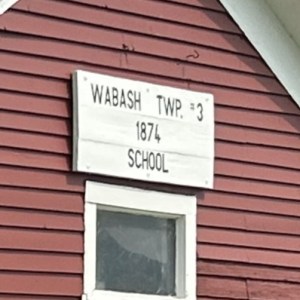
Over the door

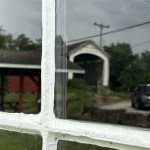
The Mecca Bridge reflected in a window


This single story frame structure was identified as a school in Wabash Township #3 with a date of 1874. It was about 30 yards from the Mecca Bridge built in 1873.

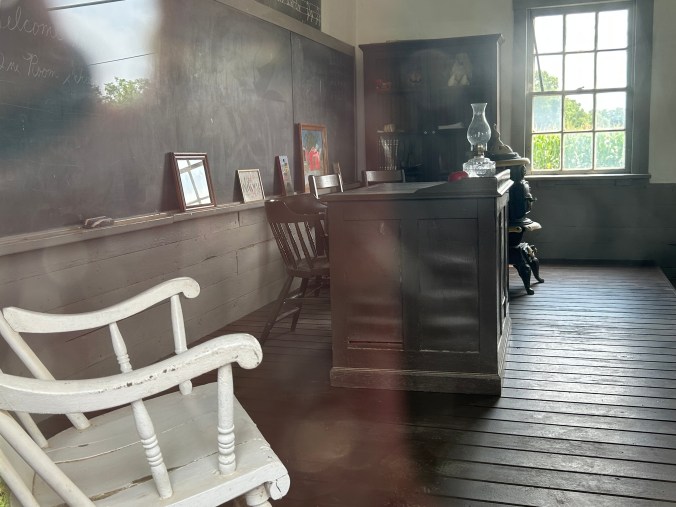
Blackboard, teacher’s desk. rocking chair and wood stove

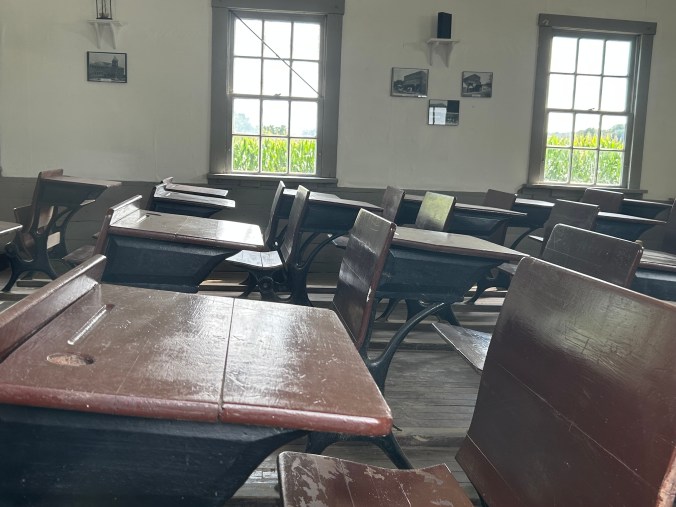
Where the children sat and learned their three “R’s”

The school was locked, but I was able to peer through the windows and get decent photos. You can imagine the kids attending the school, with one teacher covering all of the grades.  No lights, no AC, and the only heat from a wood stove at the front of the room.


Parke County, Indiana, Covered Bridge Capital of the World

Park County Indiana is home to two Indiana State Parks and the 2,110 acre Raccoon Lake State Recreation Area. In addition Parke County is home to 31 covered bridges, more than any other county in the nation. Rockville is the county seat and also is the starting point for 5 different well marked self driving road tours to see most of the 31 bridges.

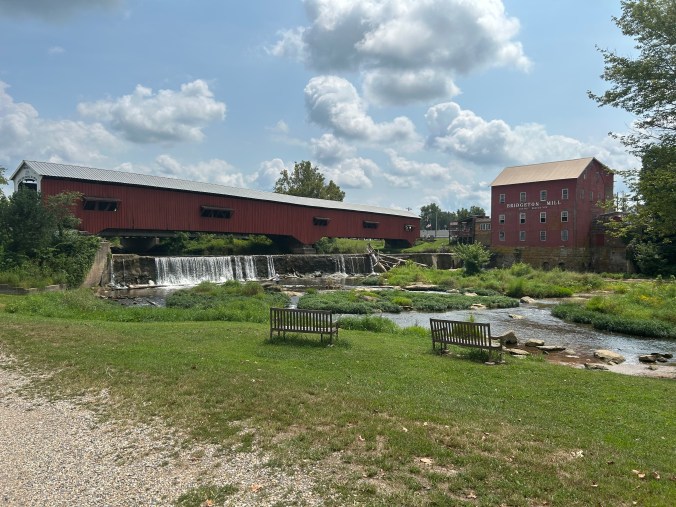
The 245′ Bridgeton Bridge and associated mill, The bridge was burned by arson in 2005, rebuilt in 2006.

These historic bridges are fairly evenly scattered over the 444 square miles of the county. Every October over two million visitors converge on Parke County for the world famed 10 day Covered Bridge Festival. People come to see the bridges and shop any of the thousands of vendors who occupy building’s or temporary tents that sprout up allover the county.

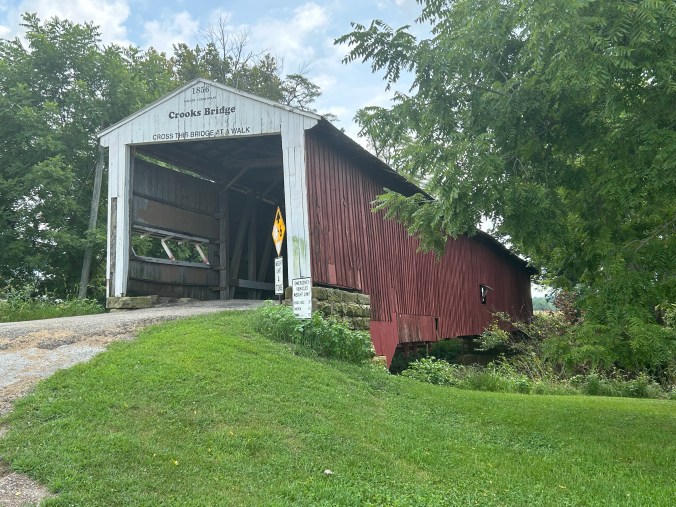
Crooks Bridge, 132′ long, built in 1856 by Henry Wolfe

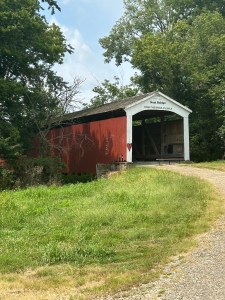
Neet Bridge, 125′ long, was built in 1904 by JJ Daniels

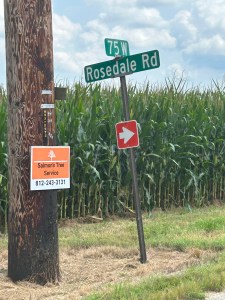
Note the Red Arrow. This shows the easy self driving tour routes.


We took the 34 mile long Red Route starting at the Rail Road Depot in Rockville. This drive brought us up close and personal to eight old covered bridges. Some we could drive across, some were closed to traffic with a new roadway running next to the bridge.

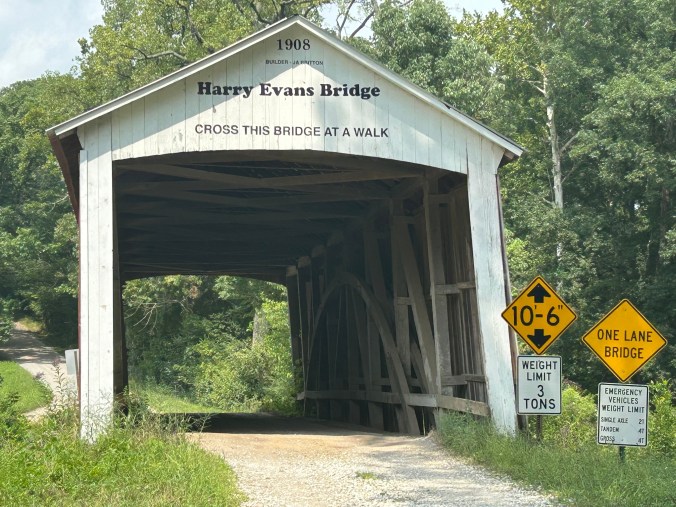
Harry Evans Bridge, 65 ‘ long, built by JA Britton in 1908

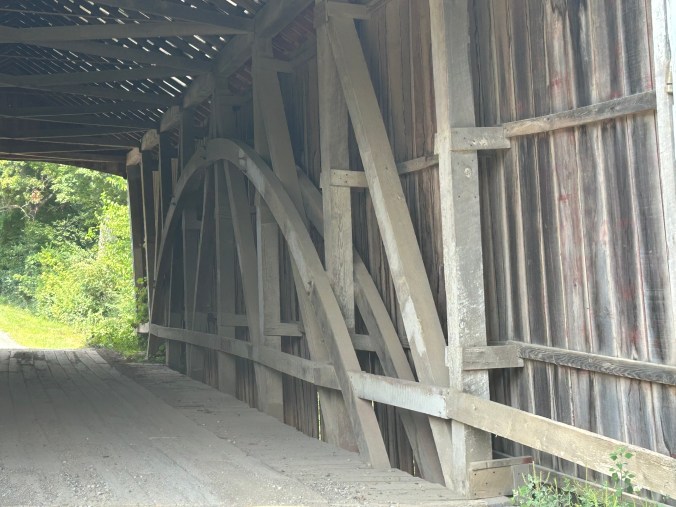
Showing the Burr-Arch support design of the Evans bridge. This design is found in 30 of the Park County bridges including one double Burr-Arch.

Our road trip to Parke County was, in our opinion, most successful. Along with our drive along the Red Route of covered bridges, we also had some other stops that we’ll share in other articles here. Just know this: a road trip to Parke County Indiana offers country roads and viewing historic bridges, enjoyable dining and shopping opportunities. Click here for the Park County Visitor’s Center website.

Indiana’s Wilbur Wright Birthplace Museum

The address is Hagerstown, Indiana, but the Wilbur Wright Birthplace Museum is out in the middle of Hoosier farmland. This fascinating museum has two different focuses: Wilbur’s birthplace and living conditions of the mid 1860’s and the success of Wilbur and Orville’s history making powered human flight at Kitty Hawk North Carolina in 1903.
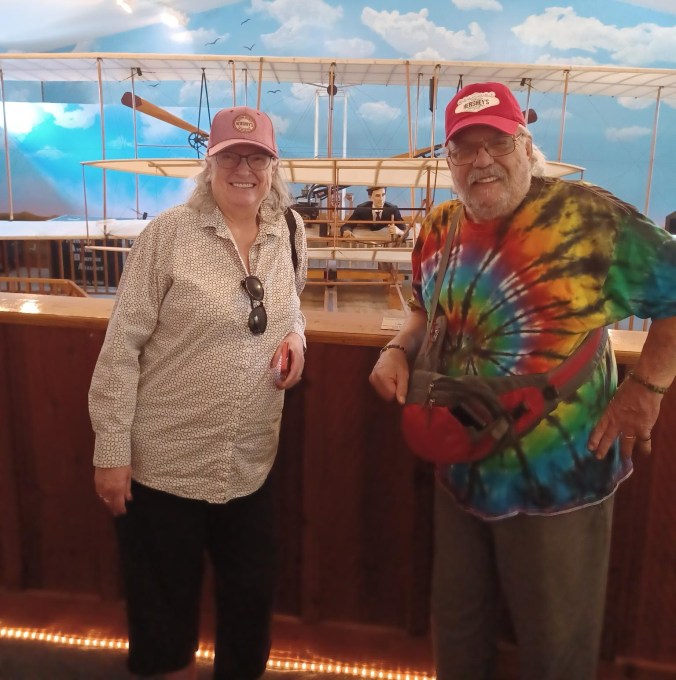
Yes, that is the Wright Flyer in the background

The flight museum and other Wright Brothers artifacts are housed in a separate building next to the family home and the visitor center. The exciting focus of this is the full life size and historically accurate reproduction of the original “Wright Flyer”.
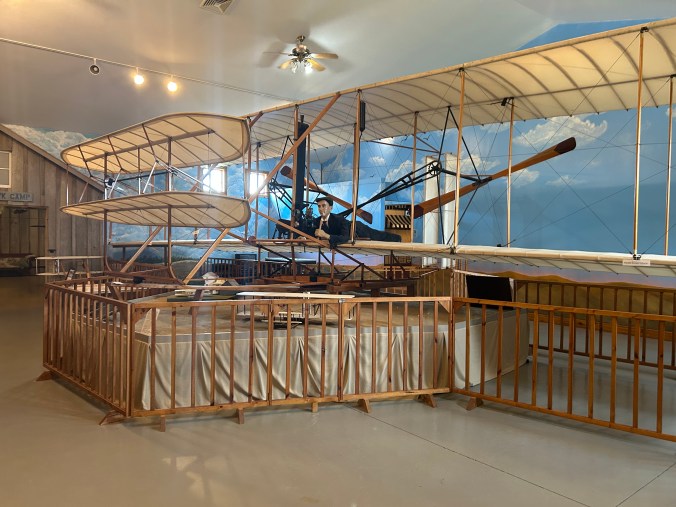
Floor level view of the Wright Flyer
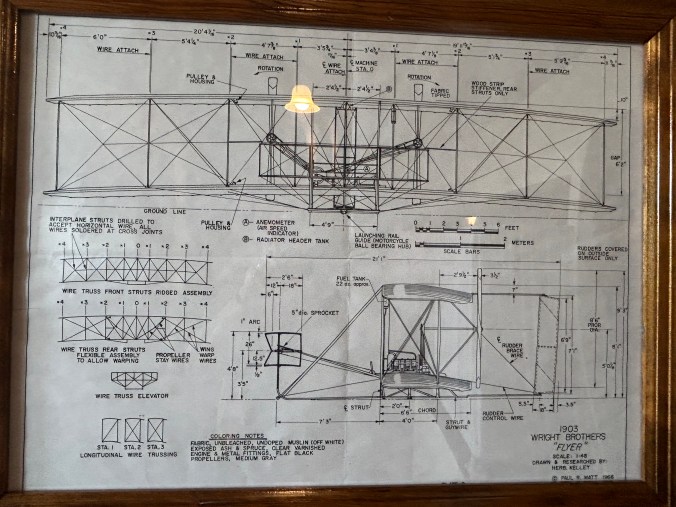
Wright Flyer Specification Drawing

This construction of  the Wright Flyer was completed after referencing the original specifications drawings from the Smithsonian.  The plane and other displays are in a lower level providing a striking view as you stand on the landing at the top of a short flight of stairs.
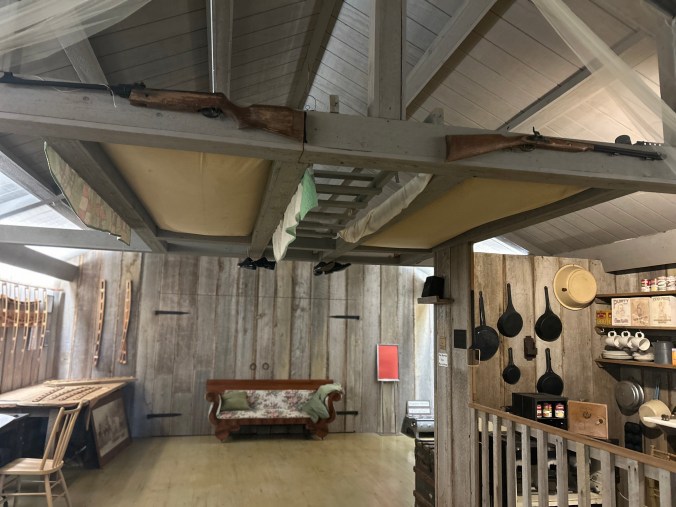
Kitty Hawk Camp work shop and living quarters (note the cots pulled up in the rafters)
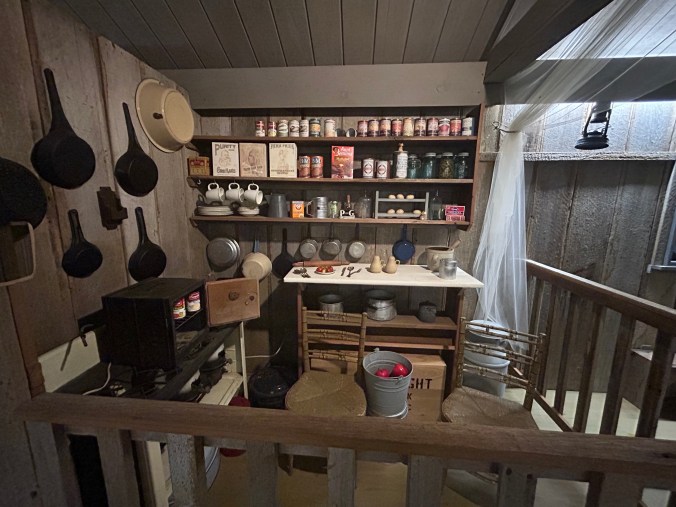
Kitchen in the shop/living quarters

In addition to the plane itself, this lower level display also includes a representation of the Brother’s Kitty Hawk Camp. Here is their work and living quarters while at the site of the flight tests. The building had work shop areas, kitchen facilities and sleeping cots that are pulled up during the day.
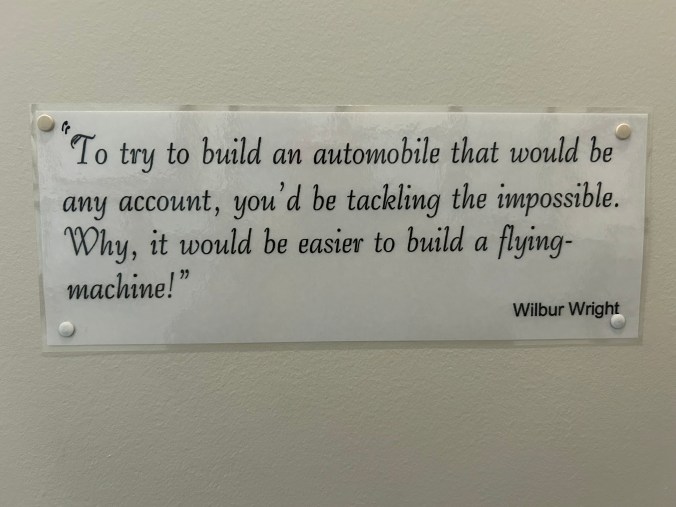
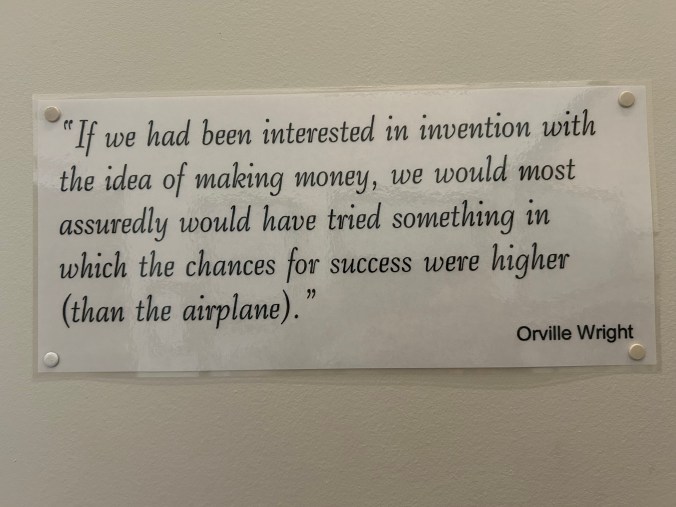
Also included is a display of 1900s storefronts, including the Brothers bicycle shop. We have been to the Kitty Hawk Park and Memorial, where there is a metal reproduction of the Flyer, Orville and Wilbur and other support folks. Seeing the repro plane at this museum was a thrill, as it is of the original materials.
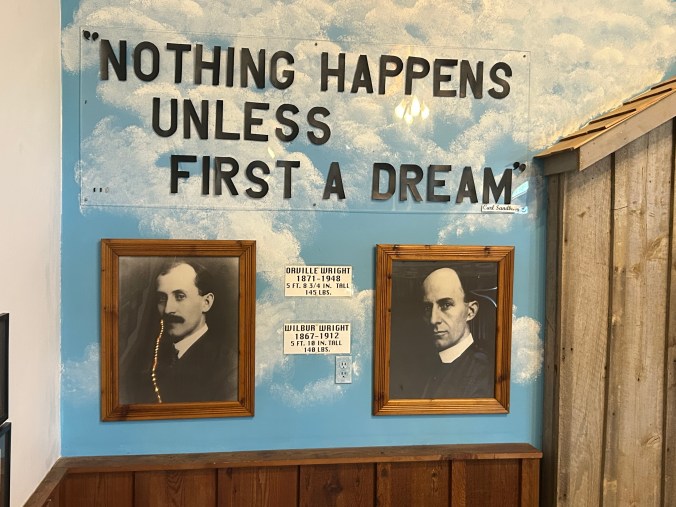
It is remarkable that a mere 66 years after Wilbur and Orville’s first flight man was walking on the moon. Take a trip to the Wilbur Wright  Birthplace Museum. You’ll be amazed at the quality and quantity of the displays.
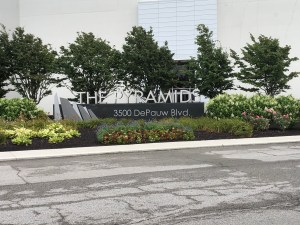
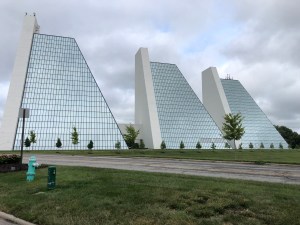
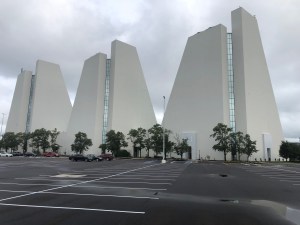
The Pyramids, an Indianapolis landmark since 1972

Construction began in 1967 on the first of three unique 11 story buildings for the College Life Insurance Company. The architectural firm of Kevin Roche John Dinkeloo and Associates was hired to design the Insurance company’s expected need for a headquarters complex. This style of design is often called Brutalist architecture.

Signage plus Landscaping

Facing South

Facing North

Each Pyramid is eleven stories, each with an L-shaped concrete core facing the north and west. The concrete supports each floor. The south and east facing exteriors are covered in reflective glass. The concrete sections contain restrooms and elevators.  The floors themselves are airy, well lit via the two wide walls of windows in each structure.  Ownership has changed hands several times, and as of this writing there is “For Lease” signage displayed.

An often overlooked monument to Indiana history

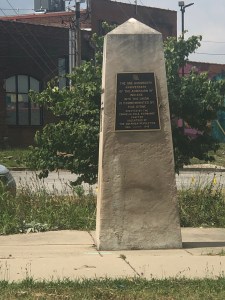
One very busy intersection in Indianapolis is where Southeastern Avenue angles into East Washington Street just east of the I-70  overpass. Chances are good that you’ve never noticed the tall limestone obelisk on a concrete deck next to the sidewalk.


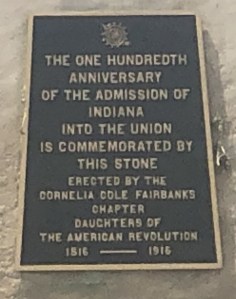
The obelisk was installed in 1916 to recognize the 100 year anniversary of the State of Indiana’s admission into the Union. This project was taken on and executed by the Cornelius Cole Fairbanks Chapter of Daughters of the American Revolution.  This Chapter organized in 1907, and remains active today. This is the Chapter’s website.

A splendid 1849 Greek Revival mansion on the Ohio River

Madison, Indiana is a wonderful town on the Ohio River between Cincinnati and Louisville. The entire downtown has been declared a National Historic site due to the remarkable number of historic buildings including the Shrewsbury-Windle House.

The Official Designation Plaque

The “back door” on city street


One historic home brings back fond memories for me, as the most recent owners of the Shrewsbury-Windle house were close friends of my paternal grandparents, who also lived for a while in Madison.  As a young lad I remember many wonderful visits with John and Ann in the house. I loved climbing up and down that spiral stairway! John and Ann Windle founded the Historic Madison, Inc society.

3 story free standing spiral staircase

Frank Costigan was a famous architect who designed many Greek Revival style homes in both Indianapolis and Madison. The Shrewsbury House features 16-foot ceilings, 12 foot high entrance doors, intricate plaster moldings, and ornately carved stone details. The most remarkable (and acclaimed) feature is the 3 story, 53 step free standing spiral staircase. The stair case serves as a means of letting hot air raise and vent out of attic windows in addition to providing access to the second floor rooms.

The expansive yard, Ohio River in background past the far fence

Front door faces Ohio River, columns are typical Costigan style

Tours of the Shrewsbury-Windle House are available. For details please go to this page of Historic Madison Inc. In addition, I strongly recommend checking out this article outlining both the history of the house, and the history of John and Ann Windle’s ownership of the house and founding the Historic Madison, Inc society.

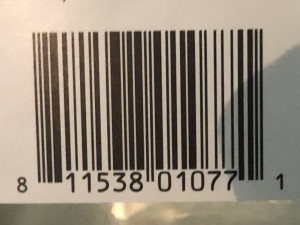
First barcode reading in 1974 at Marsh store in Troy Ohio

The Barcode we love

On June 26th, 1974 at a Marsh supermarket in Troy, Ohio retail store checkout history was made. Mr. Clyde Dawson (the supermarket’s head of research & development,) took a 10-pack of Wrigley’s Juicy Fruit gum and the Universal Product Code (UPC*)  was scanned by Sharon Buchanan (store cashier.) This gum became the first item ever to have its UPC barcode scanned at a supermarket. The gum and receipt has been rumored to be in the Smithsonian. The Smithsonian site denies this.

Memorial Day 2024

On May 5, 1868, three years after the end of the Civil War, the head of an organization of Union veterans, the Grand Army of the Republic (GAR), declared
Decoration Day as a time for the nation to decorate the graves of the war dead with flowers. Many consider this the first “Memorial Day”.

Dayton, Ohio is home to an awesome museum and memorial park

Honoring American volunteers “Flying Tigers” during WWII

Today many cities and towns across the country observe the last Monday in May as Memorial Day, an official U.S. Federal Holiday formally established in 1971. This holiday is the time to stop and  think about what the day is for, and why it is the time to remember those who sacrificed their lives for the country.