We saw a large toy soldier at a Town Festival

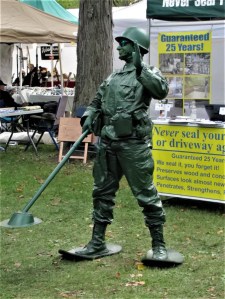
All green on every surface

Note the plates under the boots mimicking a real plastic toy soldier.

This is a novel way to make a living, or at least provide a clever side hustle. We saw this fellow at a town festival where we had set up as vendors several years ago. He showed up at noon on Saturday (of the weekend festival) and just walked around. He did not say a word, but every so often would freeze in a position and hold it for several minutes, thus becoming a big “plastic” toy soldier. Kids loved it and followed him around all afternoon.

Texas Hill Country Olive Company

We had just finished checking out the town of Dripping Springs in the Hill Country outside of Austin and were waiting for a restaurant to open. I spotted a sign for an olive company the opposite direction from the eatery, so off we went.

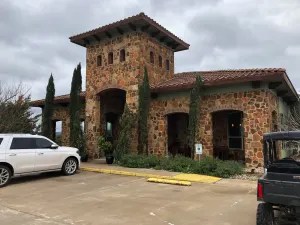
Striking architecture of the Olive Company

About five miles later we saw what looked like some kind of Italian mountain villa. Yep, that turned out to be the Texas Hill Country  Olive Company. We had no idea what to expect, except that it would involve olives. Well, what a nice surprise when the hostess showed us to the free tasting stations. Yes, we were invited to taste different olive oils. I sure got an education.

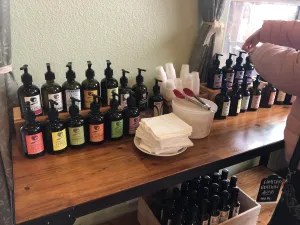
Olive oils on the left, balsamic vinegars on the right

Fun signage


I had no idea that there were so many different kinds of olive oils, all of which were made by this family owned and operated business. Sher and I both enjoyed tasting the different olive oils. You taste them by putting a few drops in a small cup and either tasting it directly by mouth or dipped on a small piece of bread.

In the showroom in front of one of the tasting stations.

In addition to the oils, there were several varieties of balsamic vinegar as well set out for tasting. These were all imported from Italy, and there was an amazing range of flavors. The balsamic vinegar we bought was a blackberry flavor, which will be perfect to mix with the olive oil we bought to make a great salad dressing. Yum! The showroom also has a wide variety of gift boxes and other goodies.

Olive trees at the Olive Company

Olive tree beginning to flower


This place should be on everyone’s list of must visit places in the Hill Country. The site has lots of olive trees in their on site orchard. Our hostess explained that the company also has many more orchards in south Texas as well. Yes, olive trees grow in places other than Southern Europe and the Mid East. You can experience them at the Texas Hill Country Olive Co..

King Neptune statue on the Virginia Beach Boardwalk

September of 2005 saw the grand unveiling of an awesome sight on the Virginia Beach Boardwalk. Where 31st Street intersects Atlantic Avenue, a 34′ tall bronze statue of the famous King Neptune gazes over the city as he emerges from the depths of the sea. Well, OK, he maybe isn’t coming out of the sea but he is sure impressive!

Compare Neptune’s size to the bike rider!

The artwork is the masterpiece of artist Paul DiPasquale’ a well known sculptor from Richmond, Virginia. Neptune grips his trident in his right hand while he “palms” a huge sea turtle in his left hand. He is surrounded by many other seas creatures, including dolphins and a massive octopus. The details in both Neptune and the sea creatures are breathtaking. This statue is adjacent to Neptune’s Park, site of many events held on the beach during both the summer season and the off season as well.

Neptune and his turtle

The octopus on the statue base

A trip to meet King Neptune is a must when you visit Virginia Beach, Virginia. You will be impressed! And be sure to check the calendar of events for Neptune’s Park to plan on attending whatever event is planned for the time of your visit.

Historic Starr Piano and Gennett Recording Studio

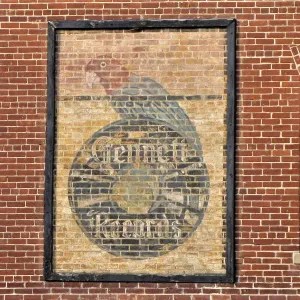
Original Gennett Records logo

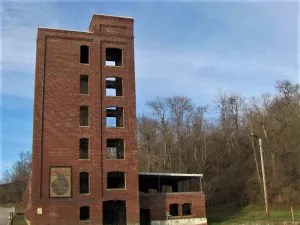
Richmond Indiana is a history filled city on the Ohio-Indiana border in the central part of the state. Both I-70 and Historic US 40 run through Richmond. One of the historic sites in Richmond is the remains of the old Starr Piano manufacturing plants and the Gennett Recording studios.

Starr made high end pianos beginning in the 1870’s. The remaining Starr pianos are highly sought after by collectors and musicians alike. The Gennett recording Studios were in business from 1920 to 1934. The records were made in a primitive concrete and brick building with little acoustical features. Legend says that an Oriental rug from the Gennett mansion was used as a wall hanging to deaden the echo sounds during the recording sessions.

Louis Armstrong’s place on the Walk of Fame

Today the Starr Gennett Foundation continues to keep the music history of the 20’s and 30’s alive with many events at the site of the old factory building. One of the many memorials to music is the Walk of Fame. The Starr-Gennett Foundation website details this feature and a special event in September 2026: “In 2007, as part of its ongoing effort to promote and celebrate the music legacy of Starr Piano Company and its subsidiary, Gennett Records, the Foundation inaugurated the Gennett Records Walk of Fame to honor those who recorded for Gennett Records and whose work contributed significantly to American history. Selected by a national panel of music experts, those honored are musicians who created the distinctly American musical genres of jazz, blues, country, gospel, and popular music. However, the Gennett studio recorded the spoken word as well as the music of American Indian and other ethnic groups.”

Many famous musicians of the times got their first recordings made at Gennett. Hoagy Carmichael’s big band recorded there. Louis Armstrong got his start in the Gennett studio. The Great Depression, however, signaled the end of Gennett Records as it did many other record companies of the times.

The old factory now refurbished for concerts

Unique view of the old factory


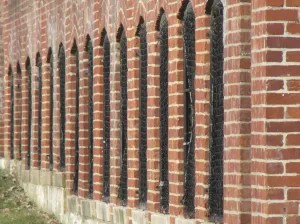
The remaining portion of the brick factory now has a modern steel structure and metal roof system. This building is used for concerts, meetings and other civic events. It is interesting to think of the tremendous musical history represented at this Indiana site. Hand made pianos and the beginnings of several genres of music began here. When in Richmond be sure to seek out the old Starr Piano building. You just might hear echoes of music from the past.

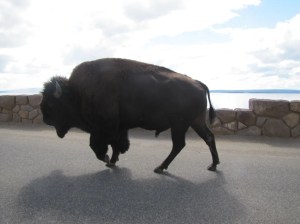
Our welcome committee to Yellowstone National Park

Our first cross county RV trip from Indiana to Seattle was a thrilling journey through totally new to us parts of the country. As we planned our route we  decided we wanted to go through Yellowstone National Park. From Cody Wyoming we drove to the East Entrance of the park. There a friendly and helpful Park Ranger gave us a map, a couple of tips and sold us our America the Beautiful Senior Pass.

He was huge! That is Lake Yellowstone in the background.

We had not been in the park very long until we saw Lake Yellowstone off to our left. Up ahead we saw brake lights and several cars stopped. I thought it must be an accident. Then we saw calmly strolling down the middle of the road the cause of the traffic jam. Coming down the road towards us was a huge bison just like he owned the road. Well, yes he did own the road! We’ll never forget the bison who welcomed us to Yellowstone!

The Alki Point lighthouse in Pugent Sound Washington

Seattle’s Puget Sound is home to 13 working lighthouses

We got this photo on a cruise from Seattle to Tillicum Island.

The first unofficial light established at Alki Point was a kerosene lantern reported to have been hung on the side of the barn sometime in the 1870s.  A permanent large light was placed on a wooden post by the U.S. Lighthouse Board in 1887. Hans Martin Hanson was the property owner and farmer and became an official paid lightkeeper at a salary of $15 per month.

The Alki Point lighthouse is currently an operational fully automated facility operated by the U.S. Coast Guard. It is the southernmost of the 13 lighthouses on the Sound. This is a beautiful structure when seen from any angle. It has been open for free tours in the past however the lighthouse is now closed for maintenance and repairs dependent upon the U.S. Coast Guard securing funding for the project in future years. Time will tell…

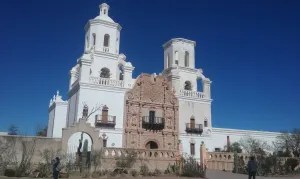
Mission San Xavier del Bac, the White Dove of the Desert

About 10 miles south of Tucson, Arizona you will find the “White Dove of the Desert” also known as the Mission San Xavier del Bac. This magnificent Spanish mission was completed in 1797. The first Spanish missionary, Father Eusebio Kino, arrived at the site in 1692. Throughout the years the location has been part of New Spain, Mexico, and finally a part of the U.S. after the Gadsen Purchase of 1854.

My postcard-like photo of the Mission

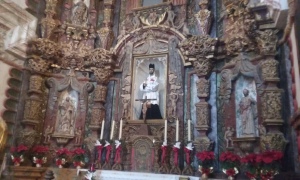
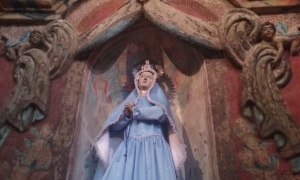
When you enter the church you cannot help but be amazed by the incredible amount of 18th century statuary and murals. The impact varies for everyone who walks the interior of this powerfully spiritual place. Candles are always lit and displayed. A shrine to St Francis is a prominent feature and one of solemn devotion.

Inside the sanctuary

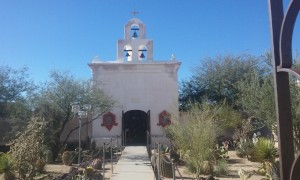
Prayer chapel and garden next to the church

Sacred statuary


The edifice is still a functioning Catholic Church that primarily serves the Tohono O’odham tribe, formerly known as the Papago. Being one of the most popular tourist stops in Tucson, we were fortunate to visit when there were very few people there. It was almost as if we had the place to ourselves. This is a site that is filled with history as well as a sacred place for contemplation, meditation and prayer. Do not miss a chance to visit San Xavier. You will be moved.

The San Xavier website is packed with info for your assistance in visit planning .

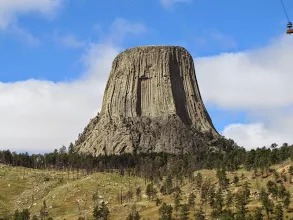
Devils Tower: the first U.S. National Monument

Northeast Wyoming is home to one of the most remarkable landscape features in the United States. The towering mass of volcanic rock known as Devils Tower has long been the destination of curious travelers and is the source of several Native American legends describing the origin of the rock formation. In the fall of 2014 we were on our way from Indiana to Seattle and decided to make a short detour to see this striking and beautiful gift from Earth.

One of, if not the most striking geologic feature in Wyoming

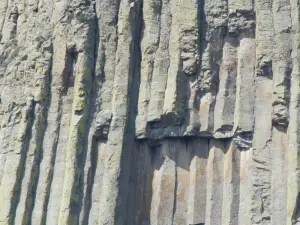
Detail image of each “column” that is about 8 feet across!

One of the legends of the origin of the tower tells the story of girls who were pursued by a huge bear. The girls prayers were answered when the Great Spirit caused the rock to raise from the ground with the girls safely on top. The bear attempted to climb the smooth sides of the rock, and his claws made the distinctive shapes we see today.

Geologists tell us that the tower was made when volcanic intrusions of lava pushed up into thick layers of sandstone, now eroded away after millions of years. The rock, an igneous basalt type, took on the shapes of columns when it cooled. Called a columnar formation, this shape is not uncommon and can be found in rocks all over the world.

The Devils Tower was the first designated US National Monument, so declared by President Teddy Roosevelt in 1906. The first Caucasians saw the tower in the 1850’s. It was also the site of the famous ending of the 1977 film Close Encounters of the Third Kind.

Rare Unique White Bronze cemetery monuments

When you come across a blueish colored grave monument you can’t help but wonder how it has maintained its lettering and clarity of the dates. No, it is not a later replacement, it is the original zinc metal grave marker. Manufactured by the Bridgeport, CT. Bronze Company, these long lasting  but somewhat fragile monuments were custom made from 1876 until 1914.

When you tap on the surface of these monuments you can immediately tell it is metal. The seams where the individual pieces are joined are also obvious.  Each piece was cast in Bridgeport and then shipped to the cemetery for installation. Customers dealt with sales reps armed with multiple catalogues with unlimited possibilities for choice of monuments.

Name/dates of deceased and panel with “Shaking Hands”

“HOW DESOLATE OUR HOME BEREFT OF THEE”


The zinc-tin alloy used in the castings did not rust and resisted the growth of mold or algae. Each monument was custom ordered, so all are one of a kind. The designs included panels that were screwed in and could even be changed at a later date, if desired.  These were perfect for symbols like the shaking hands, sheaves of wheat or personal messages in addition to the name and dates of the deceased.

A smaller monument

Name/date still legible after nearly 140 years


The material of these was advertised as White Bronze. White Bronze doesn’t exist. These are made with a zinc-tin alloy. The company, however, felt that White Bronze is a much classier and sophisticated name than zinc. They also claimed (of course!) that their monuments would outlast any stone monument. In a way that was true, however these zinc beauties were susceptible to breakage from, for example, falling trees. In addition, very tall monuments could suffer over time from settlement of part of the bases.

This panel would have been custom ordered for the monument

The next time you are enjoying a relaxing walk through a cemetery or graveyard keep an eye out for different looking monuments. Go have a look, it just might be a one of a kind White Bronze monument that was cast in Bridgeport, Connecticut between 1876 and 1914.


The Homer Covered Bridge dramatic saga of survival

Yes, this marvelous covered bridge has what can be described as a life history of epic proportions. Here’s the Reader’s Digest version: Built in 1881 over Mud Creek in Rush County Indiana. Disaster struck when it floated away during the flood of 1892 and ended up downstream in a field. The farm owner cleverly turned the bridge into a barn. This barn started falling apart over the years. Local Pioneer Engineers (antique farm machinery club) dismantle bridge/barn and rebuild it on their Club’s grounds as a pedestrian bridge in 2009. Bridge saved!

Used as a barn in 2008, photo courtesy Bridgehunter.com

Rebuilt on new location at Caldwell Pioneer Acres


This bridge, originally built by A.M. Kennedy and Sons is constructed with Multiple King trusses. These are not the more common Burr Arch trusses used by Kennedy. Surprisingly, the lumber in the trusses was still in excellent condition after time and floods. Only the foundation lumber needed total replacement, along with siding and roofing.

Good view of the Multiple King trusses. Note the diagonals notched into verticals

Reproduced name and date on the reconstructed bridge


” For Machinists, Steam and Pump Fitters Work. Go To W.H. Moffett & Co.”

The advertisement sign above had made it through the years and was noticed when the bridge timbers were salvaged at the farm where the 1892 flood had placed the bridge. It survived all those decades. Now the sign, as well as the bridge itself, continue to provide a nostalgic look back into Indiana history.